

Arrecifal
SSI dive center in La Restinga, El Hierro, running daily boat dives in the Mar de las Calmas Marine Reserve.
SSI4 languages
Also known as: El Bajon, El Bajón de El Hierro
Twin volcanic pinnacles rising from 100m to 6m below surface at El Hierro, one of Europe's best dives, with large groupers, amberjack schools, and variable Atlantic currents.
Last updated April 2026
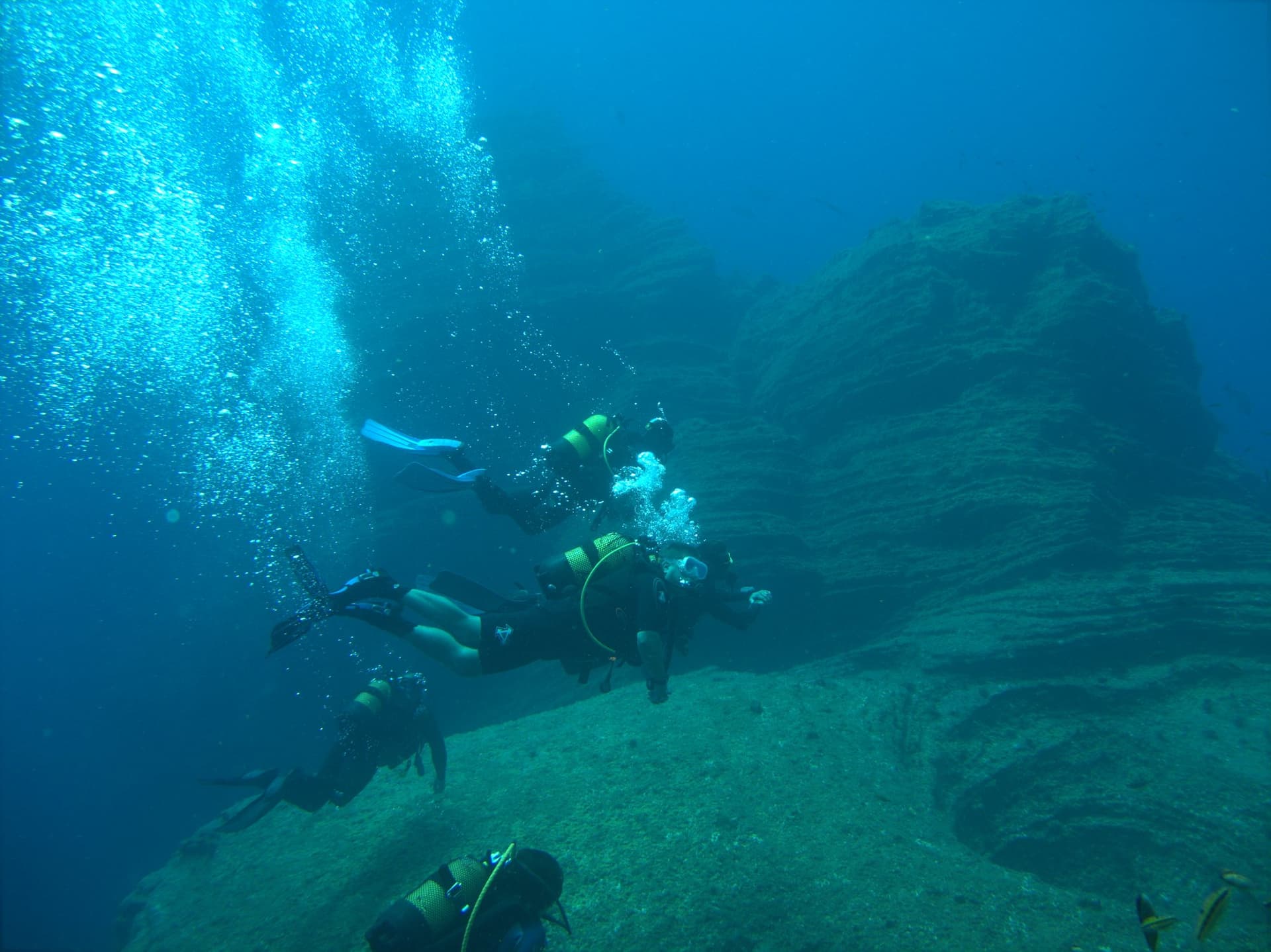
From the mooring buoy, descend quickly — current is almost always running, and the brief is to move fast down the line. The twin pinnacles resolve from below: one peak crests at six metres, its twin at nine, and the saddle between them at ten to fifteen metres is where the fish life concentrates. Groupers of exceptional size hold territory on the rock face, barely reacting to divers passing close by. Amberjack schools circle at mid-depth in slow formation. Work around one face of the formation and drop along the walls. The seaward face is near-vertical for 80 metres; recreational divers typically stay between 20 and 40 metres, where the walls remain dramatic without leaving safe limits. Barracuda and jacks move through in shifting silver formations at the outer edges. A torch rewards exploration of the crevices in the volcanic rock.
El Bajón is not a reef and not a wall dive in the conventional sense. It is a submerged mountain in open Atlantic water where every face is vertical and the depths below recreational limits are a constant presence. The currents that make it demanding are the same reason the marine life concentrates here. Nutrients sweep in from the open ocean, the fish follow, and large predators follow the fish. No other site in the Canary Islands puts this much vertical scale, pelagic density, and Atlantic exposure together in a formation reachable by a three-minute boat ride. Visibility of 30 metres or more is routine. Local operators describe every dive as different depending on what the current brings in, which is why repeat dives here are the norm rather than the exception.
Conditions control the dive. Centres make the call each morning and may cancel if swell or current exceeds safe limits — this is not unusual, and it is not the dive to rush. Build at least three days into your El Hierro stay specifically for El Bajón. When it is on, gear up and get to the water fast. The descent on the mooring line is the critical moment: a quick drop reduces the time in current before you reach the shelter of the pinnacle. Maximum 12 divers share the buoy across all La Restinga centres, so capacity can be tight during peak season. Carry a surface marker buoy in case of separation. Wear gloves — fire worms inhabit the volcanic substrate and punish bare hands.
What makes this dive site stand out.
Two peaks reaching 6-9m, walls dropping 80-100m on the seaward face
Multiple large dusky groupers described as guardians of the site
Currents bring nutrients and draw amberjacks, barracuda, bonitos, and devil rays
Annual Open Fotosub de El Hierro held here. Visibility typically 30m or more.
Max 12 divers per buoy, permit required, conditions-dependent daily
27.6410°N, 17.9805°W
Warmest water July-November (22-23C). Diveable year-round but daily conditions determine access.
From EUR 50 per dive at some centres. General reserve pricing 30-35 EUR without equipment. Verify current rates directly.
Centres require AOW or equivalent with current experience. Practical prerequisite is buoyancy control. Most centres assess divers at easier reserve sites first.
Summary
Currents almost always present, sometimes very strong and unpredictable. On calm-current days accessible to AOW with experience; on strong-current days challenging even for experienced divers.
Safety considerations
What can go wrong here, and what divers do about it. Conditions change - take the briefing from the operator on the day.
Book a guided dive at this site.
SSI dive center in La Restinga, El Hierro, running daily boat dives in the Mar de las Calmas Marine Reserve.

SSI center in La Restinga, El Hierro, highly rated by divers, with 24+ volcanic sites, a 30m depth cap, and the top recommendation on Spanish dive forums.

Dive centre in La Restinga, El Hierro, operating since 1978 and certified under PADI, FEDAS/CMAS and ESA, with a stable, named team and bundled trip logistics.
Francophone owner-run dive centre in La Restinga, El Hierro. Triple eco-certified, six divers per zodiac, top-rated across both major review platforms.
Get in touch to add or claim your dive center listing on DiveCodex.
Dive centres in the Canary Islands check that you hold the certification the dive needs.
Advanced Open Water or equivalent is the standard requirement, but centres emphasise current experience over certification level. Most will take divers to easier reserve sites first to assess buoyancy and composure before El Bajón. The challenge is managing variable, sometimes strong currents on an exposed seamount rather than depth alone.
On almost every dive: large dusky groupers, schools of greater amberjack, yellowmouth barracuda, Atlantic bonitos, and black seabream at the summit. Ornate wrasse spawn in mass aggregations on the upper section. Devil rays appear occasionally on stronger-current days. Whale shark sightings are rare but documented off El Hierro.
The site is diveable year-round with consistently exceptional visibility (typically 30m). July to November offers the warmest water at 22-23C. The bigger variable is daily conditions. Current and swell determine whether the centre takes a group out. Plan several days at El Hierro to ensure you get the dive.
Prices range from around 30-35 EUR for a guided boat dive without equipment to 50 EUR or more at some centres. The reserve permit is included. Verify current rates directly as pricing varies by season and equipment rental.
No. Drift diving is not permitted inside the Reserva Marina La Restinga. Divers descend and ascend on the permanent mooring buoy. On strong-current days, centres may cancel the dive rather than attempt a buoy descent.
Three factors limit access: daily swell and current (the main variable), buoy capacity (maximum 12 divers at any time shared across all La Restinga centres), and the marine reserve permit requirement. Building several days' flexibility into your visit significantly improves your chances.
It hosts the annual Open Fotosub de El Hierro competition, which answers the question. Visibility regularly exceeds 30 metres, large groupers hold still at close range, and amberjack schools fill the water column. A torch is useful for exploring crevices in the pinnacle walls.
Log your dives - notes, photos, conditions and the marine life you saw - and share them as one public diver profile. What you share helps the next diver, too.
Log every detail
Depth, duration, conditions, gear, buddy, notes — all in one place. Import from Suunto and other dive computers.
Track marine life
Record species sightings on each dive. Build a personal catalogue of everything you've seen underwater.
Your public dive profile
Share your dive history, stats, and experiences with a profile page you control. Show the world where you've been.