

Diving Cap de Creus
German-run CMAS/RSTC dive centre on Cadaqués's Es Caials shore since 1975, with two shore dives near the door and boat trips on an informal daily schedule.
CMAS / other4 services2 languages
Also known as: Cap Norfeo Sud, El Gat del Cap Norfeu, El Gato, The Cat
A cat-eared rock pinnacle at Cap Norfeu where a single wall runs white gorgonians shallow and red gorgonians deep, with strong, reversing current.
Last updated September 2026
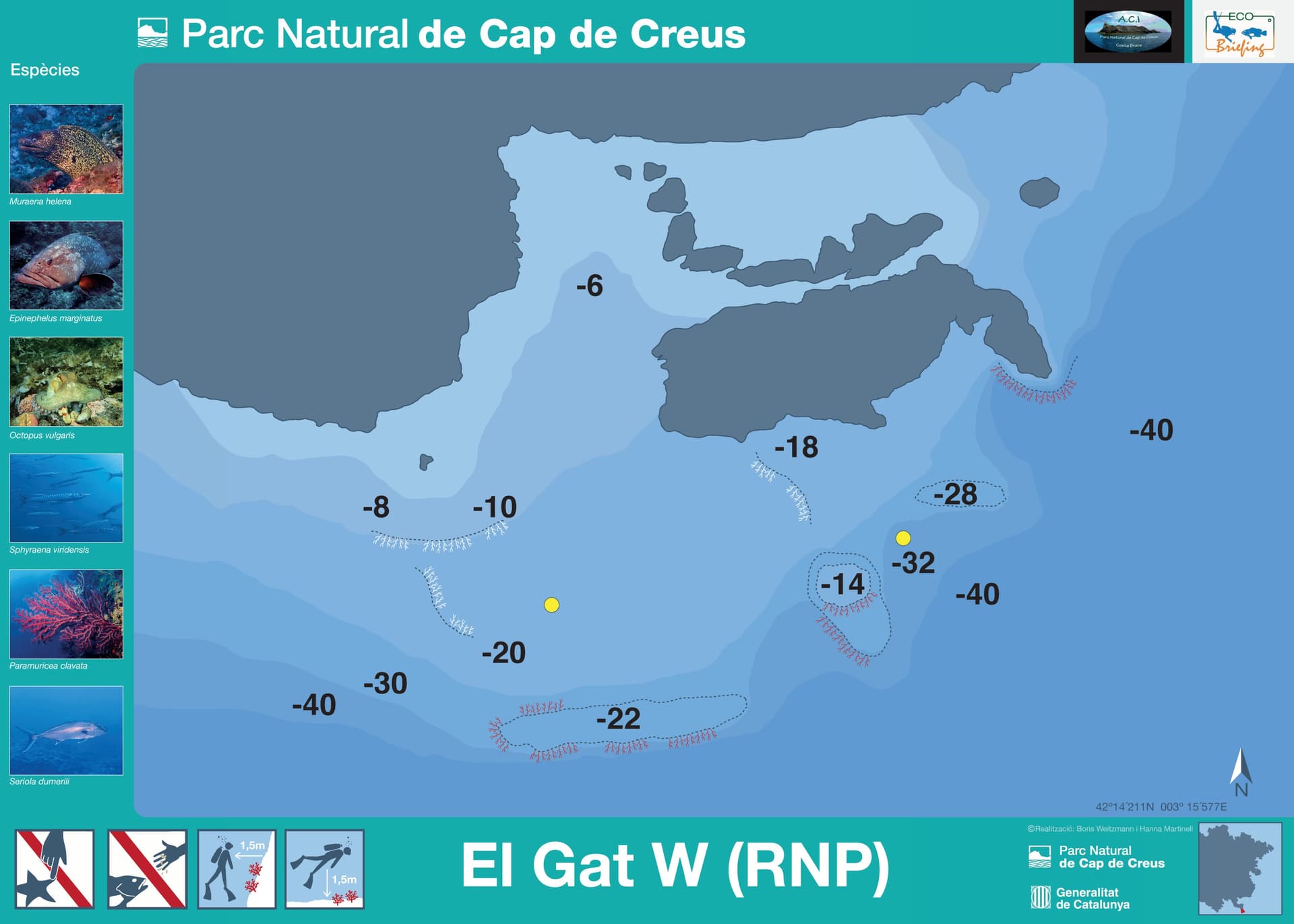
Two shelves anchor El Gat's profile: rock platforms at 5 to 8 metres near the tip of Cap Norfeu, and the main wall that carries the Open Water-friendly section down to about 18 metres. From there the route continues onto the gorgonian wall proper, in the 20 to 30 metre band most operators actually dive, moving from the white gorgonian growth into the deeper red gorgonian field that defines the site. Divers with a deep certification can keep going, since the wall carries on falling into a 40 to 45 metre band beyond the recreational route. The plateau side of the rock is the macro half of the dive: octopuses work the sandy patches, and lobster, moray and conger sit in the holes along its base. The wall side is the wide-angle half, gorgonian cover with a chance of a resident grouper hanging in open water. Current decides more of this dive than the topography does: on a hard day it can flip direction partway through, and the boat may call a calmer route on the same rock instead of pushing on. Dives run 35 to 50 minutes, shorter on the deeper pushes, and summer brings a thermocline sharp enough to plan for, not just the depth.
One wall does two things at El Gat: the shallow band runs white, the deep band runs red. Eunicella singularis, the white gorgonian, covers the rock from the platforms through the Open Water band; below it, dense stands of red gorgonian, Paramuricea clavata, take over for the deeper half of the dive. Most walls in this stretch of the park favour one colour or the other; here the sequence runs through both on a single tank, which is why area centres keep El Gat in the boat schedule ahead of quieter neighbours when conditions allow. The rock takes its name from the same silhouette that produces the view: two raised points on the skyline that read, from the water, like a cat's ears, El Gat being Catalan for the cat. Local divers group it with two other pinnacles along this stretch of coast as the sites most likely to turn a good day into a hard one, current being the deciding factor each time. That range in one profile, an accessible platform down to 18 metres and a demanding wall beyond it, is what lets a centre run a mixed-experience group here on a good day.
Current is the hazard that matters most here: it is often present, can run hard, and has changed direction mid-dive on more than one account. Stay close to the reference line on the ascent and expect the boat crew to call an early finish or switch faces if it turns against you. The wall keeps going well past the recreational band, to around 45 metres, so agree a maximum depth at the surface instead of deciding it against the rock. Summer brings a sharp thermocline near 15 metres: water above it sits in the low twenties, and it settles closer to the high teens below, so plan your exposure protection for what you meet below it, not the surface reading. A Tramontana blow from the north can close the site for days at a time regardless of season, and it is the reason the rock's sheltered north face exists as a standing alternative to the exposed eastern tip. If you are diving independently instead of through a centre, notify the park in advance and keep to its cap, six dives a day, thirty a week, applied per boat, not per diver. Boats reach El Gat from four ports, Roses, Cadaqués, Cala Montjoi and Cala Jòncols; ask your centre which face of the rock they are running before you commit to the day.
What makes this dive site stand out.
Eunicella singularis shallow gives way to dense Paramuricea clavata deeper on the same wall
A pinnacle whose twin-peaked silhouette from the water gives the site its Catalan name
Direction can change mid-dive; the boat switches to the sheltered north face when it does
Platforms down to 18 m suit Open Water, the gorgonian wall beyond that calls for Advanced
42.2370°N, 3.2631°E
Centres run roughly April to November. This stretch of Cap Norfeu is among the first to lose dive days when the Tramontana blows.
Area-wide rates from Roses- and Cadaqués-based operators; confirm the current rate when you book
Open Water covers the rock platforms and shallow wall to about 18 m when conditions are calm. Most operators run the gorgonian wall itself, in the 20-30 m band, as an Advanced Open Water dive, and the deeper extension past 30 m calls for a deep or technical certification with specific centre programming.
Summary
Some describe the site as accessible to most certified divers, others as experienced-only. Current on the day, more than depth, decides which applies.
Safety considerations
What can go wrong here, and what divers do about it. Conditions change - take the briefing from the operator on the day.
Book a guided dive at this site.
German-run CMAS/RSTC dive centre on Cadaqués's Es Caials shore since 1975, with two shore dives near the door and boat trips on an informal daily schedule.
SSI-listed dive centre inside the Carpe Diem Cadaqués complex, running since 2008 with three daily boat departures across 15 named Cap de Creus sites.
Beachfront PADI/FEDAS/CMAS dive centre inside the Cala Montjoi resort near Roses, running its own boat to Cap de Creus sites and a seasonal freediving course.
Family-run SSI dive center in Roses since 1972, three generations of the Mörker family, running boat dives to 20+ Cap de Creus Natural Park sites.
PADI 5-Star dive center in Roses running three decades, with its own 16m catamaran to Cap de Creus Natural Park sites.

SSI Instructor Training Center in Cadaqués running guided dives to 25+ Cap de Creus Natural Park sites and a blue shark snorkeling program.
Get in touch to add or claim your dive center listing on DiveCodex.
Dive centres in Catalonia must require insurance from every diver on their dives, and must be able to offer a policy to anyone who has none.
Yes. Cap Norfeo Sud is an older catalogue name for the same rock at the tip of Cap Norfeu. Local dive centres list it as one dive, usually under the name El Gat or El Gat del Cap Norfeu. If you come across 'Cap Norfeo Sud' on an older listing or a diver database, it points here, not to a separate dive.
Either can work, depending on which part of the rock you dive. The platforms and shallow wall to about 18 metres sit within Open Water limits on a calm day. Most operators run the gorgonian wall itself, the part most divers come for, as an Advanced Open Water dive, and the deeper extension past 30 metres is a separate, deep-certified profile. Ask your centre which version they are planning before you book.
The boat moves to the rock's north face, a more sheltered route on the same site. It is a routine call, not an exception: current on this stretch of coast can run hard and change direction mid-dive, and the north face is the standard fallback, not a cancelled trip.
General seasonal write-ups for the area put summer surface water as warm as 25 to 26 degrees. A more specific account naming El Gat directly gives a cooler figure: surface water in the low twenties, dropping under the thermocline to the high teens. Plan your exposure protection around the cooler figure and you will not be caught out.
Treat them as a close approximation, not a surveyed position. The point is a community-sourced coordinate that matches other divers' catalogue entries for the rock, not a government-surveyed figure. Confirm the entry point with your boat or guide on the day.
Log your dives - notes, photos, conditions and the marine life you saw - and share them as one public diver profile. What you share helps the next diver, too.
Log every detail
Depth, duration, conditions, gear, buddy, notes — all in one place. Import from Suunto and other dive computers.
Track marine life
Record species sightings on each dive. Build a personal catalogue of everything you've seen underwater.
Your public dive profile
Share your dive history, stats, and experiences with a profile page you control. Show the world where you've been.