
Calypso Diving Estartit
Family-run PADI centre in L'Estartit, run by Peter and Jacqueline Lane for nearly 40 years, with PADI Green Star and four other environmental credentials.
PADI5 services8 languages
Also known as: El Salpatxot, Salpatxot-Guix, Salpatxot/Guix
Sheltered north-face slope on Meda Gran with gorgonian-wrapped blocks, abundant grouper and sea bream, finishing in a Posidonia meadow.
Last updated May 2026
Large rock blocks appear within minutes of leaving the mooring line. The slope falls gently from 5 metres, blocks growing in size as the depth increases, each one wrapped in gorgonian fans and sheltering scorpionfish in the shadows. Groupers move between the blocks at recreational depth, often unhurried. Sea bream and corballo schools accompany divers across the slope, and in summer the open water above produces flashes of barracuda. The Salpatxot rock itself is the navigational landmark and the mid-route reference. From there the slope eases into a Posidonia oceanica meadow, where the dive's character shifts. Octopuses retreat into the seagrass, crustaceans pick through the leaf litter, and the dive can finish on the meadow margin between 5 and 12 metres. If the fan mussels are still here, this is where they stand.
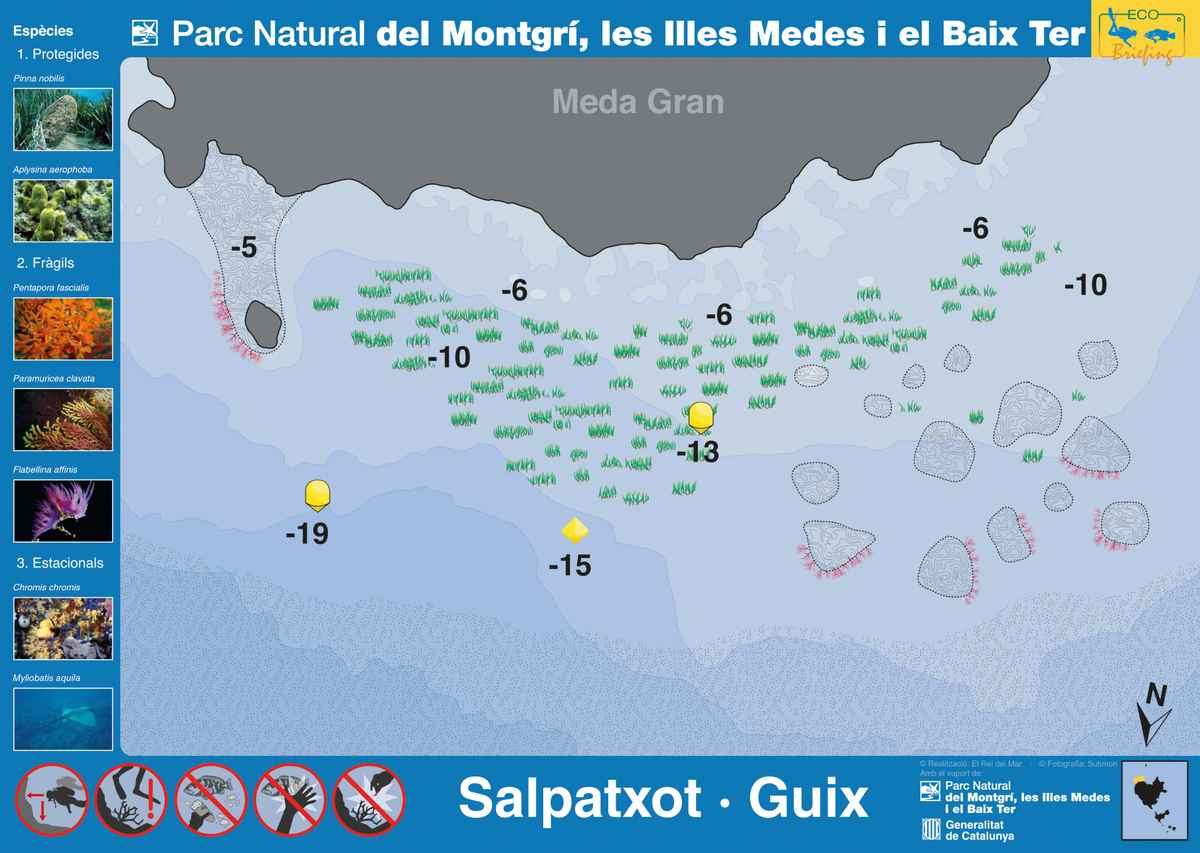
Illustration: Parc Natural del Montgrí, les Illes Medes i el Baix Ter — Generalitat de Catalunya
Every other headline Medes dive is vertical. Carall Bernat is a pinnacle, the Dofins are a cavern complex, Pedra de Déu is a wall. Salpatxot goes the other way: a slope that ends in seagrass. The Posidonia meadow is not filler at the back end of the dive. It is a nursery ecosystem, one of the most productive habitats in the Mediterranean, and rare among the routine Medes rotations because the southern archipelago is mostly rock and drop-off. The two-habitat mosaic, refuge blocks above and seagrass below, packs distinct biological communities into a single 50-minute profile. The Costa Brava underwater-photography forums return to this site repeatedly, which is the strongest signal of fish density and macro variety, since photographers vote with their cameras.
Currents. One L'Estartit centre flags them as a regular factor here, even though the terrain is gentle and the Generalitat's own description does not mention currents at all. The boat briefing is the difference, so listen properly. The north-face position shelters the site from south winds, which means your centre may route you here when the marquee southern sites are blown out. That is not a fallback dive. The site earns its reputation on calm days too. Bring a camera. Nitrox 32 % is recommended for the 18-20 m typical profile. Visibility can drop in spring when mucilage or River Ter runoff clouds the water, but from June onwards conditions are generally good. The reserve fee, 5.30 EUR per person per dive, is paid through the dive centre, and advance booking is essential in summer because the daily diver quota fills.
What makes this dive site stand out.
North-face position keeps the site diveable when the southern Medes pinnacles are blown out
Rare among Medes sites, the meadow is a nursery habitat that the wall dives do not offer
Refuge blocks concentrate grouper at recreational depth; sard schools accompany divers throughout
The Salpatxot landmark rock anchors navigation across a 5-25 m slope
Forum photographers post here repeatedly for macro and gorgonian wide-angle
42.0497°N, 3.2209°E
Warmest water, most abundant marine life. September combines warm water with fewer divers.
Verify current rates with dive centre
One of the most accessible Illes Medes sites. OW divers must be accompanied by a 3-star diver or instructor (max 4:1 ratio per park rules).
Summary
Easy at standard profile. Currents can develop on some days, so listen to the boat briefing.
Safety considerations
What can go wrong here, and what divers do about it. Conditions change - take the briefing from the operator on the day.
Book a guided dive at this site.
Family-run PADI centre in L'Estartit, run by Peter and Jacqueline Lane for nearly 40 years, with PADI Green Star and four other environmental credentials.

PADI 5 Star centre on L'Estartit seafront with stay-and-dive packages, four daily boat dives between Illes Medes and Montgrí, plus tec diving.

Family-run PADI 5 Star Resort and SSI centre in L'Estartit since 1990, with two 30-diver boats running hydraulic lifts to the Illes Medes reserve.

Long-running L'Estartit dive centre (founded 1969) running a four-boat fleet to the Illes Medes reserve and Montgrí coast, with SSI training and a strong family/snorkel programme.

Family-run hotel and dive centre in L'Estartit since 1985, with two dedicated boats and four daily departures to the Illes Medes reserve.

Owner-led PADI centre on Carrer Salines in L'Estartit, capping each guide at 5-6 divers across the Illes Medes, Montgrí, and Cap de Begur.

L'Estartit's oldest dive centre (est. 1965), a PADI 5 Star CDC running daily boat trips to Illes Medes and the Montgrí Coast with volume dive packages.
Get in touch to add or claim your dive center listing on DiveCodex.
Dive centres in Catalonia must require insurance from every diver on their dives, and must be able to offer a policy to anyone who has none.
Yes. The standard eco-briefing route stays between 5 and 18 m, with a landmark rock for easy navigation. Open Water certification is the minimum, and OW divers must be accompanied by a 3-star diver or instructor. Local divers describe it as a simple dive but full of surprises. The variable is current, which can develop without warning, so the boat briefing matters.
Groupers move between the rock blocks throughout the dive. Sea bream and corballo schools accompany you across the slope, scorpionfish hide among the rocks, and moray eels occupy crevices. In the Posidonia meadow at the end of the dive, look for octopuses and crustaceans. In summer, barracuda schools and eagle rays visit the open water above the slope.
The combination factors are gentle terrain, abundant ambient light at 5-20 m, and high subject density on a single dive. Macro subjects include scorpionfish, octopus and gorgonian close-ups. Wide-angle works for the schooling sea bream and the gorgonian-wrapped rock blocks. The relaxed pace gives photographers time to compose. The site has a long-standing reputation in the Costa Brava underwater-photography community.
The official park eco-briefing route stays between 5 and 18 m. The broader slope extends to around 24-25 m if a guide leads divers off the standard route to the deeper edge. Typical recreational profile sits at 18-20 m.
July through September offers the warmest water and most abundant marine life. September combines warm water with fewer divers and is widely considered the local sweet spot. The dive season runs April to November. Visibility is best from late spring to early autumn; spring can be murky due to mucilage events or River Ter runoff.
It is one of the easiest and shallowest sites in the reserve. The southern Medes sites like Carall Bernat, Dofí Sud and the Tascons offer vertical walls, caverns and deeper profiles. Salpatxot trades drama for density, and adds Posidonia meadow habitat that the wall dives do not have. It is also the most reliable site in south wind conditions, when the marquee southern dives are blown out.
The fan mussel has historically been reported in the Posidonia meadow here. A parasite called Haplosporidium pinnae has caused near-total Mediterranean mortality since 2016, so the current Salpatxot population status is not independently confirmed. If the colony is still present, the upright shells stand half-buried in the seagrass.
Log your dives - notes, photos, conditions and the marine life you saw - and share them as one public diver profile. What you share helps the next diver, too.
Log every detail
Depth, duration, conditions, gear, buddy, notes — all in one place. Import from Suunto and other dive computers.
Track marine life
Record species sightings on each dive. Build a personal catalogue of everything you've seen underwater.
Your public dive profile
Share your dive history, stats, and experiences with a profile page you control. Show the world where you've been.