

Buceo La Restinga
SSI center in La Restinga, El Hierro, highly rated by divers, with 24+ volcanic sites, a 30m depth cap, and the top recommendation on Spanish dive forums.
SSI2 languages
Also known as: El Salto, Los Saltos, Punta del Salto
Volcanic cave-and-tunnel circuit inside El Hierro's marine reserve, where ceiling openings create dramatic light plays at depths of 8-20m.
Last updated April 2026
Drop from the mooring line onto the lava tongue that extends from Punta del Salto, and within metres the rock fractures into a circuit of caverns, swim-throughs, and a tunnel roughly 25 metres long. Holes punched through the tunnel ceiling let sunlight pour in as shifting columns that turn the dark volcanic walls amber and blue. Stay shallow here. The richest topography sits above ten metres, where three small caves and a stone arch connect into a route that rewards slow movement and frequent stops. Past the tunnel exit, a parallel gully runs between two rocky promontories. Trumpetfish gather here in dense, vertical formations of twenty or more, hanging motionless like suspended columns. Herreña lobsters and slipper lobsters occupy the deeper crevices, visible with a torch and some patience. Below the plateau at 18m, a drop-off descends past two rocky towers toward 40m for those with the certification and gas.
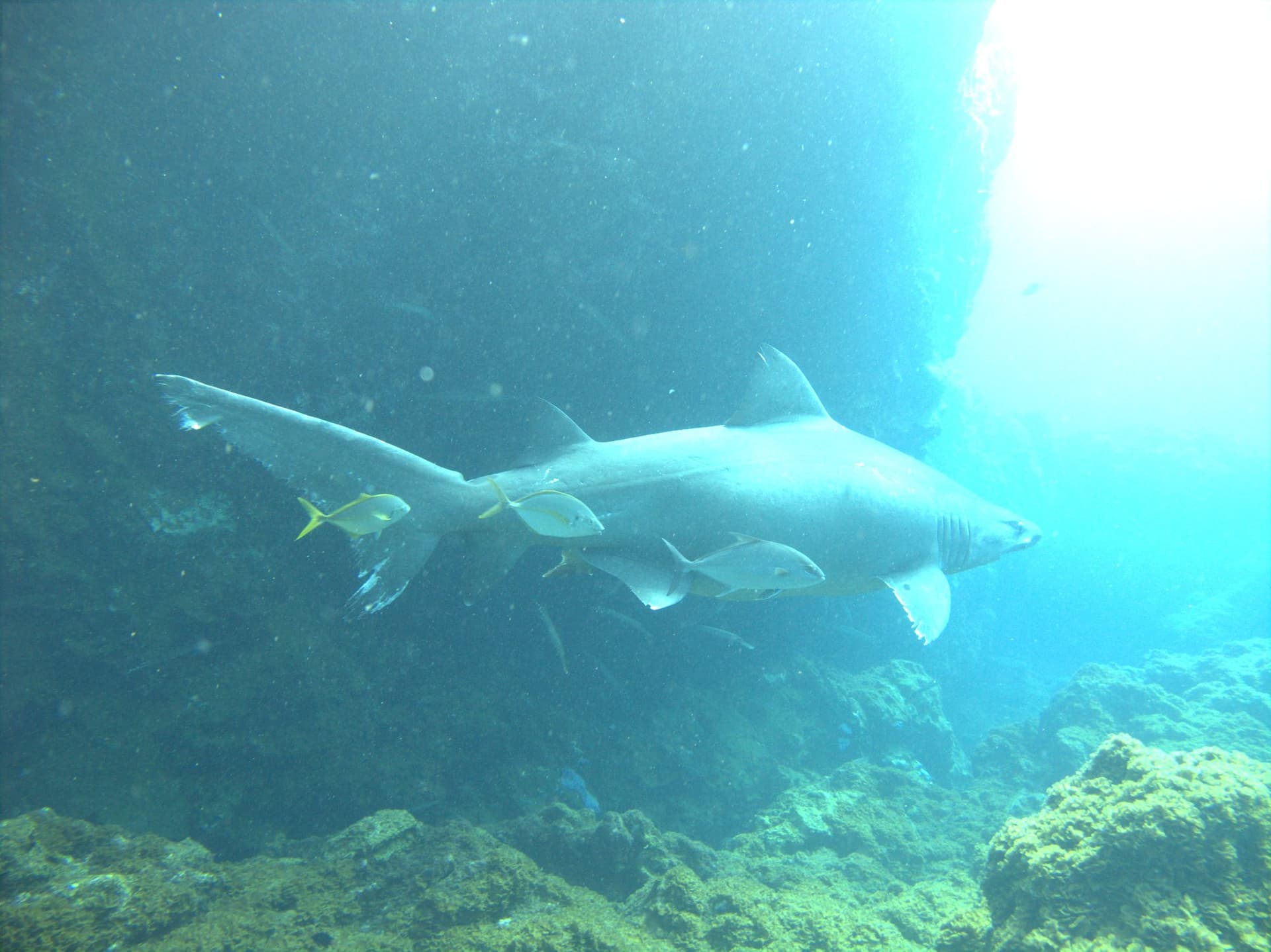
El Hierro's headline dives are vertical. Walls at El Bajon, pinnacles at Baja Bocarones, steep drop-offs everywhere. El Saltu inverts this with horizontal complexity: a layered volcanic circuit where the ceiling matters more than the depth. The light effects through the lava rock are unique on the island and give the site a photographic identity that deeper, darker sites cannot replicate. Between June and October, the bay it shares with Baja Rosario becomes a nursery for pregnant smalltooth sand tiger sharks. Few sites anywhere allow a diver to photograph light shafts inside a volcanic tunnel and then surface next to a three-metre shark within the same hour. The combination does not repeat at any other point in the reserve.
Boats from La Restinga reach the buoy in under twenty minutes. Bring a camera. The ceiling light effects are the site's signature and reward even basic setups, though a wide-angle lens captures the tunnel interiors best. Morning departures catch the optimal sun angle. The caves are wide, naturally lit, and do not require overhead-environment training, but careful buoyancy matters in the confined spaces to avoid silting. During shark season, guides brief the two-metre distance protocol before descent. The shallow profile and calm conditions invite repetition. A second visit often reveals features missed on the first pass.
What makes this dive site stand out.
Openings in volcanic rock create shifting light shafts inside caves and a 25m-long cave
Three caves, a stone arch, and a tunnel all above 10m with natural light throughout
Groups of 20+ motionless trumpetfish line the parallel gully between promontories
Pregnant smalltooth sand tiger sharks use this bay June to October
Consistently calm inside the Mar de las Calmas. Accessible to Open Water divers.
27.6102°N, 17.9948°W
Peak diving activity and overlap with the June-October shark nursery season. Year-round diving available.
Verify current rates with your dive centre
The most interesting topography sits at 8-20m, well within OW limits. The deeper drop-off to 40m requires AOW.
Summary
Easy in the shallow cave circuit. Moderate overall due to navigational complexity and the deeper veril option.
Safety considerations
What can go wrong here, and what divers do about it. Conditions change - take the briefing from the operator on the day.
Book a guided dive at this site.
SSI center in La Restinga, El Hierro, highly rated by divers, with 24+ volcanic sites, a 30m depth cap, and the top recommendation on Spanish dive forums.

Dive centre in La Restinga, El Hierro, operating since 1978 and certified under PADI, FEDAS/CMAS and ESA, with a stable, named team and bundled trip logistics.

Francophone owner-run dive centre in La Restinga, El Hierro. Triple eco-certified, six divers per zodiac, top-rated across both major review platforms.
Get in touch to add or claim your dive center listing on DiveCodex.
Dive centres in the Canary Islands check that you hold the certification the dive needs.
Openings in the volcanic rock ceiling allow sunlight to penetrate the caves and tunnel, creating shafts of light that shift with the sun's angle. The effect is strongest on clear mornings when direct sunlight enters at a low angle. Photographers describe vivid colour contrasts against the dark volcanic walls.
Yes. These are naturally lit caverns with visible openings and wide passages, not technical cave environments. The most interesting sections sit at 8-10m depth. No guideline reels or redundant gas are needed, just standard buoyancy control and a guide.
The site has three small caves, a longer tunnel (approximately 25m) with ceiling openings, and a stone arch. A parallel gully between two rocky promontories adds to the swim-through options. Most divers explore the circuit in a single dive.
El Saltu shares a nursery bay with Baja Rosario. Pregnant smalltooth sand tiger sharks have been documented here between June and October, with confirmed sightings in 2019 and 2025. The sharks are calm and approach divers. A two-metre distance rule applies.
Yes. These are all names for the same dive site at Punta del Salto. El Saltu appears to be a local dialectal variant. Centres may use any of the three names interchangeably.
Morning dives deliver the best natural light effects through the ceiling openings. The two-dive morning schedule from La Restinga typically puts El Saltu on the first dive when the sun angle is ideal for the cave illumination.
A wide-angle lens captures the light shafts and tunnel interiors. The confined spaces and high-contrast lighting reward a strobe or video light to fill shadows against the bright ceiling openings. Even compact cameras produce strong results when the light angle cooperates.
Log your dives - notes, photos, conditions and the marine life you saw - and share them as one public diver profile. What you share helps the next diver, too.
Log every detail
Depth, duration, conditions, gear, buddy, notes — all in one place. Import from Suunto and other dive computers.
Track marine life
Record species sightings on each dive. Build a personal catalogue of everything you've seen underwater.
Your public dive profile
Share your dive history, stats, and experiences with a profile page you control. Show the world where you've been.