Elphinstone
Also known as: Elphinstone Reef
Offshore Red Sea wall and drift dive 9 km from Marsa Alam, famous for autumn oceanic whitetip encounters and intact soft-coral colour.
Last updated May 2026
The dive
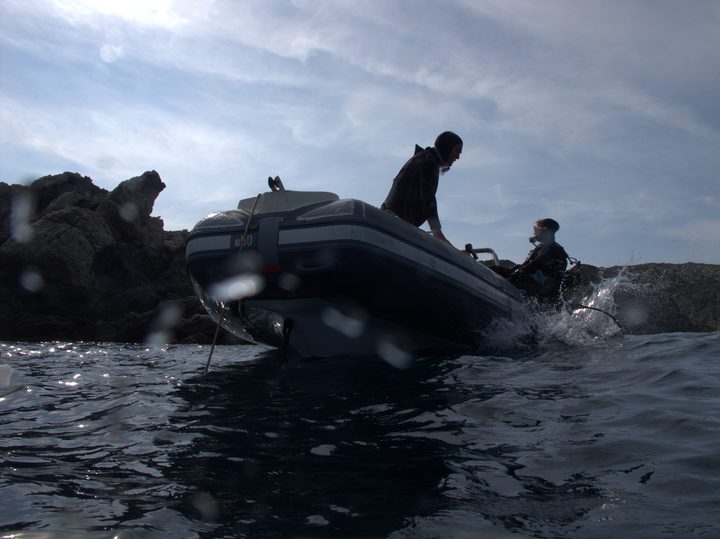
A typical dive starts on the surface in a queue of zodiacs while the guide reads the current and picks an entry point so the dive runs as a drift. The briefing covers negative entry, surface protocol and shark behaviour before the route — at Elphinstone those things matter more. The back-roll commits you immediately: divers go negative and drop past the reef top onto the wall before the surface current can scatter the group.
The wall is the spine of the dive. Most groups track the eastern face in the morning, when sun lights the soft coral directly, and the western face in the afternoon, at depths between 18 and 30 metres. The current carries you; finning is for trim and direction. Pink and red Dendronephthya catch the light, gorgonians angle into the flow, schools of anthias break around outcrops, and the larger pelagic life — tuna, trevallies, the occasional grey reef shark — works the blue side off the wall.
The two plateaus are where the reef opens up. The northern plateau is longer and starts shallower at 20 metres, the more reliable spot for a hammerhead glimpse at first light in summer. The southern plateau is shorter and deeper, and from October through December it is the autumn shark stage: guides hold the group there during the deep portion when oceanic whitetips are around, and the famous safety-stop encounters happen here, with the shark patrolling at five metres while divers wait out their off-gas time. The exit is its own moment — surface beside the zodiac on the guide's call, kit stays on, the boat lifts you in choppy water with sharks possibly still nearby.
What makes it special
There are healthier reefs in the Red Sea, and easier ones. What Elphinstone offers that no nearby site reliably matches is the combination of a drift wall in genuinely deep water, an autumn aggregation of oceanic whitetip sharks at the southern plateau, and a soft-coral structure that has held its colour through the 2024-2025 bleaching events better than most of the surrounding coast. The reef is a recognised Important Shark and Ray Area for Carcharhinus longimanus, formalising what dive operators have known anecdotally for decades.
The reputation pulls both ways. Some divers leave disappointed by quiet sharkless dives in busy water; others surface incredulous at what the wall itself still holds. The reef earns its place on a Marsa Alam trip when divers want a high-current wall dive alongside the area's calmer bays, and specifically want to put themselves in the way of a longimanus.
History and origin
The reef was charted in the 1830s during Robert Moresby's Red Sea surveys for the East India Company. Historical accounts attribute the name to either Admiral Georges Keith Elphinstone or his nephew John Elphinstone, the last governor of Bombay; sources do not settle the question. The Arabic name in continuous local use is Sha'ab Abu Hamra — "father of red" — after the coastline visible from the water, not the reef itself.
Modern dive identity grew with the southern Red Sea liveaboard scene from the 1990s, when the BDE loop became a standard week-long itinerary out of Marsa Alam. The autumn oceanic whitetip reputation built through a decade of trip reports and has since been formalised through ISRA designation. The southern tip carries a cave at around 55 metres connecting the east and west walls, and the northern plateau holds an arch known as the Sarcophagus — both too deep for recreational diving but recurring in technical-community folklore.
Know before you go
Currents shape every dive here. They run north-south along the walls, arrive without much warning, and on harder days move fast enough that finning into them is futile; downcurrents at the plateau tips are the specific risk to know. Negative entries are standard. Drop quickly, descend to the wall, and let the guide coordinate the surface. An SMB is mandatory.
The diver mix shifts with the season. Autumn brings shark-chasers and dedicated BDE liveaboards; summer widens it to advanced divers stretching their experience. Crowding is real at midday — 8-12 boats moored on the reef has been reported in October — so dawn and late-afternoon liveaboard slots feel materially different from peak day-trip windows. Speedboat day trips from Abu Dabbab depart around 07:00 for two dives at 120-135 EUR per person; Hurghada commits you to a 02:30 pickup for the 270 km transit.
Why Dive Elphinstone
What makes this dive site stand out.
- 1Oceanic whitetip plateau
Southern plateau is the autumn aggregation point for Carcharhinus longimanus, ISRA-recognised.
- 2Vertical drift walls
East and west walls drop past 100 m, soft-coral covered, dived as a drift along the face.
- 3Soft-coral resilience
Held its colour through the 2024-2025 Red Sea bleaching that hit nearby shore reefs hard.
- 4Twin plateaus
Northern plateau at 20-50 m for hammerheads, southern plateau at 25-45 m for longimanus.
- 5BDE liveaboard anchor
Standard third stop on the Brothers-Daedalus-Elphinstone week-long itinerary.
Depth & Profile
Location
25.2925°N, 34.8619°E
Conditions
Difficulty & Certification
Negative entries, fast descents, drift along open-ocean walls, occasional downcurrents.
Frequently Asked Questions
When is the best time to see oceanic whitetip sharks at Elphinstone?▾
What certification and experience do I need for Elphinstone?▾
How do you actually get there?▾
Is Elphinstone overrated?▾
How is the coral after the 2024-2025 Red Sea bleaching?▾
Can beginners or snorkellers visit?▾
What gear should I bring?▾
Log your dives
Track every dive with depth, duration, conditions, and marine life sightings. Join a club and share your underwater experiences.
Try DiveLog — it's free