

Emperor Elite
26-guest sister of Superior with Junior and Executive suites, ranging across Emperor's Egypt catalogue from northern wrecks and offshore Brothers, Daedalus and Elphinstone to the Deep South.
Liveaboard26 guestsHurghada
Quiet southern Red Sea coast of shore-diving house reefs, dugong bays and a protected dolphin reef, with Elphinstone's offshore wall a day-boat away.
Last updated October 2026
Marsa Alam is a fringing-reef coast cut by sheltered bays called marsas, and most of the diving starts from a beach. Seagrass meadows fill the shallows of Abu Dabbab and Marsa Mubarak, where a small resident dugong population grazes in water a newly certified diver can handle, and marsas such as Marsa Murena and Marsa Shouna give easy shore dives between boat days.
Two sites are the reason to book boat days. Samadai Reef is a horseshoe reef under zoned marine-park access, with a resident pod of spinner dolphins. Elphinstone is the shark dive: a reef roughly 375 m long, about 30 km north of Marsa Alam town along the coast, with drop-offs past 100 m and oceanic whitetips that usually peak in autumn, from October to December. Gota Marsa Alam adds coral towers and walls for experienced day-boat divers.
The mood is quiet and dive-first. Red Sea Diving Safari runs eco-village camps at Marsa Shagra and Marsa Nakari with unlimited dives off the house reef, and nights are early. Port Ghalib is the marina side, with day boats off the pontoons and the liveaboard fleet for the offshore islands further south.
The coral carries the mark of 2024. Monitoring found bleaching rising from north to south, with up to 50.1 percent of colonies bleached in the southern sector around Wadi El Gemal against 9 percent at Hurghada, and preliminary estimates put 2025 recovery at 75 to 88 percent depending on species and location. Much of the hard coral on affected reefs died, with new growth already showing, and condition varies from reef to reef.
The town itself is young. Development began in 1995, Marsa Alam International Airport opened in 2003, and Wadi El Gemal National Park, which covers 2,100 square kilometres of sea south of town, was established the same year.
Weather decides the offshore days. From November to February strong wind and a choppy sea can cancel dives at exposed reefs such as Elphinstone, so a trip built around one boat day has no margin, and the sheltered bays make the fallback. October to May is the best window. Winter water sits at 22 to 24 C and calls for a 5 mm suit, summer runs 28 to 30 C in a 3 mm, and summer is the stronger season for night dives.
Elphinstone day boats usually ask for Advanced Open Water plus 50 logged dives and some apply it strictly, so confirm with the centre before you pay. Open Water covers the sheltered bays and house reefs. Elphinstone and Shaab Sharm bring strong current and suit divers with drift experience.
Centres follow three patterns: the eco-village camps diving from the shore with boat and Zodiac extras, hotel-affiliated centres with their own house reef and transfers to satellite sites, and the Port Ghalib operators working from day boats. The camps keep you beside the reef you dive from, and the other two patterns trade that for boat days to Samadai and Elphinstone.
Fly into Marsa Alam International (RMF), which receives direct charters from the UK, Germany, Austria, Belgium, Italy and the Netherlands. The alternative is Hurghada, 274 km north, a 3 to 4 hour transfer.
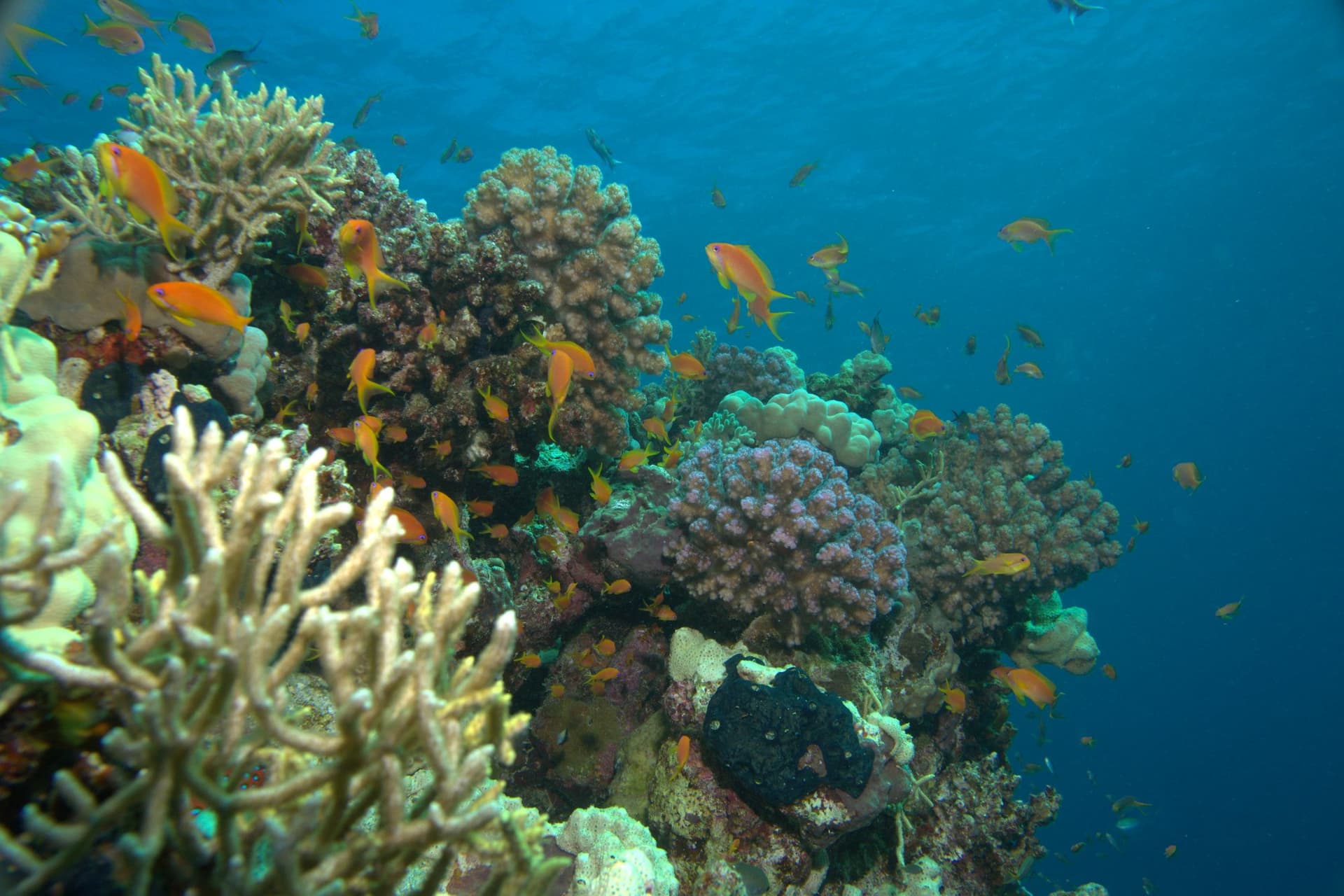
Fringing coral reef along the coast, cut by sheltered bays called marsas, with seagrass meadows in the shallows and walls and pinnacles on the offshore reefs such as Elphinstone.
The diving here splits into 2 zones:
Beginners and wildlife divers seeking close-up green turtle encounters and a realistic chance of seeing a Red Sea dugong without a boat.
Advanced wall divers chasing a realistic autumn oceanic whitetip encounter.
Turtles on the seagrass, a named resident dugong and several dives in one bay
Divers who want Red Sea reef quality combined with the chance of a genuine wild dolphin encounter under a conservation-managed permit system.
Pinnacles, a cave passage and a wreck on one shallow reef
Coral towers, anemone gardens and narrow caverns on one liveaboard reef
Seagrass slope with turtles between two reef flanks, entered by rope
Beach-entry bay with crocodilefish and scorpionfish on sand and seagrass
Liveaboard check dives, macro photographers, and anyone seeking a calm, uncrowded Red Sea bay with a genuine dugong chance.
Offshore wall with a current-swept eastern plateau and a sheltered western one
A RIB-only pinnacle and a pick-your-depth drift on one boat ride
Book online or contact a centre that dives this area.
26-guest sister of Superior with Junior and Executive suites, ranging across Emperor's Egypt catalogue from northern wrecks and offshore Brothers, Daedalus and Elphinstone to the Deep South.

Eco-diving resort south of Marsa Alam with 3 villages, unlimited house reef diving, 60+ sites, and access to Elphinstone Reef.

Get in touch to add or claim your dive center listing on DiveCodex.
Safari boats based elsewhere that run itineraries to these dive sites.
41m, 26-guest wooden liveaboard running Master Liveaboards' full Egyptian Red Sea catalogue from Hurghada and Port Ghalib, from northern wrecks and Tiran through the offshore Brothers, Daedalus and Elphinstone to the far-south Rocky, Zabargad and St John's reefs.
38 m wooden liveaboard with 13 ensuite cabins for 26 guests, on 7- and 10-night Red Sea trips from Hurghada and Port Ghalib.

Compact 18-guest, 9-cabin wooden liveaboard focused on Deep South and St John's routes from Port Ghalib, reaching remote Rocky Island and Zabargad.

13-cabin, 26-guest wooden liveaboard running Emperor's northern Red Sea wreck-and-reef weeks from Hurghada, plus offshore Brothers, Daedalus and Elphinstone.

Red Sea Explorers' largest liveaboard: 37.5m, 28 guests across 14 cabins, running the same GUE-leaning offshore and deep-south Egypt route catalogue.

36m, 22-guest steel liveaboard with a dedicated camera room and gas-blending deck, running the Brothers, Daedalus, Deep South and Fury Shoal weeks.

40m, 25-guest steel liveaboard, built 2023 for the Deep South: Daedalus, Rocky Island, Zabargad and St John's, plus Fury Shoal, from Port Ghalib.

Red Sea Explorers' tech flagship: a 37m, 22-guest steel liveaboard with a full trimix/CCR fill station and scooters for offshore and deep-south Egypt safaris.
From November to February strong wind and a choppy sea can cancel offshore dives such as Elphinstone, and November wind has cut visibility on many reefs. Oceanic whitetips usually peak in autumn, hammerheads and mantas at Elphinstone run May to August.
What can go wrong here, and what divers do about it. Conditions change - take the briefing from the operator on the day.
National rules also apply: Rules and permits in Egypt
Often enough that divers treat it as a realistic goal, though never as a promise. A small resident population grazes the seagrass in both bays, and Marsa Mubarak has produced sightings since the 2024 bleaching. The water is shallow and the entry is from the beach, so a missed first dive is easy to repeat the next morning.
The 50-dive line comes from operator practice, not from any law, and some centres enforce it strictly, so you can be turned away at the jetty. Ask before you book. Newly certified divers and families with young teens do better planning around the sheltered bays and the moderate offshore reefs, and leaving Elphinstone for a later trip.
Autumn, roughly October to December, is the oceanic whitetip season at Elphinstone, and winter adds the most reliable visibility but the greatest risk of cancelled offshore days. May to August brings hammerheads and mantas to Elphinstone, and May in particular is reported to run with 30 to 50 percent fewer divers and 15 to 25 percent lower prices. Whale sharks turn up in May and June plankton water now and then, never reliably. Summer is hot above the surface and is described as the better season for night dives.
Marsa Alam grew after its airport opened in 2003 and is described as quieter and more dive-driven, with fewer crowds on the reefs than the larger resort hubs in the north. Direct charter flights land at Marsa Alam from several European markets, which spares you the 3 to 4 hour transfer from Hurghada. The north suits divers who want a bigger resort scene around the diving. The 2024 bleaching also hit the south harder, with the northern sector around Hurghada recording 9 percent against up to 50.1 percent in the south.
For divers who want to dive all day and sleep early, yes. Guests at the camps can enter the house reef whenever they like and often log four to five dives a day over a week, with boat and Zodiac days added for offshore reefs. The camps are basic by design and evenings are quiet.
It suits divers who want day boats from marina pontoons, or a night before a liveaboard. Port Ghalib is a purpose-built marina resort, about 65 km north of Marsa Alam town and about 4 km south of the airport, so airport transfers are short. Evenings revolve around the marina, so the diving is the reason to stay.
Not as day trips. Fury Shoals is dived from the neighbouring Hamata area further south, where the Wadi Lahami camp sits about 2.5 hours by road from the airport. Brothers, Daedalus, St John's, Rocky Island and Zabargad are liveaboard destinations, and Port Ghalib is the northern port that many of those routes leave from.
Also known as: مرسى علم
Log your dives - notes, photos, conditions and the marine life you saw - and share them as one public diver profile. What you share helps the next diver, too.
Log every detail
Depth, duration, conditions, gear, buddy, notes — all in one place. Import from Suunto and other dive computers.
Track marine life
Record species sightings on each dive. Build a personal catalogue of everything you've seen underwater.
Your public dive profile
Share your dive history, stats, and experiences with a profile page you control. Show the world where you've been.