
Diverty Sub
Barcelona dive school and shop diving from Lloret de Mar, Costa Brava; SSI Diamond Instructor Training Center since 2006, plus Extended Range technical courses.
SSI6 services2 languages
Also known as: Arrecife artificial de Lloret de Mar, Biotopos, El Biotopo, Els Esculls Artificials
Artificial reef of 70+ hollow concrete blocks sunk off Lloret de Mar in 1994 to stop trawling and protect posidonia, now colonised at 23-32 m.
Last updated June 2026
The anchor line runs straight down to about 32 metres, onto sand the colour of nothing in particular. Then the blocks appear. More than seventy hollow concrete towers, each roughly five metres tall, stand in rows on the flat seabed, separated by open lanes. Three decades underwater have turned them into precoralligenous outcrops thick with rock fauna. Moray eels sit in the crevices. Fan worms open across the older concrete, and scorpionfish hold still on the surfaces. The route weaves between the blocks and back across the rock toward the coast. It is short, because the depth is real. There is no current and no overhead to manage. The whole demand is staying disciplined about gas and time at 30 metres.
This reef was engineered, not formed. Most diving off Lloret and Tossa runs over natural rocky ridges and pinnacles. Els Biotops is a deliberate structure, sunk in 1994 to defend the seabed, and the dive is a chance to see how that intervention played out. The blocks now do exactly what the project intended: they hold the rock-fauna community the bare sand never could. Dentex and gilt-head bream patrol the lanes. Groupers turn up among the shelter, occasional and wary on this coast. Few Costa Brava dive points are a conservation artefact you can swim through.
In the summer of 1994, more than seventy hollow concrete blocks were lowered onto the sand off Fenals. Each stands about five metres tall. Their job was twofold. The blocks obstruct trawl nets dragged near the coast, and by doing so they shelter the Posidonia oceanica meadow that bottom-trawling destroys. Two independent Lloret operators record the same founding facts: the 1994 sinking, the five-metre blocks, and the anti-trawling and posidonia-protection purpose. The exact commissioning body and the precise block count beyond "more than seventy" were never published.
Boat only, from Lloret. This is a deep dive on a simple layout, so the planning is about depth, not navigation. Carry a computer, dive a conservative profile, and build in a safety stop. Nitrox extends your bottom time and adds margin at 30 metres. A 7 mm wetsuit with a hood is the summer minimum, since the bottom sits well below the warm surface layer; in the shoulder and winter months a drysuit is the comfortable choice. The marine life is best from late spring through autumn.
What makes this dive site stand out.
More than seventy hollow blocks sunk in 1994 to block near-shore trawl nets
Each block stands about five metres tall on otherwise flat sand
Built to shelter the Posidonia oceanica meadow that trawling would tear up
Blocks at 23-27 m on sand, the dive working down to about 32 m
41.6900°N, 2.8360°E
Warmer water and more active marine life. Boat access depends on weather.
Standard guided boat-dive rates apply. Verify current prices with local centres.
The 23-32 m range exceeds the 18 m Open Water limit and approaches the AOW limit. Not an Open Water site. Nitrox is sensible to extend bottom time at depth.
Summary
Navigation and conditions are simple, with no current and no overhead. The demand is depth discipline: gas, no-deco time, and ascent rate.
Safety considerations
What can go wrong here, and what divers do about it. Conditions change - take the briefing from the operator on the day.
Book a guided dive at this site.
Barcelona dive school and shop diving from Lloret de Mar, Costa Brava; SSI Diamond Instructor Training Center since 2006, plus Extended Range technical courses.
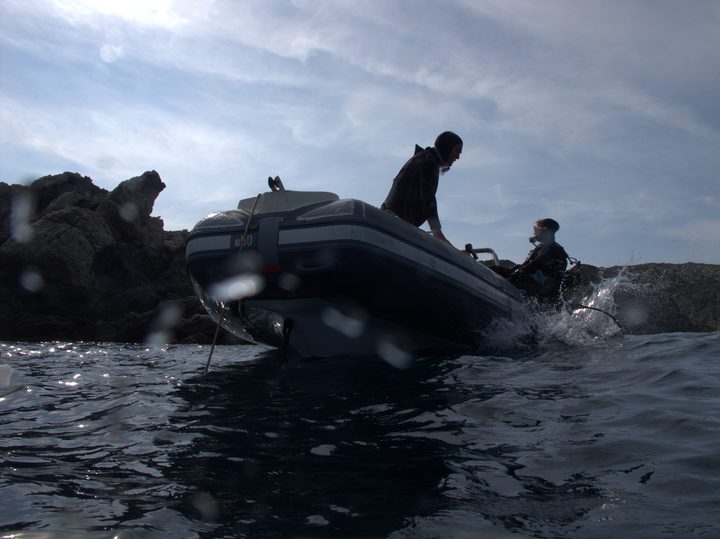
Family-run Costa Brava dive center at Cala Canyelles, Lloret de Mar, with its own boat reaching reefs and pinnacles from Blanes to Tossa de Mar.
Get in touch to add or claim your dive center listing on DiveCodex.
Dive centres in Catalonia must require insurance from every diver on their dives, and must be able to offer a policy to anyone who has none.
Two reasons, both in 1994. The concrete blocks physically block bottom-trawling nets dragged close to shore, and in doing so they shelter the Posidonia oceanica meadow that trawling would otherwise tear up. The structure was a fisheries and habitat measure first. The diving came later, once marine life moved in.
Advanced Open Water as a minimum. The blocks sit at 23 to 27 metres on sand and the dive runs down to about 32 metres, beyond the 18 metre Open Water limit. There is no current and no overhead, so the difficulty is depth rather than technique. Nitrox is worth carrying.
Groupers are reported among the blocks, which is the kind of sheltered structure that holds them. On this coast they are occasional and wary rather than the bold, habituated fish you meet at protected reserves, so treat a close encounter as a good day, not a guarantee.
The concrete blocks stand on sand at roughly 23 to 27 metres. The anchor line drops to about 32 metres at the deepest point, and the dive works back across precoralligenous rock toward the coast. Plan it as a deep dive with a typical bottom time of 35 to 45 minutes.
No. The Lloret and Tossa coast holds PEIN and Natura 2000 environmental protection, not marine-reserve status. There are no diving permits, fees, or quotas. The 1994 reef itself was an anti-trawling fisheries structure and imposes no rules on divers.
May through October brings the warmest water and the most active marine life, including the seasonal amberjack schools that pass among the blocks. The site is diveable year-round when the weather allows the boat out, though winter calls for a drysuit at this depth.
Log your dives - notes, photos, conditions and the marine life you saw - and share them as one public diver profile. What you share helps the next diver, too.
Log every detail
Depth, duration, conditions, gear, buddy, notes — all in one place. Import from Suunto and other dive computers.
Track marine life
Record species sightings on each dive. Build a personal catalogue of everything you've seen underwater.
Your public dive profile
Share your dive history, stats, and experiences with a profile page you control. Show the world where you've been.