
Cap de Creus Dive
PADI 5-Star center in El Port de la Selva with brand-new Aqualung gear, max 4 divers per guide, and year-round boat diving in Cap de Creus Natural Park.
PADI / SSI10 services4 languages
Also known as: Els 3 Frares, Es Tres Fares de Galladera, Les 3 Frères, Punta dels Tres Frares
Boat-only wall and channel dive on Cap de Creus's Mar d'Amunt (north) shore, working depth 20-40m, launched from Llançà and Port de la Selva.
Last updated September 2026
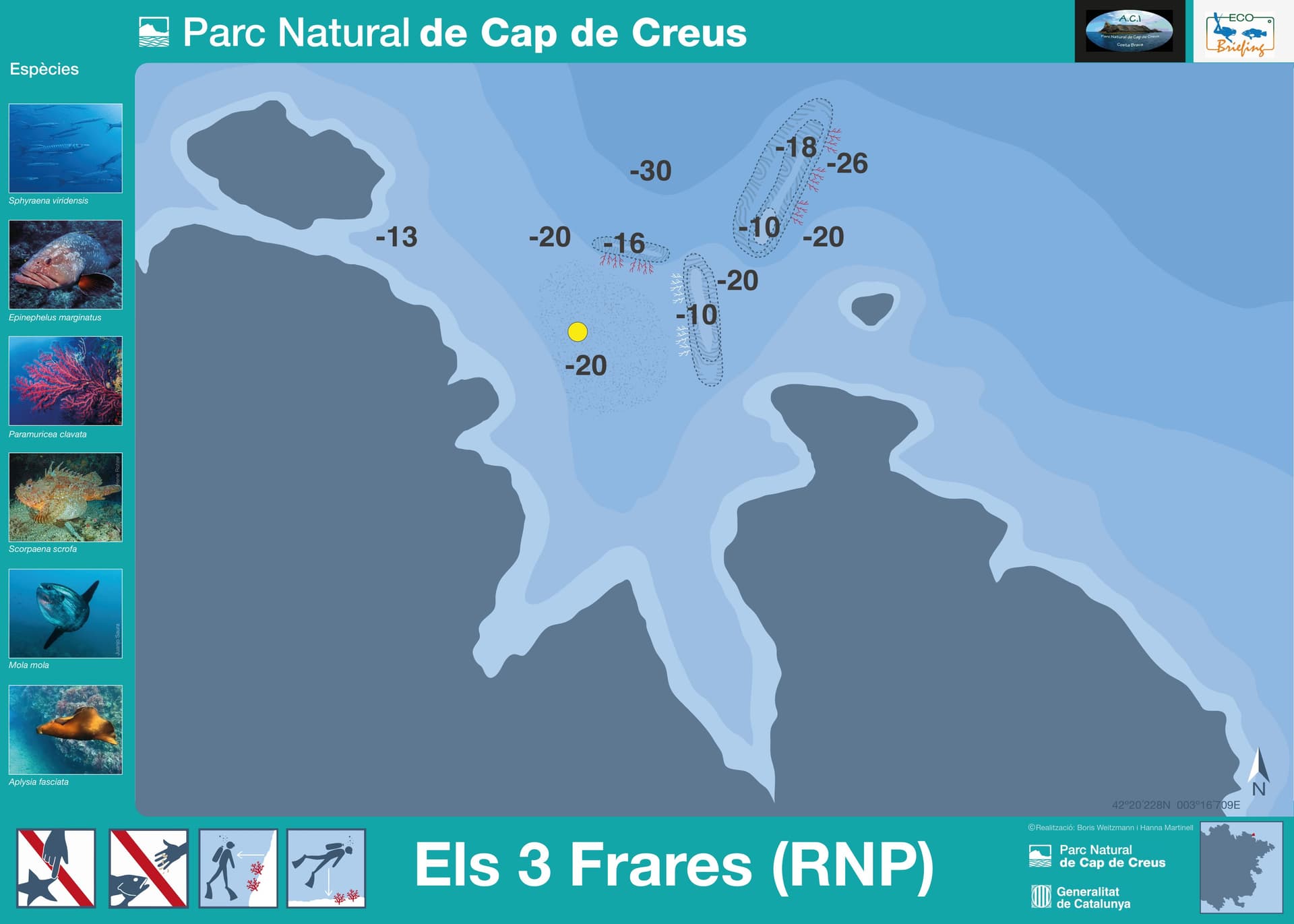
Els Tres Frares sits on the Mar d'Amunt, the quieter north side of Cap de Creus, on the stretch between Port de la Selva and the park's lighthouse, just short of Cala Culip. Boats moor off a rocky point where the bottom drops into a wall and channel worked between about 20 and 40 metres. The route runs on rock throughout, without the sand or Posidonia patches that soften some of the park's other approaches. There is no shore option here: every dive starts from a boat out of Llançà or Port de la Selva.
The Mar d'Amunt side of the park carries less boat traffic than the Cap Norfeu cluster further south, and this point is reached from Llançà and Port de la Selva, not the Roses or Cadaqués departures that serve the sites to the south. Only two eco-guiding centres are named for this exact point, both based on this side of the peninsula, a narrower choice than the southern sites offer. The guided route also asks more than its "all levels" rating suggests on paper: the working band runs from 20 to 40 metres, deep enough that Advanced Open Water is the realistic entry point.
This is a north-facing point, directly exposed to the Tramuntana, which can leave it undiveable for days when it blows hard. The adjoining cove, Cala Galladera, is marked as a no-anchor sector once the park's delimiting buoys are installed; centre-guided dives already work within that rule, so it matters mainly for a private boat. Confirm the planned depth before you go: published figures for this point range from a 20-40 metre working band to a wider 5-45 metre span, and the deep end of that spread sits outside standard recreational limits. Treat the published coordinates as approximate: they come from a single catalog listing, not a survey.
What makes this dive site stand out.
Rock wall dropping into a channel, worked from about 20 to 40 metres
North-facing sector of Cap de Creus, reached from Llançà or Port de la Selva
Only two eco-guiding centres run this exact point, both on the north side
Sits next to a cove marked as a no-anchor sector once park buoys go in
42.3373°N, 3.2786°E
The association's own fact sheet works this route from 20 to 40 metres, past the depth ceiling most agencies set for Open Water-only divers, so Advanced Open Water is the realistic minimum. A separately reported range extends the same point to 45 metres, outside standard recreational limits, and would need Deep or Technical certification if a centre programmes that depth.
Summary
Advanced across the association's own 20-40 metre working band; the route's 'all levels' rating covers only its shallow lip, under direct guide supervision.
Safety considerations
What can go wrong here, and what divers do about it. Conditions change - take the briefing from the operator on the day.
Book a guided dive at this site.
PADI 5-Star center in El Port de la Selva with brand-new Aqualung gear, max 4 divers per guide, and year-round boat diving in Cap de Creus Natural Park.
PADI/CMAS/FFESSM centre in El Port de la Selva, running since 1994; daily boat dives across ~20 Cap de Creus sites including Massa d'Or, April-October.

Get in touch to add or claim your dive center listing on DiveCodex.
Dive centres in Catalonia must require insurance from every diver on their dives, and must be able to offer a policy to anyone who has none.
No. Els Tres Frares is on the Mar d'Amunt, the park's north side near Port de la Selva and Llançà; the similarly-translated 'El Fraire' is a separate, unrelated point roughly 12 kilometres away on the opposite coast, in the Roses and Cap Norfeu sector. The two names share a translation ('friar') but describe different dives in different parts of the park.
The all-levels rating covers the shallow lip of the route, worked under a guide; the association's own fact sheet still lists a 20 to 40 metre working band for the wall and channel, past the depth most agencies set for Open Water-only divers. A separately published range extends the same point to 45 metres, deep enough to sit outside standard recreational limits, so a diver planning to work the fuller wall should hold Advanced Open Water at minimum and check with the centre before going deeper.
Log your dives - notes, photos, conditions and the marine life you saw - and share them as one public diver profile. What you share helps the next diver, too.
Log every detail
Depth, duration, conditions, gear, buddy, notes — all in one place. Import from Suunto and other dive computers.
Track marine life
Record species sightings on each dive. Build a personal catalogue of everything you've seen underwater.
Your public dive profile
Share your dive history, stats, and experiences with a profile page you control. Show the world where you've been.