

Aquatica Illes Medes
SSI Diamond ITC in L'Estartit since 1996, specialising in small-group, low-impact diving in the Illes Medes Marine Reserve from a campsite-based dive school.
SSI6 services5 languages
Also known as: Ferranellas, Ferranelles, les Ferranelles
Rock chain between Tascó Petit and Meda Gran with prolific biomass at 6-23 m and the Escrivana reefs dropping to 38 m through three gorgonian-covered barriers.
Last updated April 2026
A chain of rocks rather than a single pinnacle. Les Ferranelles stretches from its small island between Tascó Petit and Meda Gran, giving the dive a linear character unlike any circumnavigation in the Medes. The standard route follows the chain at 8-23 metres over blocks thick with gorgonians, where groupers appear at every turn. Some are territorial. One guide describes an "alpha" grouper that bit a diver at chest height and had to be faced down. Barracudas work the gaps between rocks when current pushes through, hunting bogas in tight formations. Below 22 metres on the deep side, three separate reef barriers step down to the Escrivana zone, where the final wall drops to 38 metres over sand. The gorgonians here grow undisturbed at depths most Medes circuits never reach.
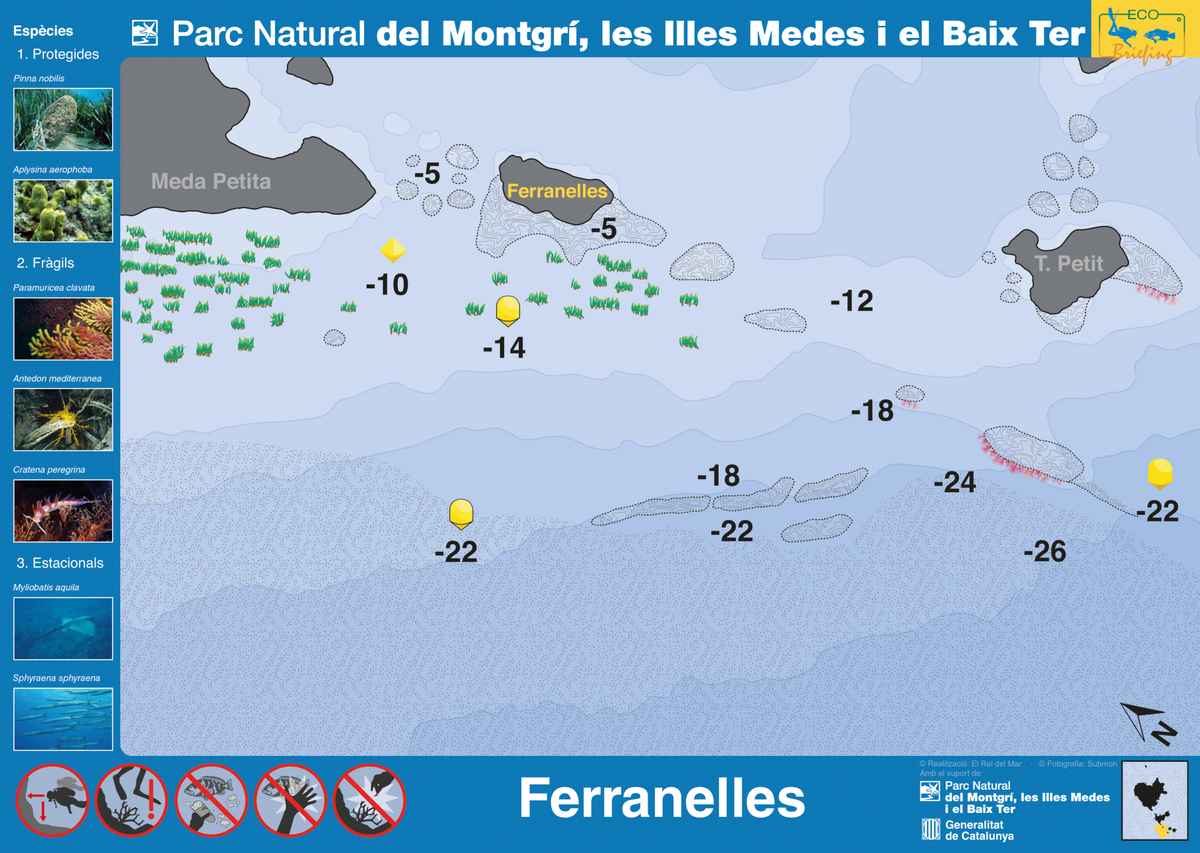
Illustration: Parc Natural del Montgrí, les Illes Medes i el Baix Ter — Generalitat de Catalunya
Two dives in one site. The shallow rock chain is pure reserve biomass at its densest, with groupers, morays, scorpionfish, and dentex packed along a compact ridge between 8 and 23 metres. The Escrivana extension below is something else entirely. Three reef barriers descend to a final gorgonian wall at 38 metres that few casual visitors to the Medes ever see. This dual character makes Ferranelles genuinely versatile. A guided group of Open Water divers stays shallow and leaves satisfied. An experienced pair drops to the Escrivana and finds a wall that rivals anything in the archipelago. Winter storms can strip the gorgonians bare. Divers who visited after a 2009 storm found white branches broken across the seabed. Recovery is measured in years.
Current shapes the dive. The rock chain sits in an exposed corridor between islands, and water funnels through the gaps with force that varies within a single descent. Strong current days push divers to the sheltered side but bring the pelagics: barracudas, dentex, and the occasional tuna cruising between the Tascons and Ferranelles. Calm days allow the full chain traverse. For the Escrivana route, carry nitrox and watch your computer. The wall at 38 metres rewards those who go deep but punishes inattention to no-decompression limits. Bring a torch for the overhangs and crevices on the south side, where morays and conger eels retreat into shadow.
42.0421°N, 3.2256°E
Peak marine life activity and pelagic sightings. Best visibility in calm summer conditions.
Verify current rates with dive centre
Open Water sufficient for the shallow circuit along the rock chain at 8-23 m. The Escrivana deep reefs at 27-38 m require Advanced Open Water.
Summary
Easy on the shallow rock chain; moderate to advanced on the deep Escrivana route due to depth and current exposure
Safety considerations
What can go wrong here, and what divers do about it. Conditions change - take the briefing from the operator on the day.
Book a guided dive at this site.
SSI Diamond ITC in L'Estartit since 1996, specialising in small-group, low-impact diving in the Illes Medes Marine Reserve from a campsite-based dive school.
Family-run PADI centre in L'Estartit, run by Peter and Jacqueline Lane for nearly 40 years, with PADI Green Star and four other environmental credentials.

PADI 5 Star centre on L'Estartit seafront with stay-and-dive packages, four daily boat dives between Illes Medes and Montgrí, plus tec diving.

Family-run PADI 5 Star Resort and SSI centre in L'Estartit since 1990, with two 30-diver boats running hydraulic lifts to the Illes Medes reserve.
Long-running L'Estartit dive centre (founded 1969) running a four-boat fleet to the Illes Medes reserve and Montgrí coast, with SSI training and a strong family/snorkel programme.

Family-run hotel and dive centre in L'Estartit since 1985, with two dedicated boats and four daily departures to the Illes Medes reserve.

Owner-led PADI centre on Carrer Salines in L'Estartit, capping each guide at 5-6 divers across the Illes Medes, Montgrí, and Cap de Begur.
Get in touch to add or claim your dive center listing on DiveCodex.
Dive centres in Catalonia must require insurance from every diver on their dives, and must be able to offer a policy to anyone who has none.
Three separate reef barriers starting at around 22-27 m depth on the deeper side of the rock chain. The last barrier reveals a wall covered with gorgonians that drops to 38 m over a sandy bottom. This is the advanced extension of the standard Ferranelles dive and requires AOW certification.
The shallow route follows the rock chain from Ferranelles toward the Tascons at 8-23 m over blocks dense with gorgonians, groupers at every turn, and barracudas hunting overhead when current runs. The deep Escrivana route descends through three reef barriers to a final gorgonian wall at 38 m. The shallow route has more biomass density. The deep route has more dramatic scenery.
Large territorial groupers have been known to confront divers here. One documented encounter describes a grouper biting a diver at chest height, with the dive guide intervening. Keep a respectful distance from large individuals and avoid holding eye contact, which some groupers interpret as a challenge.
Excellent. The prolific biomass means subjects are everywhere. Groupers hold position for the camera, nudibranchs dot the shallow rock surfaces, and gorgonian walls in the Escrivana zone reward wide-angle compositions. Morays and scorpionfish on the south side work well with macro setups.
Gorgonians and nudibranchs are heavily affected. Divers have documented stripped branches and broken white gorgonians on the seabed after major storms. Gorgonians grow slowly (1-2 cm per year), so recovery takes years. Visibility can drop to 2 m immediately after a storm.
Open Water divers can enjoy the shallow rock chain at 8-23 m, where most grouper encounters and barracuda action happen. The Escrivana deep reefs at 27-38 m require Advanced Open Water. Some dive centres tailor the route to group level, and OW divers must be accompanied by an instructor.
Log your dives - notes, photos, conditions and the marine life you saw - and share them as one public diver profile. What you share helps the next diver, too.
Log every detail
Depth, duration, conditions, gear, buddy, notes — all in one place. Import from Suunto and other dive computers.
Track marine life
Record species sightings on each dive. Build a personal catalogue of everything you've seen underwater.
Your public dive profile
Share your dive history, stats, and experiences with a profile page you control. Show the world where you've been.