

Diving Cap de Creus
German-run CMAS/RSTC dive centre on Cadaqués's Es Caials shore since 1975, with two shore dives near the door and boat trips on an informal daily schedule.
CMAS / other4 services2 languages
Also known as: Isla de Messina, Messina Island
Open-water island half a mile east of Port Lligat, with a south-side canyon, red gorgonian walls and pelagic fish; current can change direction mid-dive.
Last updated September 2026
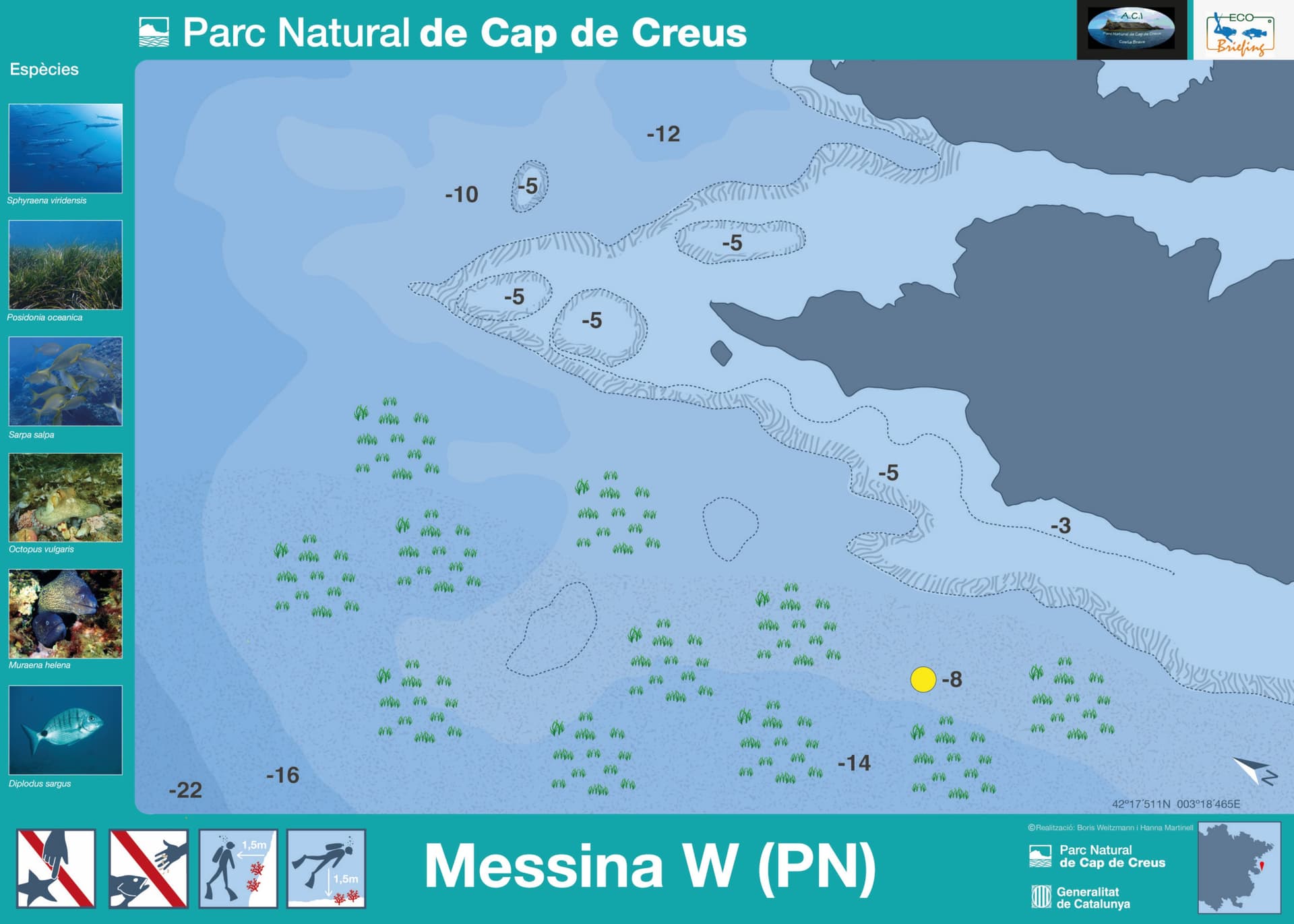
The west wall of Illa Messina drops from the surface rim into the canyon on the island's south side, a channel between two rock formations that gives the dive its shape. Past the channel the rock gives way to sand at the canyon's base, and the route continues onto the east flank, where the island stops sheltering the water and the current starts to matter. Barracuda schools and hunting amberjack work this open-water stretch, and tuna pass through on occasion, alongside the resident grouper among the boulders. On a different day the same island offers Messina W instead, a shallower route on the west side over a Posidonia meadow, where salema and white seabream graze the grass. Operators run the island as one trip and choose between the two routes on the day, so which dive you actually get depends on conditions and the group as much as on the booking.
The Cap de Creus Natural Park surveys Illa Messina as two separate named dive points, Messina S and Messina W, each with its own government-mapped depth and species panel,12 yet no operator sells them apart. The island is one trip with two profiles inside it, and the choice of which one you get is made by the boat, not by the brochure. What carries the reputation is the canyon itself, a real rock passage divers swim straight through, walled in red gorgonian on the way down and opening onto blue water on the way out. Local divers who return to Cap de Creus season after season name Illa Messina among the area's most beautiful dives. Barracuda schools and amberjack keep that reputation current on the open-water side, where the same shift in current that makes the dive interesting is also what a skipper reads before deciding whether to run it that morning.
Current is the variable to plan around here. It can be light or demanding, and local divers warn it can reverse direction partway through the dive, so carry an SMB and stay close to the wall on entry and to the guide through the canyon. Expect a sharp thermocline near 15 metres in summer, with surface water at 21-25C dropping to 14-18C below it on the Messina S canyon route; the shallower Messina W meadow mostly stays above that line, so plan your exposure suit around whichever route the boat runs that day. Tramontana wind shuts the site for days at a stretch outside high summer, so build slack into the trip if Illa Messina is the dive you came for.
What makes this dive site stand out.
Messina S's canyon and Messina W's Posidonia meadow both have their own park itinerary sheet
A channel between two rock formations runs from the west wall to sand near 30m
Direction can change mid-dive, among the area's most current-exposed sites
Barracuda schools, amberjack and the occasional tuna work the east flank
42.2903°N, 3.3086°E
Late spring to autumn covers the warmest water. Mid-September often brings settled weather and lighter boat traffic.
Cadaqués- and Port de la Selva-based centres, 2025-2026 season. Confirm current rates with your operator.
Messina W's shallow Posidonia route stays within Open Water limits, to about 18m. Messina S's canyon traverse and the deeper east-flank sections call for Advanced Open Water.
Summary
Centres list the island for all levels; local divers rate it advanced once the current is running. A logged dive to 35m on the deeper route was rated medium difficulty for an advanced diver.
Safety considerations
What can go wrong here, and what divers do about it. Conditions change - take the briefing from the operator on the day.
Book a guided dive at this site.
German-run CMAS/RSTC dive centre on Cadaqués's Es Caials shore since 1975, with two shore dives near the door and boat trips on an informal daily schedule.
SSI-listed dive centre inside the Carpe Diem Cadaqués complex, running since 2008 with three daily boat departures across 15 named Cap de Creus sites.

PADI 5-Star dive center in Roses running three decades, with its own 16m catamaran to Cap de Creus Natural Park sites.

SSI Instructor Training Center in Cadaqués running guided dives to 25+ Cap de Creus Natural Park sites and a blue shark snorkeling program.
Get in touch to add or claim your dive center listing on DiveCodex.
Dive centres in Catalonia must require insurance from every diver on their dives, and must be able to offer a policy to anyone who has none.
No. Illa Messina is a small island half a mile east of Port Lligat, and the dive works its walls and a south-side canyon. A separate wreck, the Reggio Messina, a 122m freighter resting around 34m, lies elsewhere on the Costa Brava, and some centre listings and trip reports use 'Messina' loosely for either. Book the island by its full name if the canyon and gorgonian walls are what you want.
The Cap de Creus Natural Park's own underwater-itinerary programme surveys the island as two named points, Messina S and Messina W, each with its own marked depth and species panel. Centres do not sell them separately; they run the island as one trip and choose the route on the day. Messina S is the deeper south-side canyon, marked at -21m, with gorgonians and dentex. Messina W is the shallower Posidonia meadow on the west side, marked at -8m.
Messina W, the shallow Posidonia meadow route, stays within Open Water limits in calm conditions. Messina S's south-side canyon and the open-water east flank run deeper and call for Advanced Open Water. On a strong-current day the skipper may keep everyone shallow, or move the boat to a sheltered site regardless of certification.
Variable. It can be barely noticeable on a calm day and demanding on a current day, and local divers warn it can change direction mid-dive. Illa Messina sits among the area's most current-exposed sites, and boat-skipper judgment on arrival decides whether the site runs that morning.
Not as a separate product. Operators sell Illa Messina as one island dive and choose which of the park's two named routes to run depending on conditions and the group. If the shallow Posidonia meadow specifically is what you want, say so when booking and confirm with the skipper on the day.
Log your dives - notes, photos, conditions and the marine life you saw - and share them as one public diver profile. What you share helps the next diver, too.
Log every detail
Depth, duration, conditions, gear, buddy, notes — all in one place. Import from Suunto and other dive computers.
Track marine life
Record species sightings on each dive. Build a personal catalogue of everything you've seen underwater.
Your public dive profile
Share your dive history, stats, and experiences with a profile page you control. Show the world where you've been.