

Buceo Aqualia
Training-led dive centre in La Herradura with SSI courses, UTD technical programmes and daily guided dives from Marina del Este, by shore or boat.
SSI5 services2 languages
Also known as: Los Gigantes
Sheltered cove and deep wall on the western side of Punta de la Mona, with Cueva del Bogavante at 30m and El Derrumbe rock-fall to 40m.
Last updated May 2026
A short boat run from Marina del Este ties off at the mooring above the cove, and the descent line drops to sand-and-rock bottom at about 8 metres on the sheltered west side of the Punta de la Mona headland. The cove side is the workhorse of the local fleet: overhangs sheltering conger eels, crevices where lobsters back into shadow, octopus tucked into rock cracks, and the occasional torpedo ray resting in a sandy hole. Spirograph worms wave in current that barely registers here. Wall edges carry rosettes of orange coral that catch torchlight even at midday.
The deep route turns west of the mooring toward Piedra de los Lunas, a landmark rock named in a long-circulated 2005 local route guide as the entry into the deeper terrain. From there divers exit onto sand at 30 metres, where schools of lemon fish work the bottom, occasionally rubbing against the sand to deparasite — one of the deep route's signature scenes in older accounts. Following the rock-sand interface west leads to Cueva del Bogavante: a cave at 30 metres where a large European lobster has been documented across multiple visits, with spider crabs and slipper lobsters in surrounding crevices and a large greater forkbeard inside. Past the cave, the topography opens into El Derrumbe, a rock-fall slope roughly 25 metres wide at its base that drops toward 40 metres, the boulders dotted with orange coral colonies.
The return runs through the terrace at 18-25 metres, where European sea bass hunt and groupers cruise. Local accounts describe these groupers as muy muy desconfiados — very, very wary — so divers approach slowly. The dive ends back over the cove for off-gassing among the reef rocks. Typical duration runs around 49 minutes for either profile.
Three things separate La Calita from its siblings on this stretch of the Punta de la Mona cliff. First, the dual profile: a single mooring serves both an OW-friendly 8-20m cove and an AOW deep route to 40 metres. Few La Herradura sites pair a 7-metre baptism dive and a 40-metre cave loop in the same descent. Second, Cueva del Bogavante: the lobster cave is a named, repeatable landmark — the resident European lobster has been documented across multiple visits over years, not a one-off encounter. Third, El Derrumbe and the orange coral that covers its boulders, framing the deep loop as a coherent geological route rather than a sequence of stops. Macro divers also single the site out for its concentration of nudibranch species along the cove walls.
The community framing is quietly local rather than touristy. Spanish runs through the dive logs and forum threads, and centres lean on the Mola mola association for spring and summer trip pitching even though encounters remain conditional. The cove side carries the day-to-day rhythm — Open Water La Herradura's mixed-level groups, baptism dives, FEDAS 1-star course dives — while the deep route is locals' territory, run for AOW divers when conditions and certification line up.
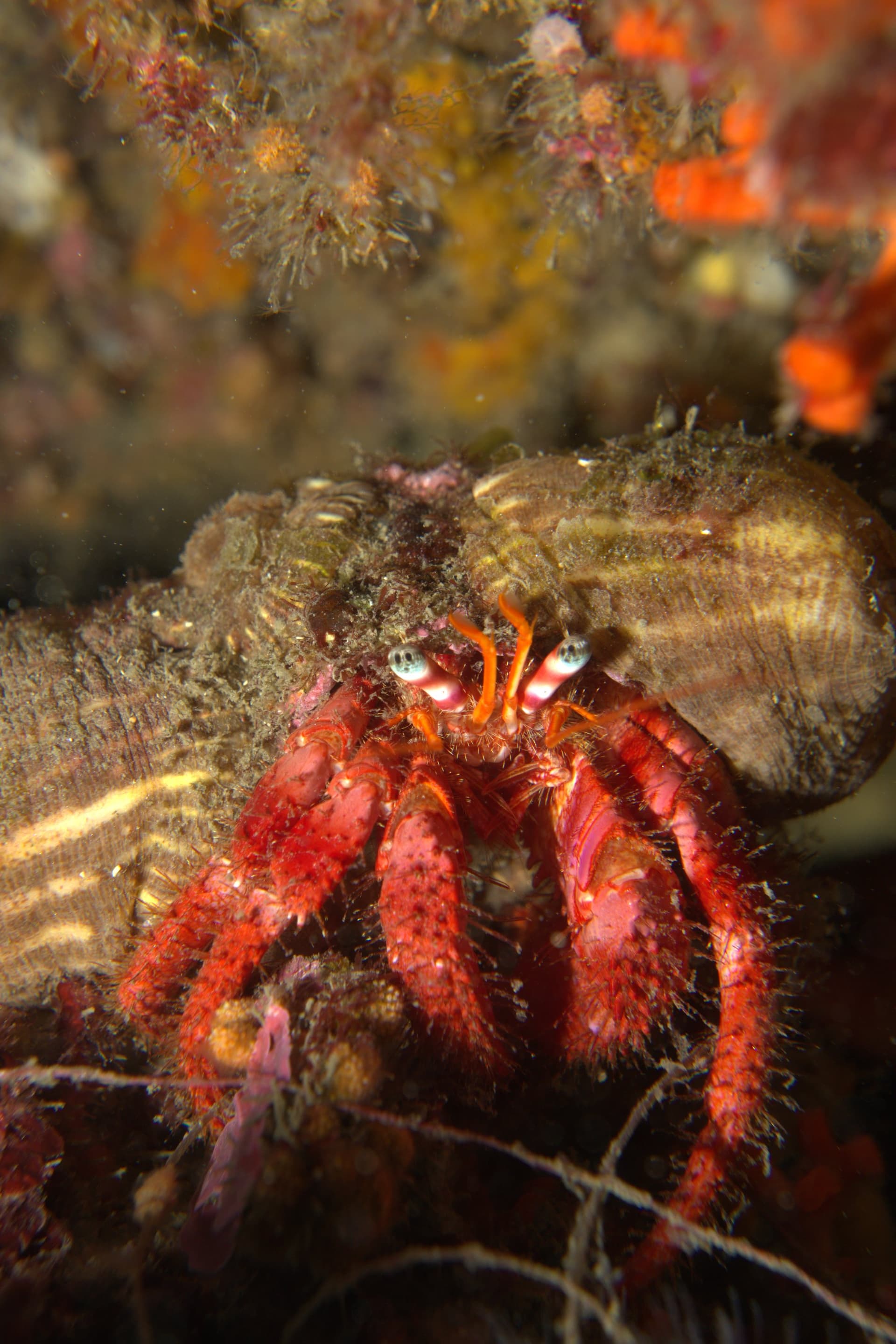
La Calita is one of La Herradura's stronger macro destinations and rewards a deliberate lens choice. The cove walls and overhangs at 8-18 metres concentrate the nudibranch work: six species are documented across the site, including the vivid blue Felimare picta, the pink-cerata Flabellina affinis, and Peltodoris atromaculata grazing sponges under overhangs. Spirograph worm gardens on the reef structures and bryozoan lace (Pentapora foliacea) at depth give wide-angle subjects, and the Astroides calycularis colonies on the deep walls and through El Derrumbe need an artificial light to read on camera — without one they sit dark against the rock. A torch helps in the cave interior where the orange coral picks up only under a direct beam. Early morning gives the best surface light and the calmest water.
Gas management is the critical skill on the deep route. The local rule is to turn for ascent at one-third tank because the deep loop earns decompression obligations quickly, and the wall extends past 40 metres at El Derrumbe without obvious depth cues — easy to overshoot if you follow the rock face downward without watching the gauge. Nitrox is recommended for the full deep loop. For the cove dive, bring a macro setup. The cove sits on the sheltered side of the headland and stays workable in conditions that close the exposed sites east of the point, but moderate flow can develop around the headland on tidal change or strong Levante or Poniente. Deploy an SMB on ascent given the boat traffic.
What makes this dive site stand out.
OW cove at 8-20m and AOW deep route past the lobster cave to 40m on the same boat drop
Cave at 30m with a documented resident European lobster
Wide crevice slope to nearly 40m, orange coral on tumbled boulders
Six species documented: Felimare picta, Flabellina affinis, Peltodoris atromaculata and three more
Sabella spallanzanii gardens on reef structure, Astroides scattered through the deep rocks
36.7218°N, 3.7352°W
Peak July to September. Spring brings lower visibility but variable: May logs span 16-24°C, with Alborán upwelling driving the cooler episodes.
Typical La Herradura boat dive pricing. Verify current rates with the dive centre.
Cove dive at 8-20m suits OW divers, including baptism dives at 7m. The deep route, Cueva del Bogavante at 30m, and El Derrumbe at 40m require AOW with deep diving experience.
Summary
Easy in the cove (8-20m). Advanced on the deep route (20-40m) where depth and gas management are critical.
Safety considerations
What can go wrong here, and what divers do about it. Conditions change - take the briefing from the operator on the day.
Book a guided dive at this site.
Training-led dive centre in La Herradura with SSI courses, UTD technical programmes and daily guided dives from Marina del Este, by shore or boat.

PADI 5 Star IDC center in Marina del Este with 20+ years of experience, 6 instructors, and boat dives across 16 sites in La Herradura bay.

PADI 5 Star beachfront center in La Herradura with an in-house workshop, marine biology programs, and 16 sites from beginner coves to 40m walls.
Boutique SSI center in La Herradura built around deliberate slow-pace diving, marine education, and low-impact access to the Maro-Cerro Gordo protected coast.
Get in touch to add or claim your dive center listing on DiveCodex.
Yes — that is the local pattern. The cove at 8-20m suits Open Water divers and even baptism dives at 7m, while AOW divers run the deep route west from the mooring through Piedra de los Lunas, past Cueva del Bogavante at 30m and El Derrumbe at 40m. Centres bring mixed-level groups and split them at depth, with everyone ending the dive together back over the cove.
A cave at 30m on the deep route, named for the European lobster (bogavante) documented as a resident there across multiple visits. Spider crabs and slipper lobsters share the ceiling cracks, and a large greater forkbeard has been recorded inside. Beyond the cave the topography opens into El Derrumbe, a rock-fall slope dropping toward 40m.
Six species are documented across the cove walls and overhangs: Felimare picta (vivid blue and yellow), Flabellina affinis (pink-purple cerata), Peltodoris atromaculata (cow nudibranch on sponges), Thuridilla hopei, Crimora papillata, and Polycera quadrilineata. Most sightings concentrate at 8-18m where natural light still reaches the rock surface.
Mola mola visits in the area are reported spring and summer and remain a sighting-luck event rather than a guarantee. A specific cleaning-station feature is described in centre material but has not yet been corroborated by community dive logs or forum reports, so treat it as a possible highlight rather than a planned encounter.
From the mooring at 8m, head west to Piedra de los Lunas (a community-named landmark rock from a long-circulated 2005 local route guide), exit onto sand at 30m where lemon fish school, follow the rock-sand interface to Cueva del Bogavante, continue to El Derrumbe at 40m, then return via the terrace at 18-25m back to the cove for off-gassing. Turn for ascent at one-third tank.
May to October for the warmest water and best visibility, with a peak from July to September when summer dive logs record 18m+ visibility and 24°C surface temperatures. Spring visibility drops to 8-9m and water can swing between 16°C and 24°C in May because of episodic Alborán upwelling. Easter is documented as a productive shoulder window with full-length 49-minute dives.
Yes — La Calita is inside the Paraje Natural Acantilados de Maro-Cerro Gordo. The permit is held by the dive centre, not the individual diver. Booking through any of the authorized La Herradura centres covers the requirement.
Log your dives - notes, photos, conditions and the marine life you saw - and share them as one public diver profile. What you share helps the next diver, too.
Log every detail
Depth, duration, conditions, gear, buddy, notes — all in one place. Import from Suunto and other dive computers.
Track marine life
Record species sightings on each dive. Build a personal catalogue of everything you've seen underwater.
Your public dive profile
Share your dive history, stats, and experiences with a profile page you control. Show the world where you've been.