

Sea & Sun Diving Center
Family-scale CMAS and SSI center in La Isleta del Moro, operating for 30+ years inside the Cabo de Gata-Nijar Natural Park.
CMAS / SSI1 language
Also known as: Cueva del Francés, El Chalet del Francés, La Cueva del Frances
Naturally lit cavern with hundreds of cardinal fish at 8-18m in Cabo de Gata, with three substrates and resident groupers on the cave lip.
Last updated May 2026
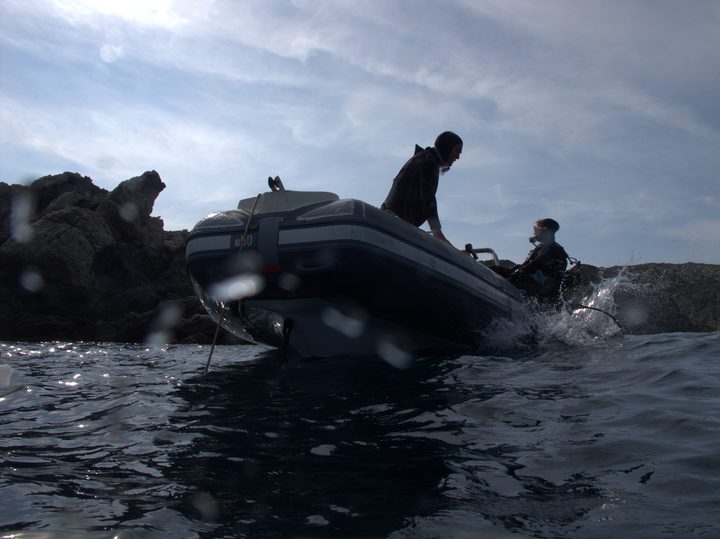
The boat anchors at eight metres on sand. From there the route works inland through low passages and rocky build-ups toward an underwater volcanic mound, then drops into a sandy-floored canyon that opens at the cliff base. That cliff cove is the headline scene: several large dusky groupers usually hold position on the lip, slipping deeper into the rock as divers close in. Pollack and sea bass cycle through. The cave itself sits a little off the cliff wall, easy to swim past without a guide, and the moment you cross the threshold the cardinal-fish swarm becomes visible: hundreds of bodies hanging in the dim chamber. Switch a torch on and the space changes. Translucent reds and silvers flash across the school, and daylight from cracks in the rock above falls in shafts across the sand. The exit isn't a single doorway. Several fractures in the cliff offer route options, and a guide picks one based on sea and wind. The return loops through Posidonia patches where nacras stand upright in the seagrass and salema schools graze the leaves like cattle in a meadow. A typical dive lands around an hour at fourteen metres maximum.
The cardinal-fish chamber is the obvious draw, but the dive's character comes from how it stitches together the rest of the site. Inside an eight-to-eighteen-metre profile divers cross sand, Posidonia meadow, and volcanic rock, three substrates, and the route changes dive to dive depending on which exit fracture the conditions favour. That layout is why centres on both sides of La Isleta del Moro keep it in their top rotation, and why local divers come back to it: a 2004 forobuceo trip report described the dive as different every visit, and 2023 word-of-mouth still framed it as "usually one of the best." Outside the cardinal fish, the regulars list reads short and specific: resident groupers on the cave lip, brown meagre at the entrance, nacras and the occasional triton's trumpet in the adjacent meadow.
Bring a torch. The cave is navigable in daylight, but the cardinal fish and the colour on the walls only register under a beam. Once inside, hover; do not settle. The sand floor lifts at the smallest fin kick, and the silt drops visibility for every diver behind you. Agree exit order with the guide for the same reason. The cave entrance is genuinely hard to find without local knowledge, so this is not a self-guided dive even on a centre boat. Book a few days ahead, since walk-in same-day diving is rare in this park. Standard recreational safety kit applies (torch, SMB, dive computer); the site is easy on certification but unforgiving on buoyancy.
What makes this dive site stand out.
Hundreds of Apogon imberbis hang in the chamber, vivid reds and silvers under torchlight
Several large dusky groupers sit on the cave lip and retreat deeper as divers approach
Sand, Posidonia meadows, and volcanic rock all in a single 8-18m route
Guides choose between several exit fractures based on sea and wind, so repeat dives differ
Daylight slips through cliff fractures and falls across the cardinal-fish swarm
36.7850°N, 2.0500°W
October is singled out by local divers for good conditions and quieter centres.
Prices from local centres. Verify current rates before booking.
Naturally lit cavern with daylight through fractures and visible exits. Open Water divers enter with a guide; not a technical penetration dive.
Summary
Shallow and sheltered, but the sand floor inside the cave silts easily, so buoyancy discipline is required.
Safety considerations
What can go wrong here, and what divers do about it. Conditions change - take the briefing from the operator on the day.
Book a guided dive at this site.
Family-scale CMAS and SSI center in La Isleta del Moro, operating for 30+ years inside the Cabo de Gata-Nijar Natural Park.
Get in touch to add or claim your dive center listing on DiveCodex.
Parque Natural de Cabo de Gata-Níjar
Centres handle permits for their clients. Independent shore diving requires a separate Junta de Andalucía permit, valid 3 months; no night dives under that permit.
Hundreds of small reddish fish with oversized eyes, Apogon imberbis, hang in the cave chamber, almost motionless in the half-light. With a torch, their translucent bodies catch the beam and the space fills with shifting reds and silvers. They are resident year-round, so the scene is reliable on every dive.
Yes, with a guide. It is a daylit cavern, not a technical cave: rock fractures admit sunlight throughout, and exits are visible from inside. Open Water certification covers the standard 8-18m route. The real demand is buoyancy, because the sandy floor silts up quickly and reduces visibility for everyone behind.
The site sits on the boundary between the two diving zones. La Isleta centres reach it heading west; San José operators reach it from the south. Both clusters keep it in their headline-dive rotation, which is unusual since most Cabo de Gata sites are clearly in one zone or the other.
A torch is essential. Without one the cardinal fish read as shadows, and the wall life (nudibranchs, sponges, madrepores) stays invisible. Standard recreational kit otherwise: SMB, dive computer, and a 5mm wetsuit most of the year, 7mm in winter.
May to October for warm water and reliable conditions. Local divers single out October for good visibility with fewer crowds and quieter centres. The site stays diveable through winter, with surface water sitting around 14 to 16°C from December to March, but pace and group size argue for booking ahead.
It is the area's signature shallow cavern dive. La Amatista offers the nacra-and-Posidonia spectacle without overhead; Las Hermanicas is the wind-protected easy reef when levante closes everywhere else; El Vapor is the deep advanced wreck dive. Cueva del Francés sits between them: easy depth, accessible certification, but with the cave-and-grouper drama no other shallow site in the area produces.
No. Centres handle the marine-reserve administrative requirements as part of their service price. There is no separate per-dive fee at diver level for centre-organised dives. Independent shore divers need a 3-month Junta de Andalucía permit, but the site itself is boat-only, so this is rarely the relevant route.
Log your dives - notes, photos, conditions and the marine life you saw - and share them as one public diver profile. What you share helps the next diver, too.
Log every detail
Depth, duration, conditions, gear, buddy, notes — all in one place. Import from Suunto and other dive computers.
Track marine life
Record species sightings on each dive. Build a personal catalogue of everything you've seen underwater.
Your public dive profile
Share your dive history, stats, and experiences with a profile page you control. Show the world where you've been.