

Open Water La Herradura
PADI 5 Star beachfront center in La Herradura with an in-house workshop, marine biology programs, and 16 sites from beginner coves to 40m walls.
PADI7 services2 languages
Also known as: La Playita, Playa de La Herradura - extremo oeste
Walk-in shallow on La Herradura's western beach: sandy training zone with a low rocky flank, and the bay's main bautismo and night-dive site.
Last updated May 2026
Walk down the parking ramp at the western end of La Herradura's main beach, kit up on the sand, and step into the bay. The first ten metres of fin work is over flat sand at chest depth, then the floor drops gently to a 3-12m sandy plain that centres simply call "La Playita" and use as the area's training and try-dive zone. Light here is bright and pale, the bottom is featureless in a useful way for skills work, and seahorses occasionally turn up in the algae patches if a guide knows where to look. Carry on west and the sand gives way to a low rocky flank: small swim-throughs, low-relief outcrops, and Alcyonium palmatum (dead man's fingers) on the overhangs. Octopuses sit in the cracks, scorpionfish press flat against the rock, moray eels watch from holes. The rocky line runs to about 20m at its far end. Most divers turn back well before that, finishing on the sand at 5-6m for a relaxed safety stop.
The western shallow is the bay's everyday site, not its destination dive, and that is the point. Centres put try-divers and OW students here because the carry from car park to water is the shortest in La Herradura and the sand floor is forgiving. Divers logging two tanks pair it with a Punta de la Mona or Piedras Altas boat dive earlier in the day. And it is the bay's effective night-dive option: the Paraje Natural restricts night activity at most other sites, so the small group that wants to look for octopus and conger after dark almost always ends up here. The macro on the western rocks - octopus, scorpionfish, moray, the occasional nudibranch sweep - rewards a slow second dive of the day rather than a chase for depth.
Wind direction sets the day. Poniente (west wind) sharpens visibility on this western shallow and the rocky flank cleans up; summer Levante or any beach swell silts the sand and visibility drops to 5-10m on the same stretch. Centres recommend morning entries for calmer water and better light. Sand discipline matters - rinse regulators and the BCD inflator thoroughly after every dive. The beach is busy in summer with watercraft traffic, so an SMB on ascent and a surface tow back to shore are routine. The bay shore is inside the Paraje Natural de Maro-Cerro Gordo and the recreational-diving authorisation lives with the dive centre, not with you - book through a Junta de Andalucia-registered local operator and the regulatory side is handled. Costs run around 25-35 EUR for a guided beach dive with your own gear, 45-50 EUR with full rental.
What makes this dive site stand out.
Walk-in beach access from the western parking with the shortest carry in La Herradura
Sand-dominated 3-12m zone centres use as 'La Playita' for try-dives and OW students
One of the few night-dive options in the protected Paraje Natural, centre-coordinated
Octopus, scorpionfish, moray eel and Alcyonium on a low rocky flank to 20m
36.7384°N, 3.7545°W
Warmest water and most reliable conditions; year-round diveable, with calm-spell winter dives reporting 18C bottom and 15m visibility
Beach dive with own equipment from around 25 EUR; full rental brings the price to roughly 45-50 EUR. PADI Discover Scuba uses this shallow at around 80-91 EUR.
Working profile is well within OW limits. Suitable also for Discover Scuba Diving and bautismo under instructor supervision.
Summary
Sheltered bay, gradual sand slope, negligible currents, max depth 20m and most of the dive at 8-12m, beach exit visible throughout.
Safety considerations
What can go wrong here, and what divers do about it. Conditions change - take the briefing from the operator on the day.
Book a guided dive at this site.
PADI 5 Star beachfront center in La Herradura with an in-house workshop, marine biology programs, and 16 sites from beginner coves to 40m walls.
Boutique SSI center in La Herradura built around deliberate slow-pace diving, marine education, and low-impact access to the Maro-Cerro Gordo protected coast.
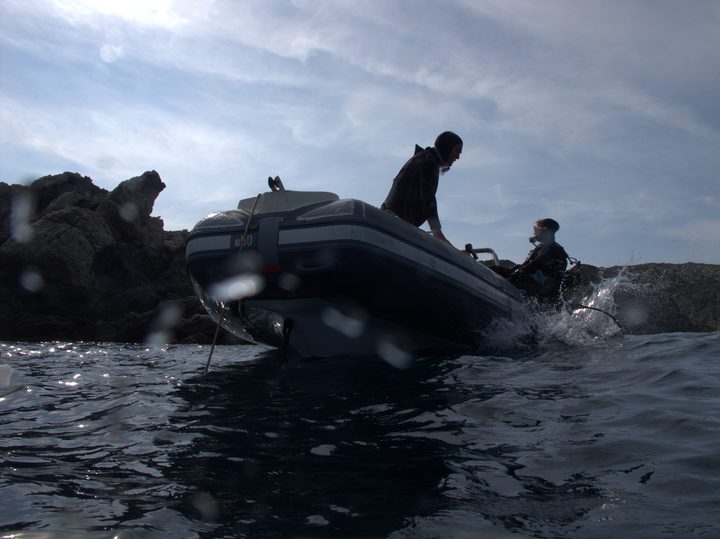
Get in touch to add or claim your dive center listing on DiveCodex.
Bay shore is inside the Paraje Natural Acantilados de Maro-Cerro Gordo (1989) but not in a marine reserve. Authorisation is centre-administered: divers cannot apply individually and dive with a Junta de Andalucia-registered centre. Marina del Este's January 2025 Natural Reserve declaration covers the eastern side, not the western beach.
Yes. The western shallow is La Herradura's main training site. The 3-12m sandy zone is used for Discover Scuba try-dives and Open Water dives 1-2, and the bay is sheltered with negligible currents. Certified divers can extend the dive west into the rocky flank to 20m.
Yes, and this is one of the few night-dive options inside the Paraje Natural. Most of the protected zone is restricted at night, but the bay shore can be dived after dark when arranged through an authorised local centre. Octopus, moray and conger eel are the headline night fauna.
It is the area's accessible-and-cheap option, not its signature dive. A guided beach dive runs around 25 to 35 EUR and you walk in from the parking. The bay's reputation rests on Punta de la Mona's deep wall and Marina del Este's reef and Mola mola sightings - those are boat profiles. Most divers pair this site with a deeper boat dive on a two-tank day.
Local centres report seahorses in algae patches in the shallow sandy zone, likely the long-snouted Hippocampus guttulatus. They are difficult to spot without a guide who knows current locations and they are not guaranteed on any single dive. A slow, careful pass with patience is the right approach.
May to October for warmest water (22-26C) and most reliable conditions. Winter dives are also possible: under calm Poniente spells, divers report 18C at depth and 15m visibility. Summer Levante and any beach swell silt the sand quickly, so wind direction matters more than month.
No individual permit is required. The Paraje Natural's recreational-diving authorisation is centre-administered: divers must dive with a Junta de Andalucia-registered local centre, which holds the registration. Independent shore diving with your own gear is technically possible but in practice a local centre handles the regulatory side and shows you where the rocky flank is.
Log your dives - notes, photos, conditions and the marine life you saw - and share them as one public diver profile. What you share helps the next diver, too.
Log every detail
Depth, duration, conditions, gear, buddy, notes — all in one place. Import from Suunto and other dive computers.
Track marine life
Record species sightings on each dive. Build a personal catalogue of everything you've seen underwater.
Your public dive profile
Share your dive history, stats, and experiences with a profile page you control. Show the world where you've been.