

Open Water La Herradura
PADI 5 Star beachfront center in La Herradura with an in-house workshop, marine biology programs, and 16 sites from beginner coves to 40m walls.
PADI7 services2 languages
Also known as: Huerta, The Garden, The Orchard
Boat dive in the Maro-Cerro Gordo reserve over orange-coral pinnacles, a rock-and-sand interface where rays lie and shallow boulder pools, 5-21m.
Last updated October 2026
Bogas and sargo hang overhead from the first metres, where the descent line reaches rocky ground at 5-6m. In spring through autumn juvenile anchovy and sardine work the upper water, sometimes with bonito or little tunny driving them from below. The route follows the side of a pinnacle down into the orange-coral zone, where Astroides calycularis and yellow Parazoanthus axinellae coat the rock in a deep yellow-orange skin. This is the macro section: nudibranchs sit across the walls and overhangs.
At about 15m the rock gives way to sand and rubble. Torpedo rays lie in the rubble, stingrays settle part-buried on the open sand, and in summer and autumn eagle rays cross low over the bottom. Groupers, morays and lobsters back into the crevices of the pillars next to the sand, so the work here is a slow look into holes. The deepest point sits at the rock edge by the white sand at 19-21m. When the current runs, the dive is a drift along the wall and the loop gives way to a one-way line.
The return crosses crevice rock and boulder ground at 5-8m and ends in the pozas at 3-5m. The safety stop has its own programme there, with morays in the cracks and small wrasse on the move.
Four habitats stack up inside one 45-minute profile: sandy ray ground, an encrusted pinnacle, a crevice wall and a shallow boulder pool. Each holds a different cast, and the overlap of rocky-reef and sand communities is where the variety comes from. The name, "the orchard", is a local nod to how thickly the pinnacles are grown over with yellow anemones and orange coral.
It all sits inside 21 metres. The pinnacles and the sand floor are reachable on one tank by a diver who has a few logged dives, and the dive keeps its interest to the last metres of the ascent.
The orange coral and the encrusting anemones grow slowly and do not recover from contact, so buoyancy is the skill this dive tests. A check on the descent line pays off, and the rock is for looking at from a hover. Water runs cool for much of the year, with 13-15°C in midwinter, so the exposure suit is worth a conversation with the centre before a spring or winter booking.
On high tidal coefficient days the current decides where the dive goes, so settle the direction and the exit plan with the guide on the boat, before anyone descends.
What makes this dive site stand out.
Astroides calycularis and yellow encrusting anemone coat the walls and rocky outcrops
From about 15m torpedo rays lie in the rubble and eagle rays pass in summer and autumn
Nudibranchs on walls and overhangs, a recurring highlight of the site
Pozas at 3-5m hold moray eels and small wrasse, dived as the safety stop
When the current runs, the route is dived with the flow instead of looping back
36.7340°N, 3.7740°W
Warmest water and most reliable visibility. Centres run the site all year.
The top of the dive sits at 5-6m, so Open Water is the minimum on calm days. When the current picks up, the drift along the wall suits a diver with some experience.
Summary
Easy to moderate on slack days, moderate when current is running. Buoyancy control matters on the encrusted pinnacles.
Safety considerations
What can go wrong here, and what divers do about it. Conditions change - take the briefing from the operator on the day.
Book a guided dive at this site.
PADI 5 Star beachfront center in La Herradura with an in-house workshop, marine biology programs, and 16 sites from beginner coves to 40m walls.
Boutique SSI center in La Herradura built around deliberate slow-pace diving, marine education, and low-impact access to the Maro-Cerro Gordo protected coast.
Get in touch to add or claim your dive center listing on DiveCodex.
Paraje Natural Acantilados de Maro-Cerro Gordo
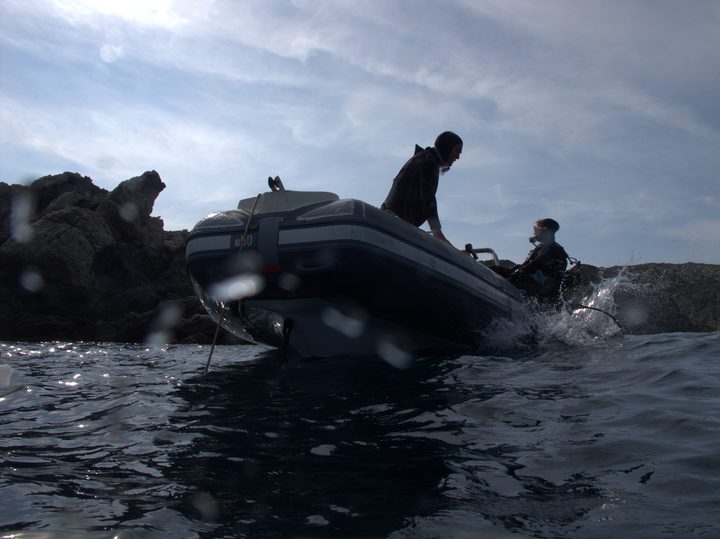
Scuba in the Paraje is done from a support boat moored to the provided buoys, for 3 hours at most and only from sunrise to sunset.
Three centres give Open Water as the minimum, and the dive starts at 5-6m with a floor around 21m. One centre adds a recommendation of Advanced (2 star), nitrox and experience with current. It is a recommendation, not a requirement. The current is what separates an easy day from a busier one, so the useful question for the centre is what the water is doing that morning.
Yes, centres list the site from January to December. One Easter trip report put the water at 15-17°C and advised a semi-dry or drysuit, so a summer wetsuit is not the plan for early spring. The same report logged 49 minutes on the dive.
Log your dives - notes, photos, conditions and the marine life you saw - and share them as one public diver profile. What you share helps the next diver, too.
Log every detail
Depth, duration, conditions, gear, buddy, notes — all in one place. Import from Suunto and other dive computers.
Track marine life
Record species sightings on each dive. Build a personal catalogue of everything you've seen underwater.
Your public dive profile
Share your dive history, stats, and experiences with a profile page you control. Show the world where you've been.