

Blaumar
CMAS dive centre in Mataró port with 40+ years of trading, running 600+ boat outings a year on the Maresme rocky ridges, 30 minutes by train from Barcelona.
CMAS7 services3 languages
Also known as: La Trencada Llevant
Shallowest of the named Mataro rocky ridges at about 14m, with porous biogenic rock, Posidonia patches alongside, and long bottom times for macro work.
Last updated April 2026
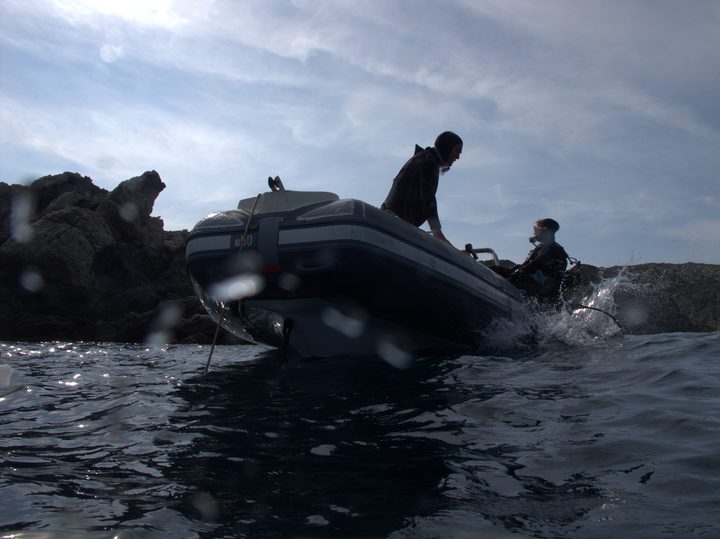
Out of Port de Mataro, ten to fifteen minutes south-east, the boat anchors at a midpoint of a long, narrow rocky ridge that sits at about 14m on top. The structure rises a couple of metres above sand and Posidonia, and the centre's lead picks a direction along the ridge, typically away from the boat into the more sheltered north-east third where the cornisa (a ledge zone) concentrates resident fauna under a single overhang. Divers move slowly along the rock. Octopus tucked into pockets, moray heads at the lip of crevices, conger sharing space with cleaner shrimps, lobster antennae poking from holes: the cornisa repays time more than distance.
After twenty-five or thirty minutes the group reverses on the shallower side at 12-14m and works back toward the anchor. The trencada in the name reads literally as "broken," and the rock is fractured enough that scorpionfish camouflage in cracks and small life lives in shadow. Recent dives have surfaced detail not common on neighbouring barras: three small dusky groupers in one dive, a gilthead bream circling a school of sargos, and several brown meagre (Sciaena umbra, locally corvinas) hiding under rocks. Standard Mediterranean schooling fills the water column above the ridge: castanyoles, cabrilla, merlo, and sargos.
What sets the dive apart in operational terms is bottom time. At 14-15m the no-deco envelope is generous on air, and a single 12L cylinder regularly stretches past sixty minutes. A sixty-seven-minute owner dive sits in the recent log, which is the kind of duration the deeper Mataro barras simply cannot match.
La Trencada is the shallowest of the named Mataro ridges. That shallow profile is the dive's single most operational fact: long bottom times mean photographers can work specific subjects carefully, refresher dives recover into the rhythm of Mediterranean diving without depth pressure, and centres pair the site as the canonical second dive after a deeper Row 4-5 barra such as El Negre. The fauna mix punches above its depth: corvinas under rocks are a recurring observation here that owner notes specifically flag as not typical of the other ridges in the rotation, and small groupers, large octopus, and stingray sightings during breeding season all show up in the local record.
Macro work has a decade-spanning track record on this ridge. Older photo threads from the Catalan diving community document flatworm portraits (Prostheceraeus roseus and Planocera), serrano studies, and detailed nudibranch work, with a 2014 thread specifically posting first-results from a 60mm macro setup acquired for this kind of dive. A local lifestyle magazine has framed La Trencada among the top Mataro dives, and the site is described in centre and review writing as the macro option in the rotation. The shallow profile is what makes the photography work — long bottom times let a photographer compose carefully. After rough seas the nudibranchs disperse and the column suspends; calm windows reward the wait.
Bring a torch. The porous rock cracks reveal scorpionfish, small crustaceans, and resting fauna only when illuminated, and much of what makes the site rewarding sits in shadow. Anchor at a midpoint of the ridge and pick a direction by current at the time of the dive; sporadic light current is possible even though the site is not on the area's current-exposed list. The northeast cornisa at about 13m is the productive zone for morays, conger, lobster and octopus sharing a single ledge habitat. Spanish recreational regulation requires SMB, cutting device and a valid certification, and at this site the SMB is particularly relevant because Mataro is an active recreational port with surface boat traffic on free ascents. Weather sensitivity is real: after rough seas the nudibranchs disperse and visibility drops, so pick a calmer window if subjects matter.
What makes this dive site stand out.
Top about 12-14m, max 15-17m, well inside Open Water depth limits and the no-deco envelope
Gas is the limit at this depth, not no-deco time; 60+ minute dives are routine
Cracks and crevices conceal scorpionfish, small crustaceans and resting fauna
Adjacent seagrass extends the habitat mosaic and feeds in occasional sand-edge species
41.5350°N, 2.4900°E
Warmer water and best-odds visibility. Site sits at or just above the summer thermocline, so less of the deep-cold drop seen at 25m+ neighbours.
Area-typical 38-50 EUR per boat dive with own tank. Site-specific pricing not published. Verify current rates with the operating centre.
Maximum depth sits well within the 18m OW limit. Suitable for new divers, refresher dives, and as a relaxed second dive.
Summary
Shallow profile, mild current, well-defined ridge. Standard Mediterranean barra navigation along the anchor line.
Safety considerations
What can go wrong here, and what divers do about it. Conditions change - take the briefing from the operator on the day.
Book a guided dive at this site.
CMAS dive centre in Mataró port with 40+ years of trading, running 600+ boat outings a year on the Maresme rocky ridges, 30 minutes by train from Barcelona.

Port-based SSI club in Mataró, 30 km from Barcelona, running year-round boat dives on the Maresme barras with adaptive and technical training.
Get in touch to add or claim your dive center listing on DiveCodex.
Dive centres in Catalonia must require insurance from every diver on their dives, and must be able to offer a policy to anyone who has none.
No. La Trencada is a shallow Mataro-coast barra at about 14m, dived from Port de Mataro. El Trencat is a Port Balis structure at 22-24m run by a different centre. The names look similar in writing and online sources occasionally conflate them, but they are different sites.
Yes. Maximum depth sits about 15-17m, well inside the 18m OW limit. The shallow profile makes this a routine OW outing and a common refresher-dive pick. Long bottom times are possible because gas, not no-deco time, is the limiting factor.
Scorpionfish in the porous rock cracks, Mediterranean moray, conger eel, octopus, spiny lobster, and standard Med schooling above the ridge. Recent dives have logged corvinas hiding under rocks (notable, not typical on other Maresme barras), small dusky groupers, and a gilthead bream circling a school of sargos. Macro photography is reliable across seasons.
The shallow profile keeps no-deco time generous and gives surface-interval recovery after a deeper Mataro barra such as El Negre or Barreta de l'Arbre. Local diving magazines and centres specifically frame La Trencada as the canonical second-dive companion to a deeper first.
On a full 12L cylinder of air, fifty to sixty minutes is comfortable. Owner logs include a sixty-seven minute dive at this site. With Nitrox 32 the limit is gas rather than no-stop time, and divers prepared to monitor consumption can stretch dives accordingly.
Late spring through autumn for warmer water and best-odds visibility. Summer-calm days reach 18-20m visibility. The site is dived year-round in centre rotations; winter dives are entirely possible with drysuit or 7mm semi-dry, accepting colder bottoms and the area's weather sensitivity to Garbi (SW) wind.
Log your dives - notes, photos, conditions and the marine life you saw - and share them as one public diver profile. What you share helps the next diver, too.
Log every detail
Depth, duration, conditions, gear, buddy, notes — all in one place. Import from Suunto and other dive computers.
Track marine life
Record species sightings on each dive. Build a personal catalogue of everything you've seen underwater.
Your public dive profile
Share your dive history, stats, and experiences with a profile page you control. Show the world where you've been.