
Calypso Diving Estartit
Family-run PADI centre in L'Estartit, run by Peter and Jacqueline Lane for nearly 40 years, with PADI Green Star and four other environmental credentials.
PADI5 services8 languages
Also known as: Cova de la Vaca, Cow Cave, la Vaca
Wide 30 m through-tunnel under Meda Gran with three lit entrances, a habituated resident grouper, and a gorgonian wall on the north exit.
Last updated October 2026
Three openings in the rock face at the south flank of Meda Gran, all converging into a single passage that cuts through the island. The resident grouper is usually waiting somewhere near the entrance, a metre-long fish that ignores divers more than it reacts to them. The tunnel runs 30 metres north, around 5 metres wide, broken inside by rock pillars and short partial walls. Light enters from the three south entrances and from openings above, so the passage never goes dark. Swim toward the blue rectangle of the north exit at 22 metres, where the tunnel opens onto a vertical wall thick with red gorgonian fans. Schools of brown meagre and gilt-head bream hold station along the wall edge. Below, the rock-block platform keeps dropping, deeper than the park's guidance for recreational dives; the guide sets how far the group goes along the wall. On the return to the boat, the Rincon de la Vaca at 13 metres has two small caves and a chimney. Unlike the lit tunnel, the caves are dark and narrower, and the Park says visiting them takes more experience; the guide decides whether the group goes in.
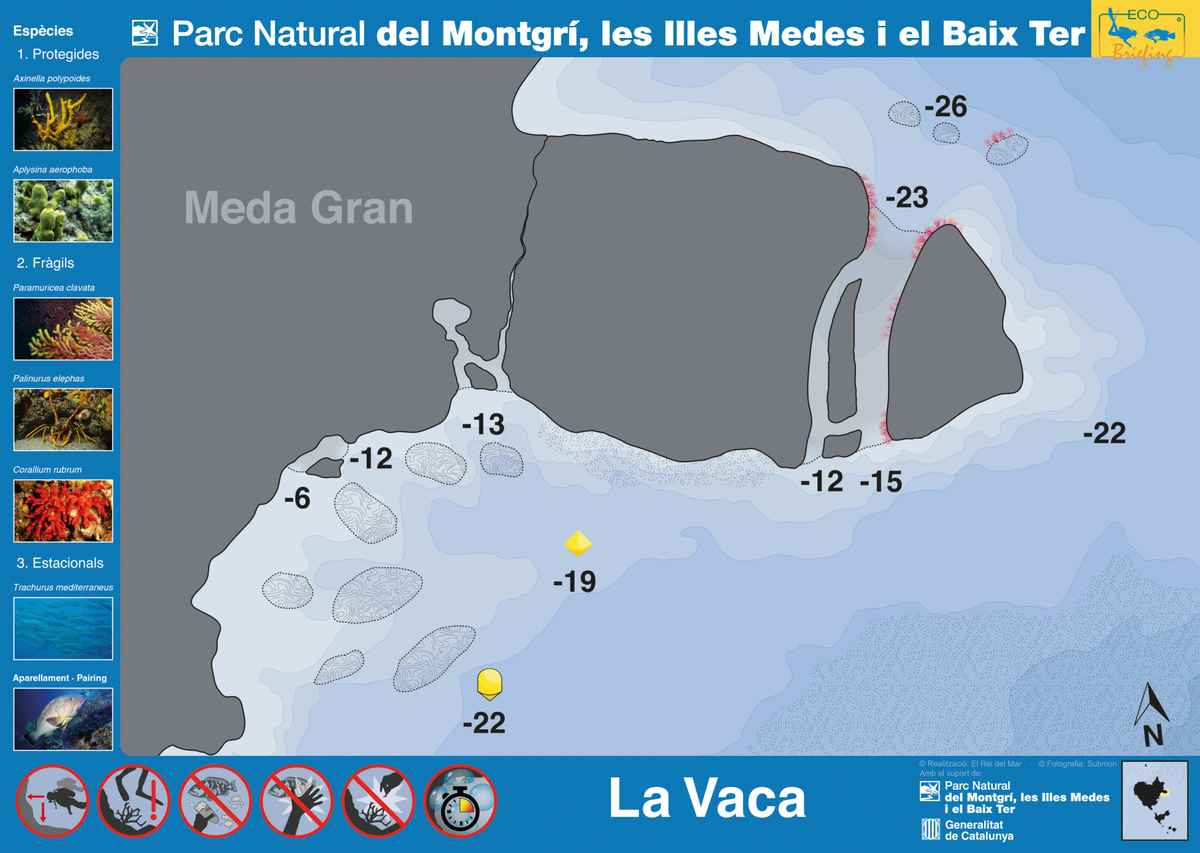
Illustration: Parc Natural del Montgrí, les Illes Medes i el Baix Ter — Generalitat de Catalunya
Natural light is the headline. The tunnel's three entrances and the geometry of the passage mean sunlight reaches every section, and the exit reads as a blue frame from inside. The signature shot of the Medes rotation, silhouette diver against the blue rectangle, is taken here. The transition compresses two dive characters into one profile: enclosed rock with red coral, sponges and bryozoans on the walls, then open water and a gorgonian-covered drop on the north side. The resident grouper sits somewhere on that boundary. Forum reports from regulars are honest about the fish: it has been around long enough to associate divers with attention rather than threat, which is striking on a first visit and a little ambiguous on later ones.
Buoyancy control matters inside the tunnel. Sediment on the floor rises fast if a fin clips it, and the encrusting life on the walls and ceiling is fragile. Hover, do not settle. On the north wall, depth creeps up without warning because the gorgonians draw the eye downward. The guide sets the depth for the group and the dive follows that plan. Visibility varies more than centre marketing suggests. Calm summer produces 15-25 metres; after storms or Ter-river runoff it can drop below 5 metres, and the 2004 forum trip reports include both extremes from the same diver. The boat run from L'Estartit is short but exposed to ground swell outside the summer flat-calm windows.
What makes this dive site stand out.
30 m passage with three entrances; sunlight reaches every section so the exit is visible from inside
Silhouette frames against the blue exit are the signature shot of the Medes rotation
A large dusky grouper hovers near the south entrance; decades of guided diving have shaped behaviour
Tunnel at 12-22 m; the north wall beyond the exit goes deeper, and the guide sets the depth on the day
Two small caves plus a chimney at 13 m near the boat; darker and narrower than the tunnel, and the guide decides whether to go in
42.0474°N, 3.2264°E
September is the local sweet spot, warm water retained, fewer crowds than August.
Open Water is the level the tunnel itself asks for: wide (~5 m), naturally lit, exit visible throughout. The reserve's own entry requirement is shown in the regulations module. The north wall is deeper than the park's guidance for recreational dives, and what the group does there is the centre's call on the day.
Summary
Easy through the tunnel. The north wall is deeper and more demanding, and the guide sets the plan on the day.
Safety considerations
What can go wrong here, and what divers do about it. Conditions change - take the briefing from the operator on the day.
Book a guided dive at this site.
Family-run PADI centre in L'Estartit, run by Peter and Jacqueline Lane for nearly 40 years, with PADI Green Star and four other environmental credentials.

PADI 5 Star centre on L'Estartit seafront with stay-and-dive packages, four daily boat dives between Illes Medes and Montgrí, plus tec diving.

Family-run PADI 5 Star Resort and SSI centre in L'Estartit since 1990, with two 30-diver boats running hydraulic lifts to the Illes Medes reserve.

Long-running L'Estartit dive centre (founded 1969) running a four-boat fleet to the Illes Medes reserve and Montgrí coast, with SSI training and a strong family/snorkel programme.

Family-run hotel and dive centre in L'Estartit since 1985, with two dedicated boats and four daily departures to the Illes Medes reserve.

Owner-led PADI centre on Carrer Salines in L'Estartit, capping each guide at 5-6 divers across the Illes Medes, Montgrí, and Cap de Begur.

L'Estartit's oldest dive centre (est. 1965), a PADI 5 Star CDC running daily boat trips to Illes Medes and the Montgrí Coast with volume dive packages.
Get in touch to add or claim your dive center listing on DiveCodex.
Dive centres in Catalonia must require insurance from every diver on their dives, and must be able to offer a policy to anyone who has none.
It is a cavern, not a cave: the tunnel is roughly 5 metres wide, naturally lit from three entrances, and the exit is visible from the moment you enter. Open Water is the level the tunnel itself asks for; the reserve's own entry requirement is shown in the regulations module. The deeper north wall beyond the exit is a separate, harder dive, and the guide decides what the group does.
The main passage is around 30 metres long and runs south to north through Meda Gran. Sunlight reaches the entire passage, so navigation does not depend on a torch. The guide confirms what to carry.
A large dusky grouper (Epinephelus marginatus) typically hovers near the south tunnel entrance. The fish has become habituated to divers after decades of guided dives in the reserve, and it tends to approach rather than retreat.
The tunnel itself works between 12 and 22 metres: south entrance at about 12, north exit at about 22. Outside the exit the wall keeps going down. One operator puts the seabed on that side near 45 metres, while the Park's own sheet prints soundings of 12 and 15 metres at the south mouths and 22, 23 and 26 metres off the north exit, nothing deeper than 26. The wall beyond the exit is deeper than the park's guidance for recreational dives, so how far the group goes is the centre's call on the day.
Two small caves and a chimney at around 13 metres on the way back to the boat. Unlike the lit tunnel, the caves are dark and narrower, and the Park says visiting them takes more experience. Whether the group goes in is the guide's decision.
Both are through-tunnels, but the character differs. La Vaca is a single wide, straight passage with strong natural backlight ideal for silhouette photography. The Dofi system is a branching complex with two tunnel options, ceiling light shafts and an air chamber, and is generally a step up in complexity.
La Vaca sits inside a regulated marine reserve, and most visitors dive it with a local centre, which arranges the day. In summer the slots fill, so book a few days ahead and ask the centre which time and boat suit the tunnel and the north wall.
Log your dives - notes, photos, conditions and the marine life you saw - and share them as one public diver profile. What you share helps the next diver, too.
Log every detail
Depth, duration, conditions, gear, buddy, notes — all in one place. Import from Suunto and other dive computers.
Track marine life
Record species sightings on each dive. Build a personal catalogue of everything you've seen underwater.
Your public dive profile
Share your dive history, stats, and experiences with a profile page you control. Show the world where you've been.