
Sea & Sun Diving Center
Family-scale CMAS and SSI center in La Isleta del Moro, operating for 30+ years inside the Cabo de Gata-Nijar Natural Park.
CMAS / SSI1 language
Also known as: Cala de las Hermanicas, Cala Hermanicas
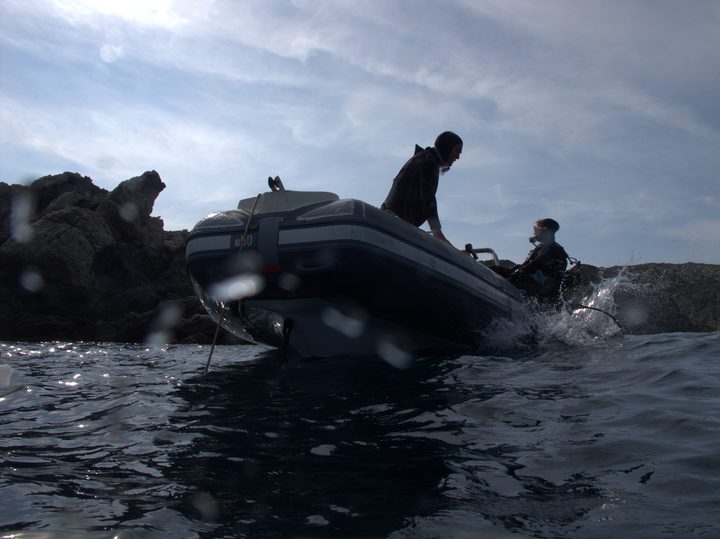
Sheltered shallow shelf below Monte del Fraile in Cabo de Gata, run as a 5-12m cove dive when easterly wind shuts the exposed sites.
Last updated May 2026
A volcanic shelf runs along the cliff base below Monte del Fraile in two clean steps, an upper platform at five metres and a lower one at twelve, with canyons cut perpendicular between them. The boat anchors on the upper step. Drop down the slope to the lower platform and the topography reads at once: short canyons slicing the shelf, overhangs on the cliff side, sand and Posidonia patches running off into open water. Dusky groupers hold the canyon mouths. Moray eels watch from the crevices, forkbeards (brótola locally) shelter under the overhangs, and red scorpionfish blend into the ledges so completely that a guide's eye helps. The bottom-time portion stays on the lower step, working canyons and peering into cracks for small fish, then climbs the slope to finish along the upper shelf with saddled seabream and salema drifting overhead. At this depth, sixty minutes is comfortable on a standard tank.
The site earns its slot in the Cabo de Gata rotation by being calm when the headline sites are not. The cliff blocks the easterly wind that regularly closes the eastern-exposed reefs, so centres lean on this cove as the reliable fallback day. The diving reason is denser than the wind story. The two-step shelf compresses the park's three core habitats — volcanic rock, sand, and Posidonia oceanica — into a small footprint, which is why one independent guide describes it as a general overview of the park's seabed types. The canyon mouths read as a beginner-friendly version of what the deeper Cabo de Gata sites do at larger scale, and the resident groupers under the overhangs deliver the headline encounter on Open Water depth. A visiting diver running a four-site rotation from La Isleta del Moro in October 2023 named Las Hermanicas his standout — a one-line favourite call from someone who had already dived the deeper stars on the same trip.
Pair it with something deeper from La Isleta del Moro and let the shallow profile stretch the bottom time and off-gassing while still delivering encounters. The boat is the practical entry: the land approach to Cala Hermanicas is rough and only confirmed for snorkelling and swimming, so for full scuba kit take the boat. Centres handle the reserve permit administratively for booked clients. Independent shore divers need the separate infantería permit from the Junta de Andalucía (3 months validity, 1-4 weeks online via Cl@ve, next-day in person at the Rodalquilar park office), and night diving is not allowed under that permit. Carry standard safety kit — computer, surface signal, torch for the canyon-wall cracks. Trim and buoyancy keep you clear of resting scorpionfish on the ledges, and the no-contact rule applies to the Posidonia margins and the rocky shelf alike.
What makes this dive site stand out.
Cliff orientation blocks easterly wind, so centres run this when exposed sites close
Two-tier rock platform at 5m and 12m cut by canyons and overhangs along the cliff base
Whole dive sits inside OW limits with full no-deco bottom time and large air margins
Volcanic rock, sand patches, and Posidonia in a small footprint along one wall
36.7950°N, 1.9780°W
May-June and September-October are the standout months for warm water with thinner crowds. Diveable year-round when levante is up.
Maximum 12m sits well inside Open Water limits. Centres also run discover-scuba sessions here with an instructor.
Summary
Sheltered cove, shallow profile, straightforward navigation along the shelf. Site-specific current data is unavailable; assume the operator's call on the day.
Safety considerations
What can go wrong here, and what divers do about it. Conditions change - take the briefing from the operator on the day.
Book a guided dive at this site.
Family-scale CMAS and SSI center in La Isleta del Moro, operating for 30+ years inside the Cabo de Gata-Nijar Natural Park.
Get in touch to add or claim your dive center listing on DiveCodex.
Parque Natural de Cabo de Gata-Níjar
Centres handle the Junta de Andalucía permit invisibly for booked clients. Independent shore divers need the separate infantería permit (3 months validity, 1-4 weeks online via Cl@ve, next-day in person at the Rodalquilar park office).
The cove sits below Monte del Fraile, and the cliff orientation blocks levante, the easterly wind that regularly closes the exposed sites along the Cabo de Gata coast. When boats cannot work the headline reefs, this shelf still runs. Centres schedule it to keep dive days going rather than cancelling.
Yes. The maximum depth sits at 12m and the profile stays inside Open Water no-deco limits with comfortable air margins. Centres pair it with discover-scuba sessions, drysuit refreshers, and check-out dives for visiting divers before deeper days.
Resident dusky groupers hold position in the canyon mouths along the lower step. Moray eels watch from the crevices, scorpionfish blend into the rock, and forkbeards shelter in the deeper overhangs. Schools of salema, saddled seabream, and grey mullet drift above the upper shelf, and the Posidonia fringe carries octopus, wrasse, and the area's wider invertebrate cast.
A coastal track from Los Escullos descends into Cala Hermanicas via a roughly 500m walk near a two-storey ruin, but the land approach is described as rough, and primary sources only confirm snorkelling and swimming use from shore. For full scuba, take the boat from La Isleta del Moro. If you do walk in, bring aqua shoes for the rocky entry and a personal infantería permit from the Junta de Andalucía.
At 5-12m the air stretches comfortably past 50 minutes on a standard tank. Centres run dives toward the hour mark, which is one reason they pair Las Hermanicas with a deeper morning site.
It earns its place beyond the wind-fallback role. The shelf compresses three habitats — rock, sand, and Posidonia — into a small footprint, the canyon mouths reliably hold groupers, and one diver running a four-site Cabo de Gata rotation in October 2023 picked it as their personal favourite. As a slow, photo-friendly second dive, it works on any day.
Log your dives - notes, photos, conditions and the marine life you saw - and share them as one public diver profile. What you share helps the next diver, too.
Log every detail
Depth, duration, conditions, gear, buddy, notes — all in one place. Import from Suunto and other dive computers.
Track marine life
Record species sightings on each dive. Build a personal catalogue of everything you've seen underwater.
Your public dive profile
Share your dive history, stats, and experiences with a profile page you control. Show the world where you've been.