

Buceo Aqualia
Training-led dive centre in La Herradura with SSI courses, UTD technical programmes and daily guided dives from Marina del Este, by shore or boat.
SSI5 services2 languages
Also known as: Eastern Marina
Sheltered La Herradura bay with shore-accessible reef sub-sites, signature Mola mola encounters at depth, and dense nudibranch fauna on the Costa Tropical.
Last updated May 2026
Cars unload at the marina car park, divers walk over boulders to the waterline, and the bay opens up underwater within a minute of the surface. The geometry is the simplest part of the site: reef on the left flank, reef on the right, a sandy floor between them where octopus and torpedo rays settle and the route runs straight out from the beach. Most divers pick a side. Berengueles drops over boulders to a 12m reef threaded with cracks, swim-throughs and overhangs, and a guide will point out castanuelas, sargos and small groupers along the rock. Pared del Puerto runs along the harbour breakwater, angling down the rock outcrop to about 17m. The shallow profile suits OW certification limits and is what most try-dives and AOW students see.
For the boat profile, the depth is the difference. Mola Mola Point sits at 18-26m on a wall fringed with cathedral sponges, sea pens and Dendrophyllia ramea coral gardens reaching about a metre tall in branching colonies. Vapor-Escollera, on the same itinerary, is a sheltered rock wall on a much gentler profile, with seahorses reported by one centre and red coral on the same descent. Las Hondonadas drops past 40m into gullies that hold rare soft corals at depth. Thermoclines are real here in summer, cutting visibility and temperature suddenly mid-dive, and divers describe them as the variable that decides the day rather than a site flaw.
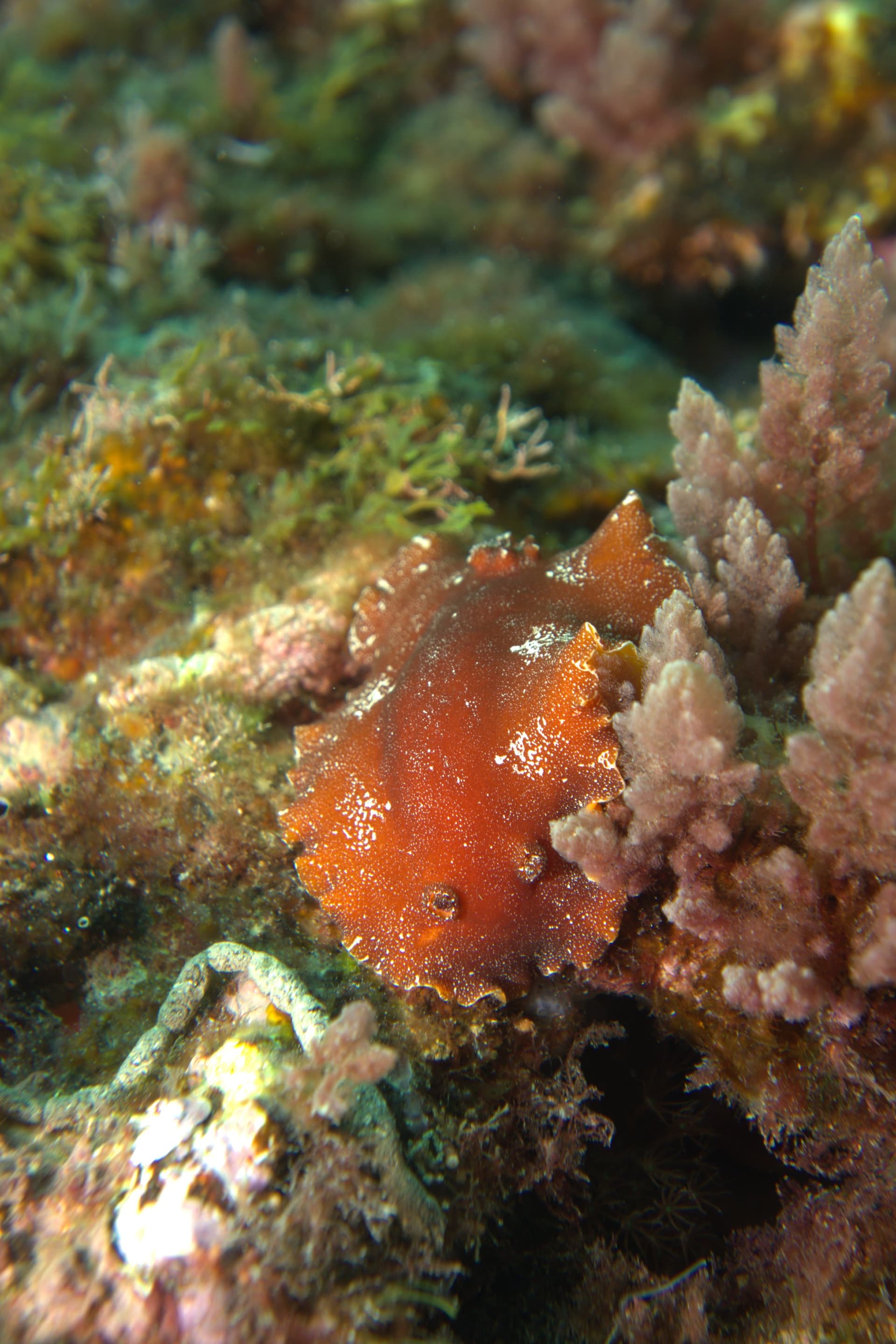
The macro density is what local centres trade on. Forty opisthobranch species across one bay is a count few Mediterranean sites match, and the sheltered conditions plus stable sponge cover let Felimare picta, Flabellina affinis, Chromodoris krohni and Thuridilla hopei sit at depths where natural light still reaches. Winter pushes the numbers higher when colder water concentrates breeding activity. The Dendrophyllia ramea garden adds a structural feature most La Herradura sites do not have at recreational depth: tree-form yellow coral colonies, branching to roughly a metre, holding their territory between the wall and the sand.
The other part of the case is operational. The same harbour where boats depart for the deep wall at Punta de la Mona is also the main shore-entry point for Marina del Este, and the bay stays clean and diveable when Poniente blows the western flank. When wind, certification or buddy mix rule out the cliff dives, this is the working alternative. The bay is not the dramatic dive in La Herradura. It is the one that runs.
The bay reads as a macro site first. Forty nudibranch species in one location is the number that brings local photographers back, and the boulder-and-crack terrain at Berengueles concentrates them in the 8-15m range where natural light still does the work. Sponge cover on the rock holds Peltodoris atromaculata and the Felimare and Flabellina species across the year. Spirograph worms wave on the reef structures, and octopus, cuttlefish and small groupers fill the wide-angle gaps when the macro brief is satisfied. One useful diver story from 2011: a photographer arrived at Mola Mola Point with the camera set up for macros and a Mola mola appeared at close range, leaving him without a wide-angle option. On the boat itinerary, a backup wide-angle is worth the kit space. Early-morning trips are described by Black Frog Divers as offering the best contrast for colour work in the bay.
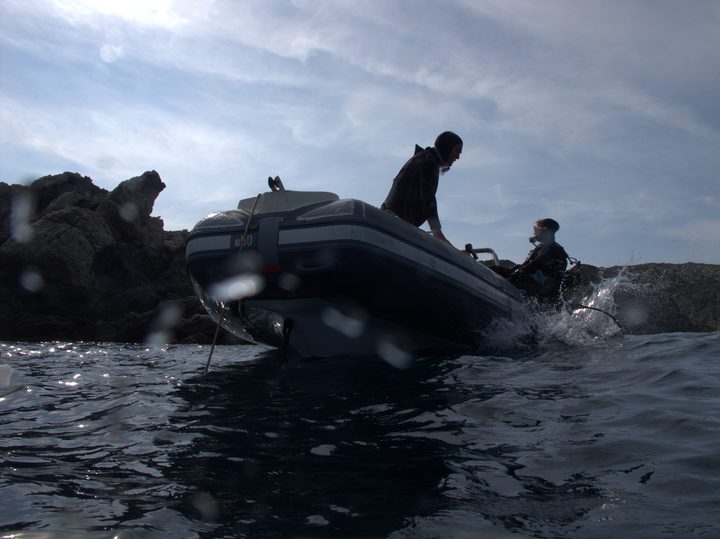
Booties are essential for the shore entry. The marina beach is rocky and there is no easier line to the waterline. Levante is the specific condition to avoid: it warms the surface but stirs the bay floor and visibility can drop from 25m to a few metres within a single afternoon. Poniente is the wind to book for. The bay carries regular boat traffic from Puerto Deportivo, so an SMB on every ascent is non-negotiable, and surface near shore or at designated points rather than the open channel. The bay sits inside the Paraje Natural Acantilados de Maro-Cerro Gordo and was declared a Natural Reserve under MAPA in January 2025; recreational divers cannot book the dive directly and need to go through a registered local centre, who handle the authorisation as part of the trip price. For the deeper boat sub-sites, Nitrox extends the useful bottom time at 18-26m and is worth requesting in advance.
What makes this dive site stand out.
Centres document 40+ opisthobranchs across the bay's rocky substrate
Boat sub-site at 18-26m where sunfish are reported in spring and summer
Walk in from the marina or board boats for the deeper sub-sites
Yellow tree coral colonies described as reaching about 1m height
Protected from Poniente, the working alternative when cliff sites close
36.7227°N, 3.7286°W
Peak July to September for warmest water. Winter rewards macro divers when nudibranch numbers rise.
Verify current rates with the dive centre
Berengueles and Vapor-Escollera at 12m suit OW divers. Mola Mola Point at 26m and Las Hondonadas past 40m need AOW.
Summary
Easy in the bay sub-sites. Moderate to advanced at Mola Mola Point and Las Hondonadas where depth becomes the limiting factor.
Safety considerations
What can go wrong here, and what divers do about it. Conditions change - take the briefing from the operator on the day.
Book a guided dive at this site.
Training-led dive centre in La Herradura with SSI courses, UTD technical programmes and daily guided dives from Marina del Este, by shore or boat.

PADI 5 Star IDC center in Marina del Este with 20+ years of experience, 6 instructors, and boat dives across 16 sites in La Herradura bay.

PADI 5 Star beachfront center in La Herradura with an in-house workshop, marine biology programs, and 16 sites from beginner coves to 40m walls.

Boutique SSI center in La Herradura built around deliberate slow-pace diving, marine education, and low-impact access to the Maro-Cerro Gordo protected coast.
Get in touch to add or claim your dive center listing on DiveCodex.
Reserva Natural Marina del Este
The bay sits inside Paraje Natural Acantilados de Maro-Cerro Gordo, with EU ZEPA, ZEPIM and SAC layers. Recreational divers cannot obtain authorisation directly and must dive with a registered local centre, with the permit fee bundled into the trip.
Six are commonly run. Pared del Puerto follows the harbour breakwater to about 17m. Berengueles is a 12m reef with cracks and swim-throughs. Mola Mola Point (Piedra de en Medio) reaches 26m and is named for the seasonal sunfish reports. Vapor-Escollera is a sheltered rock wall at low difficulty. Las Hondonadas drops past 40m into gullies. Centres also run left- and right-side reef routes from the bay.
Local centres document over 40 opisthobranch species across the bay's rocky substrate, including Felimare picta, Flabellina affinis, Chromodoris krohni, Thuridilla hopei, Crimora papillata and Polycera quadrilineata. Sheltered conditions and varied sponge cover support the diversity. Winter dives concentrate the most species in the macro range.
Yes. Entry from the marina beach passes over rocks and boulders, so booties are essential. The bay's left- and right-side reef routes and the harbour wall are reachable from shore. Boat departures from the Puerto Deportivo open the deeper sub-sites including Mola Mola Point and Las Hondonadas.
Sunfish reports concentrate in spring and summer at the Mola Mola Point sub-site, sitting at about 18-26m. A 2011 community account describes a diver setting up for macros and meeting a sunfish at close range. Centre listings confirm sunfish as a recurring spring-summer feature, not a guaranteed encounter.
Poniente keeps the bay clean and is the preferred wind for Marina del Este. Levante warms the surface but stirs muddy sediment off the bay floor and visibility can drop from 25m to a few metres within hours. Conditions deteriorate quickly when the wind shifts. Local centres make the call on the morning of the dive.
Several sub-sites work for beginners and try-dive participants. Vapor-Escollera and Pared del Puerto run as low-difficulty profiles. Berengueles sits at 12m within OW limits. The sheltered geometry, light currents and shore access make it the most accessible site in the La Herradura area for newer divers.
Yes, indirectly. The bay sits inside the Paraje Natural Acantilados de Maro-Cerro Gordo and was declared a Natural Reserve under MAPA in January 2025. Recreational divers cannot obtain authorisation themselves and must dive with a registered local centre. The permit fee is bundled into the trip price.
Log your dives - notes, photos, conditions and the marine life you saw - and share them as one public diver profile. What you share helps the next diver, too.
Log every detail
Depth, duration, conditions, gear, buddy, notes — all in one place. Import from Suunto and other dive computers.
Track marine life
Record species sightings on each dive. Build a personal catalogue of everything you've seen underwater.
Your public dive profile
Share your dive history, stats, and experiences with a profile page you control. Show the world where you've been.