

Andreas Diving
Family-run SSI center on Menuda Beach in Tossa de Mar since 1998, with eco-guide philosophy, 17 dive sites, and authorized Cressi service.
SSI4 languages
Also known as: Roca de Na Bosca, Roca Na Bosca
Twin-rock boat dive in Tossa de Mar with a sand canyon between formations, seahorse sightings, and a large bream school at 8-21 m.
Last updated April 2026
Two rocks sit side by side a few minutes from Mar Menuda beach, one large, one small, with a sand-bottom canyon running between them. The standard route traces a figure-eight: descend to the base of the larger rock at around 16 m, follow its contour upward along walls lined with crevices, then cross the sand channel to loop around the smaller formation. Conger eels and moray eels peer from gaps in the rock. Lobsters tuck into the darker recesses. The sandy crossing between the two rocks demands careful finning to avoid kicking up sediment, but the route itself needs no compass work. Most divers surface after 40 to 50 minutes.
On the outermost face of the larger rock, a dense school of white seabream holds position. The fish hover in a calm mass over the rock surface. For photographers, this is the shot. The school stays put, which gives time to compose rather than chase. Na Bosca is also one of the documented seahorse sites in Tossa de Mar. Local dive guides have filmed specimens here and singled them out as standouts for the area. Between the seahorses, the bream school, and the variety of invertebrates in the canyon, this site packs a lot of subject matter into a shallow, relaxed profile.
Na Bosca is a boat dive. The ride from Mar Menuda is short, but there is no practical shore alternative. Several centres in Tossa de Mar run regular trips here. Pricing ranges from around 35 EUR to 54 EUR per guided dive depending on the operator and equipment included. Diving must be done through a licensed centre. Night dives have been run here, and the area's nocturnal life includes juvenile octopuses and lobsters, though not every centre offers this option regularly. Summer thermocline means the bottom at 21 m can be 16-20 C even when the surface feels warm. A 5 mm wetsuit handles most summer dives, but consider thicker neoprene for extended time at depth.
What makes this dive site stand out.
Two distinct rocks separated by a sand-bottom channel that structures the whole dive route.
Documented at the site since at least 2014, with specimens praised by local dive guides.
A large school of white seabream rests on the outermost rock, a draw for underwater photographers.
Simple figure-eight route around two rocks with no navigation complexity.
41.7240°N, 2.9280°E
Peak warmth and marine life activity. September-October sweet spot: warm water, improving visibility, fewer crowds. Winter offers best clarity and macro opportunities.
54 EUR at Oceanomads includes equipment, 12L air, weights, guide, and boat. Other centres typically 35 EUR per guided dive. Diving insurance not included (daily 7 EUR or annual 39 EUR).
Maximum depth of 21 m is within OW limits. No strong currents, no overhead environments.
Summary
Described as simple and suitable for all divers by multiple local centres. Very easy orientation. Only caution: careful finning when crossing the sand channel to avoid silting.
Safety considerations
What can go wrong here, and what divers do about it. Conditions change - take the briefing from the operator on the day.
Book a guided dive at this site.
Family-run SSI center on Menuda Beach in Tossa de Mar since 1998, with eco-guide philosophy, 17 dive sites, and authorized Cressi service.
Barcelona dive school and shop diving from Lloret de Mar, Costa Brava; SSI Diamond Instructor Training Center since 2006, plus Extended Range technical courses.
Family-run Costa Brava dive center at Cala Canyelles, Lloret de Mar, with its own boat reaching reefs and pinnacles from Blanes to Tossa de Mar.
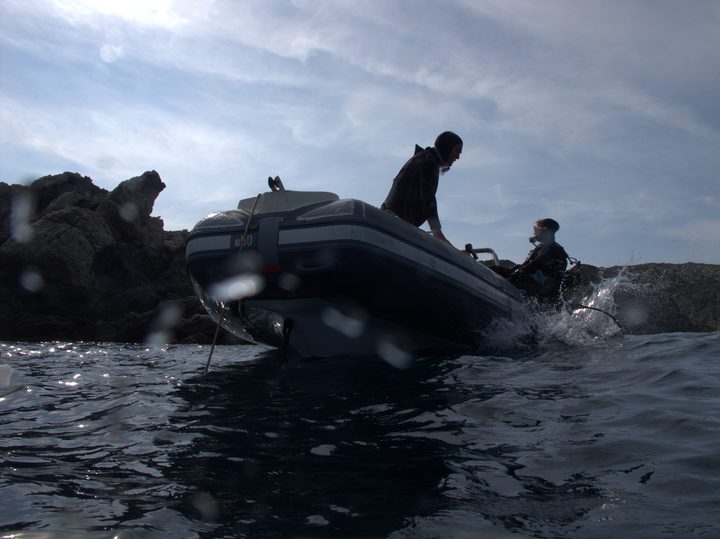
Get in touch to add or claim your dive center listing on DiveCodex.
Upcoming trips to this dive site published by local centres.
Availability is read from each centre's public calendar and refreshed daily. Last checked September 21. Confirm with the centre before travelling.
No reserve fee, no permits, no diver quotas. Tossa has PEIN and Natura 2000 ZEC environmental protection only. Costs are centre service fees.
Yes. The maximum depth is 21 m, well within Open Water certification limits. Multiple Tossa de Mar dive centres describe Na Bosca as simple and suitable for all divers. Orientation is straightforward, there are no currents to manage, and the figure-eight route around the two rocks keeps the dive plan clear.
The site's signature encounter is a large school of white seabream on the outer rock, often the first thing divers notice. In the crevices and along the rock walls, expect conger eels, moray eels, spiny lobsters, octopus, and various nudibranch species. Seahorses have been documented here, though sightings depend on patience and a sharp eye.
By boat from Mar Menuda beach in Tossa de Mar. The ride takes under 5 minutes. A shore approach exists through forest and a steep torrent, but local divers describe it as hazardous and all centres use the boat.
The bream school on the outer rock is the main draw for photographers. The fish rest calmly on the rock, which makes framing easier than chasing pelagics in open water. Macro shooters can look for nudibranchs and seahorses along the walls and in the sand channel.
Technically yes, but it is extremely difficult. The shore route requires descending through forest and a steep torrent. Local divers who attempted it years ago describe the approach as hazardous. All centres access Na Bosca by boat from Mar Menuda.
May through October for warmest water and most active marine life. September and October are the sweet spot with warm water, fewer crowds, and improving visibility. Winter is colder (13-15 C) but brings the best clarity and good macro opportunities with nudibranchs.
No. Tossa de Mar has environmental protection (PEIN and Natura 2000 ZEC) but is not a marine reserve. There are no permits, fees, or diver quotas. You pay only the dive centre's service fee.
Log your dives - notes, photos, conditions and the marine life you saw - and share them as one public diver profile. What you share helps the next diver, too.
Log every detail
Depth, duration, conditions, gear, buddy, notes — all in one place. Import from Suunto and other dive computers.
Track marine life
Record species sightings on each dive. Build a personal catalogue of everything you've seen underwater.
Your public dive profile
Share your dive history, stats, and experiences with a profile page you control. Show the world where you've been.