
Calypso Diving Estartit
Family-run PADI centre in L'Estartit, run by Peter and Jacqueline Lane for nearly 40 years, with PADI Green Star and four other environmental credentials.
PADI5 services8 languages
Also known as: El Negre del Falaguer, El Negre del Falguer, La Negre del Falaguer
Sheltered Costa del Montgrí dive named for the black cliff rock. Sand-and-rock slope to a wall and tunnel at 4-28 m, dense small life, tramuntana-proof.
Last updated May 2026
Sand at eight metres under the mooring opens onto a slope that walks down through the dense band of life between 8 and 18 m, where most of the dive happens. The cliff wall on one side carries the rich plant cover that gives the site its character; submerged rocky ridges (barras) and scattered blocks fan out to the south-east. Past 20 m, the bottom flattens onto a reef shelf and the coralligenous formations begin, reaching 25–28 m where red gorgonians and sponges hold court. A cliff tunnel sits along the route as an AOW-level option for divers who want it.
A spiny lobster on the very first rock is a common opening at this site. Past that, white seabream school against the wall, octopus appear in crevices, and a guide with a torch will pick out scorpionfish 3–4 cm long in colours that look painted on. Most centres run a 40–50 minute dive on a 12–18 m profile and finish shallow on the slope where the small-life density is highest.
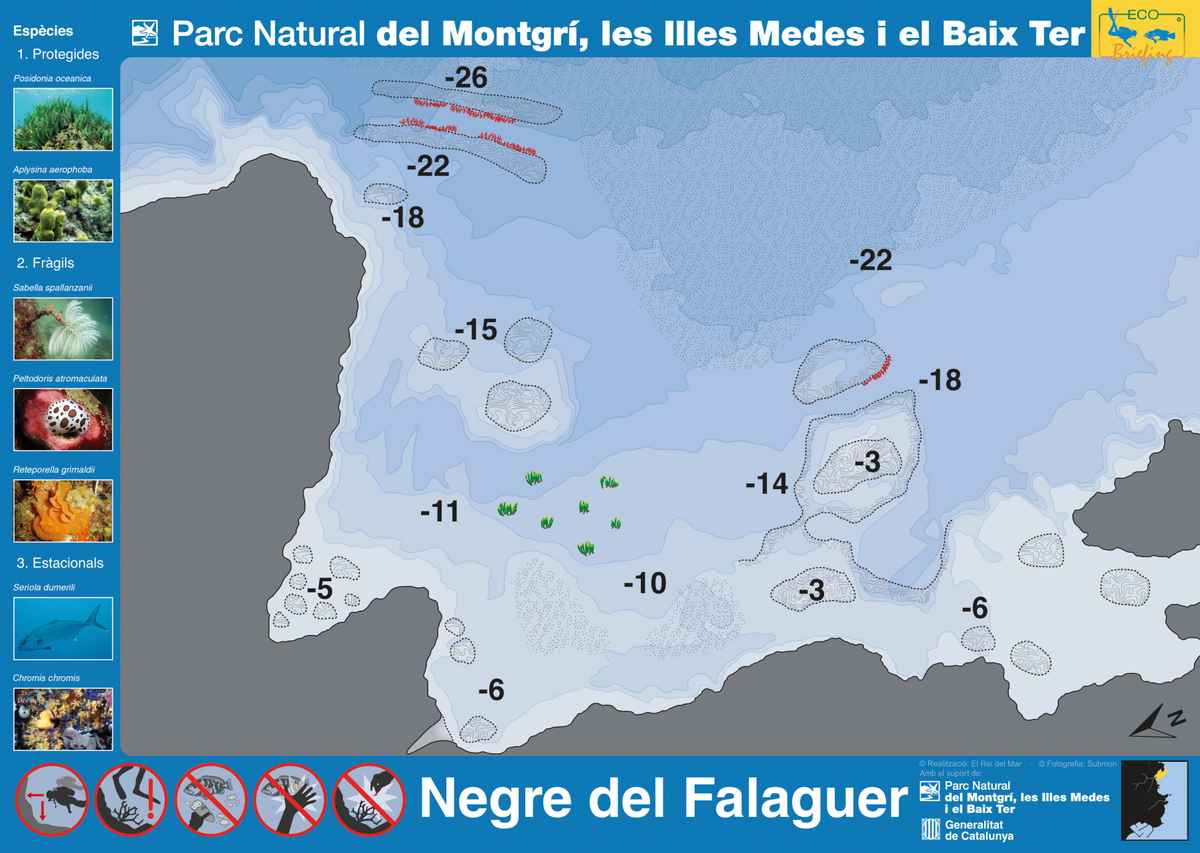
Illustration: Parc Natural del Montgrí, les Illes Medes i el Baix Ter — Generalitat de Catalunya
Three things, in combination. The cliff blocks tramuntana, so the site holds when the Medes archipelago closes — boats from L'Estartit fill it on weather days. The terrain stacks three difficulty layers from one mooring: baptism depth on the shallow sand, OW dive on the slope and wall, AOW shelf and tunnel below. And local centres consistently call this the densest site on the Costa del Montgrí coast for visible life — a claim borne out by trip reports that catalogue lobster, multiple octopuses, large schools of seabream, and a guide pulling shrimp off anemone branches by the dozen on a single dive.
For a macro photographer, this is the destination dive on this coast. The richness sits within reach of the rock face, the wall has the shaded niches macro subjects favour, and the local guides know exactly where to point.
Bring a torch and a macro lens with a diopter if you have one — the small life is the headline, not a side benefit. A dive computer is compulsory under Spanish recreational-diving law, and dive insurance is required (centres sell day cover). The site sits inside the Natural Park but outside the strict Medes Reserva, so there is no permit, no diver quota, and no per-dive park tax. Anchoring on Posidonia is prohibited; centres use mooring buoys only.
When tramuntana is blowing, ask your centre specifically about Negre del Falaguer. It is the coast's most reliable substitute when the Medes islands trip is off the table, and the site rewards a slow finning rate more than an ambitious depth profile.
What makes this dive site stand out.
Cliff orientation blocks the dominant north wind that closes the Medes archipelago
Local centres describe this as the densest site in the Montgrí zone
Baptism depth, OW slope, AOW coralligenous shelf and tunnel — all at the same buoy
Anemone shrimp, juvenile scorpionfish, nudibranchs along the dense rock-wall life
Inside the Natural Park but no diver quota, no per-dive park tax, no permit required
42.0666°N, 3.2108°E
Warmest water and best visibility in summer; spring and autumn are quieter. The cliff makes the site go-to whenever the islands are weather-cancelled.
Costa del Montgrí coast dive rates apply, lower than the Medes archipelago dives. Verify current pricing with your dive centre.
Open Water sufficient for the slope and shallow wall (4–18 m). Trial dives possible in the 4–8 m zone. The cliff tunnel and 25–28 m coralligenous shelf are AOW territory.
Summary
Shallow slope is easy and easy to navigate. Deeper wall, coralligenous shelf, and cliff tunnel raise the difficulty for those who want them.
Safety considerations
What can go wrong here, and what divers do about it. Conditions change - take the briefing from the operator on the day.
Book a guided dive at this site.
Family-run PADI centre in L'Estartit, run by Peter and Jacqueline Lane for nearly 40 years, with PADI Green Star and four other environmental credentials.

PADI 5 Star centre on L'Estartit seafront with stay-and-dive packages, four daily boat dives between Illes Medes and Montgrí, plus tec diving.

L'Estartit's oldest dive centre (est. 1965), a PADI 5 Star CDC running daily boat trips to Illes Medes and the Montgrí Coast with volume dive packages.
Get in touch to add or claim your dive center listing on DiveCodex.
Dive centres in Catalonia must require insurance from every diver on their dives, and must be able to offer a policy to anyone who has none.
No. The site sits on the Costa del Montgrí coast, inside the Natural Park but outside the strict Medes Reserva Natural Parcial. There is no diver quota and no per-dive park tax. The €5.30 Medes-specific tax applies only to dives entering the Medes archipelago. Spanish law still requires diving insurance and a dive computer.
The cliff above the dive blocks the dominant north wind, so the boats from L'Estartit can drop divers into flat water here when island trips are cancelled. The site also stays sheltered when the summer-evening garbí (south-west) picks up. It is the Costa del Montgrí's go-to weather alternative.
Yes. The slope from the mooring stays in the 4–18 m band, with most of the dense life concentrated against the rock wall in 8–18 m. Trial dives also run on the shallow 4–8 m sand-and-rock zone. The coralligenous shelf at 25–28 m and the cliff tunnel are AOW-level options if you have the certification and gas plan.
Spiny lobsters in the rock crevices, octopus along the wall, morays, schools of white seabream against the rock, scorpionfish (including 3–4 cm juveniles in vivid orange and yellow), nudibranchs, and macro shrimp on anemone branches that local guides will point out. Big pelagics are not the draw here — guides often brief that point in advance.
Yes for both. The wall has shaded niches even mid-day, and the macro subjects sit deep in them. Local guides specifically recommend macro equipment with a diopter; the small life is the headline of this dive.
The park authority confirms a tunnel exists in the cliff and notes it is for more experienced divers. Exact dimensions, depth profile, and light cone are not published. Treat it as an AOW-level feature within the dive plan, not as a wide swim-through equivalent to the Medes archipelago tunnels.
Most L'Estartit centres include it on their Costa del Montgrí coast rotation: Unisub, Xaloc, Calypso, Aquàtica Illes Medes, Hotel & Diving Les Illes, El Rei del Mar, and Costa Brava Divers. From L'Escala, Grassi Sub also runs the coast. The site is roughly 10–15 minutes by boat from L'Estartit harbour.
Log your dives - notes, photos, conditions and the marine life you saw - and share them as one public diver profile. What you share helps the next diver, too.
Log every detail
Depth, duration, conditions, gear, buddy, notes — all in one place. Import from Suunto and other dive computers.
Track marine life
Record species sightings on each dive. Build a personal catalogue of everything you've seen underwater.
Your public dive profile
Share your dive history, stats, and experiences with a profile page you control. Show the world where you've been.