
Palamos Dive Center
SSI and PADI center inside Port Marina Palamós, twenty-plus years operating, with a published price list and a 4.8/237 Google rating under owner Jordi.
SSI / PADI3 services4 languages
Also known as: Cairo, El Cairo
Scattered fishing-boat remains at 32-34 m off La Llosa de Palamós, reached by a 120 compass bearing as the deep leg of a multilevel dive.
Last updated May 2026
Cairo begins on the Llosa anchorage in 6-10 m of water and runs as a single multilevel. AOW divers descend the Llosa face to roughly 25 m, then take a 120 bearing across flat sand at the seabed. The transit is short, a few minutes of compass work, before the wreck appears as a low dark spread of rib frames on the bottom at 32-34 m. There is no hull silhouette to swim past — the boat has broken down to its cuadernas and the negative space between them. Spiny lobsters fill the gaps under the frames, anthias hover in small schools above the highest part of the wreckage, and the rest is sand. The structure is small enough to circle inside one bottom-time window, around fifteen minutes on air or a little longer on EAN32. The ascent reverses the approach: navigate back to the Llosa anchorage along the sand line, then climb the shelf face into the cracks and channels at 10-25 m and use the shallow top at 3-7 m as the safety-stop zone. Total dive time runs 35-45 minutes as one tank.
Cairo is the second wreck in Palamós. Boreas is the headline tugboat with five penetrable rooms and the WWII backstory; Cairo is the quiet alternative for divers who have already logged Boreas and want something different from the same port. The character is opposite. No intact hull, no rooms, no dramatic descent onto a recognisable vessel. What you get instead is a low debris field of rib frames on sand, with lobsters working the crevices and the route in built around a compass bearing rather than a mooring drop directly above the structure. Centres do not push it as a destination of its own; there is no separate Cairo booking line and no community trip-report tradition around the site. That is part of why it works as an AOW deep extension. You earn it by navigating to it, you spend a short focused window on the structure, and the rest of the dive is the Llosa shelf above.
Cairo asks for a tighter plan than the Llosa shelf alone. Nitrox is worth taking when the centre offers it: at 32-34 m, EAN32 buys roughly 5-8 more minutes of bottom time and a lower nitrogen dose. Plan thermal protection for 14-19 °C at depth, not the surface, because the wreck sits below the May-October thermocline at 15-20 m. The compass bearing is not optional. The wreck is not visible from the Llosa mooring, and a 300 reciprocal brings you back to the shelf. Hover above the rib frames; poor buoyancy on sand silts the wreck for everyone behind you. Three centres run the extension explicitly: Gidive, H2O Diving Center, and Medusadive. They price it as part of the standard Llosa boat dive rather than a separate Cairo trip.
What makes this dive site stand out.
The cuadernas of an old fishing boat lie spread on flat sand at 32-34 m, no hull silhouette.
Spiny lobsters concentrate in the gaps under the rib frames, flagged by every centre that runs it.
Reached at 120 from the Llosa anchorage; the wreck is not visible from the mooring.
Centres pair it with the Llosa shelf for one-tank profiles, not a stand-alone dive.
41.8250°N, 3.1300°E
Warmest water and best visibility. Diveable year-round when conditions allow the Llosa run.
Single boat dive priced as part of the standard Llosa run, not a separate Cairo charge. Verify with the centre.
32-34 m sits beyond the Open Water 18 m limit. OW divers do the Llosa shelf and channels above; the wreck itself requires AOW.
Summary
Wreck depth gives a tight no-deco window. Compass bearing across sand is mandatory, and the sandy bottom silts up fast under poor buoyancy.
Safety considerations
What can go wrong here, and what divers do about it. Conditions change - take the briefing from the operator on the day.
Book a guided dive at this site.
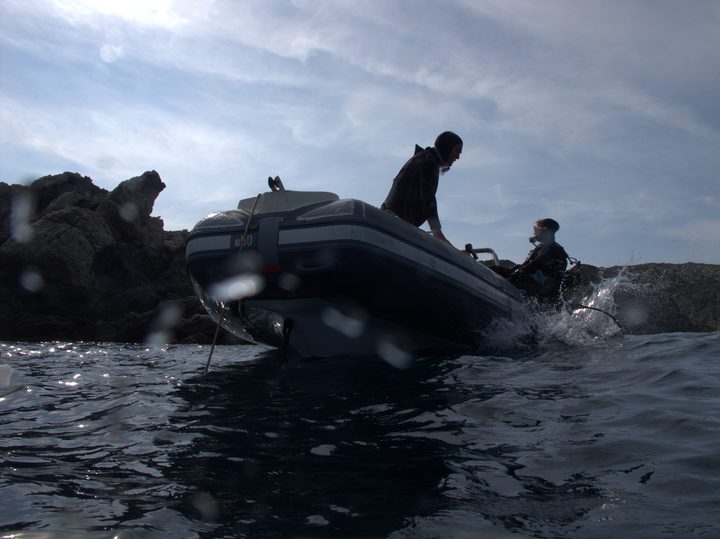
SSI and PADI center inside Port Marina Palamós, twenty-plus years operating, with a published price list and a 4.8/237 Google rating under owner Jordi.
Get in touch to add or claim your dive center listing on DiveCodex.
Boreas is an intact 40 m tugboat scuttled deliberately in 1989, with five penetrable rooms between 18 and 32 m. Cairo is a small fishing boat that has decayed to scattered rib frames on sand at 32-34 m, with no enclosed spaces and no penetration. Boreas is the headline wreck dive of the area; Cairo is a quieter add-on after you have already done it.
Centres run it as the deep leg of a Llosa de Palamós multilevel. From the Llosa anchorage at 6-10 m, descend the shelf face, then take a 120 compass bearing across sand to find the wreck at 32-34 m. The structure is not visible from the mooring, so the bearing is mandatory. Reciprocal 300 to return.
No. The wreck sits at 32-34 m, well beyond the 18 m Open Water limit, and centres do not waive that. OW divers can still join the boat and dive the Llosa shelf and channels at 6-25 m on the same run while AOW divers run the wreck extension.
Spiny lobsters in the crevices under the rib frames are the wreck's recognised draw — three centres flag them in their site descriptions. Small schools of anthias hover above the structure. Surrounding fauna belongs to the Llosa shelf above the wreck. Mola mola was filmed at the site in September 2014; treat that as a historical record, not a seasonal expectation.
It is not really run on its own. Every centre that covers Cairo treats it as the deep first leg of a Llosa multilevel, with the shallower shelf serving as the off-gassing ascent. Bottom time at 32-34 m is short on air — roughly 15-20 minutes — so the combined profile is the standard, and a single tank is enough for both.
Three Palamós centres run Cairo explicitly: Gidive, H2O Diving Center and Medusadive. Each treats it as the deep south-east leg of a Llosa de Palamós multilevel rather than a standalone dive. Other Palamós centres run the Llosa shelf without taking AOW divers down to the wreck.
Log your dives - notes, photos, conditions and the marine life you saw - and share them as one public diver profile. What you share helps the next diver, too.
Log every detail
Depth, duration, conditions, gear, buddy, notes — all in one place. Import from Suunto and other dive computers.
Track marine life
Record species sightings on each dive. Build a personal catalogue of everything you've seen underwater.
Your public dive profile
Share your dive history, stats, and experiences with a profile page you control. Show the world where you've been.