

Buceo Aqualia
Training-led dive centre in La Herradura with SSI courses, UTD technical programmes and daily guided dives from Marina del Este, by shore or boat.
SSI5 services2 languages
Also known as: Los Candelabros, Los Candeleros, Pecio Los Candelabros
Reef-and-seca dive east of Cantarrijan with a fishing boat's buried frames at 13m and a rock rising near the surface, in the Maro-Cerro Gordo park.
Last updated October 2026
The descent line reaches the cliff face at five to seven metres, depending on where the boat ties up. Keep the wall on your left and follow the line where rock meets white sand, on a heading of about 225 degrees. Orange coral colours the rock from the first minutes, scattered boulders form rooms along the way, and octopus and morays work the edge between rock and sand. At about 13 metres the remains of the fishing boat lie half-buried in the sand, wooden frames with a few railing posts standing clear. Past the wreck the route ends at the seca, a rocky seamount that rises from 15 metres almost to the surface. Amberjack and dentex hunt above it, and triggerfish are regularly seen. An anti-trawling artificial reef sits to the right of the seca and is described as a sunfish cleaning station. The route is about 150 metres each way. The usual plan turns the dive when a third of the air is gone and returns north along the wall in shallower water, which is where the safety stop falls.
One short line along the cliff gathers a buried boat, an orange-coral wall and a seamount, all within 15 metres. The boat gives the dive its name and its sense of history: only the frames and the railing posts remain, standing out of the white sand. The seca adds height to a dive that otherwise runs along the foot of the cliff, with hunting fish that give it movement in open water.
Between the two, the wall holds the dive's small life. Astroides calycularis covers the rock, several nudibranchs are reported on it, including the dotted sea slug and the violet sea slug, and the crevices hold morays and conger eels. A shallow route this short leaves time to look closely at all of it.
A large cave near the end of the route is reported to shelter a resident lobster, and an old fishing net is draped over the rocks beside it. Keep your distance from the netted rocks and carry a cutting tool. Torpedo rays lie partly buried on the sand along the route, so hover and keep your fins off the bottom. The cliff swim from Cantarrijan beach is over 600 metres and not recommended, and changing conditions can make the return dangerous, so this is a dive to reach by boat.
What makes this dive site stand out.
Frames and prow railing posts lie half-covered in sand at about 13m
A rocky seamount at the end of the route rises from 15m almost to the surface
Astroides calycularis covers the cliff along the route
The route follows the boundary for about 150m one way, wall on the left
36.7319°N, 3.7729°W
Warmest water of the year; the site is diveable year-round.
Three centres state Open Water for the route. One recommends Advanced, Nitrox and current diving on top, a recommendation and not a requirement. The 22m profile one centre lists is deeper than the 5-15m route the others describe.
Summary
Graded low difficulty by most centres that grade it; one grades it medium.
Safety considerations
What can go wrong here, and what divers do about it. Conditions change - take the briefing from the operator on the day.
Book a guided dive at this site.
Training-led dive centre in La Herradura with SSI courses, UTD technical programmes and daily guided dives from Marina del Este, by shore or boat.

PADI 5 Star beachfront center in La Herradura with an in-house workshop, marine biology programs, and 16 sites from beginner coves to 40m walls.
Boutique SSI center in La Herradura built around deliberate slow-pace diving, marine education, and low-impact access to the Maro-Cerro Gordo protected coast.
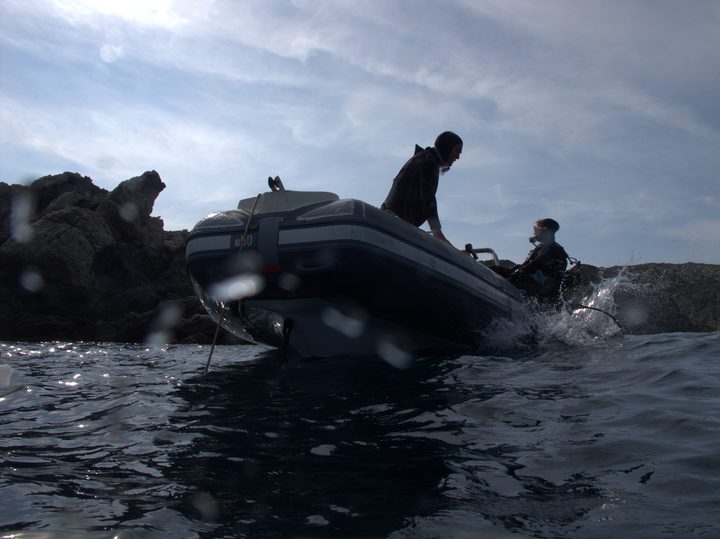
Get in touch to add or claim your dive center listing on DiveCodex.
Paraje Natural Acantilados de Maro-Cerro Gordo
Scuba diving in the Paraje is done from a support boat moored to the park buoys, for a maximum of 3 hours and only from sunrise to sunset. Authorisation covers at most 6 people per boat for private parties and 10 plus the skipper for active-tourism companies. Dives are arranged through a licensed centre or on an individual authorisation.
Listed maximums are 14m, 15m, 17-18m and 22m. The boat remains at about 13m and the seca at 15m sit inside the shallow route that three centres grade as Open Water. The 22m figure goes past the 18m an Open Water certification covers, and the centre that lists it also recommends Advanced, so treat that version as an Advanced dive.
Reports differ. One centre describes none to light current, and another classes the site as a current dive with a drift entry. Plan for a current: ask for the briefing at the boat and carry an SMB.
The remains are those of a sunk wooden fishing boat: its frames (cuadernas) and a few of the posts from the prow railing, called candeleros, stick out of the sand. The popular name Candelabros appears to come from confusion with candeleros, and the upright pieces do look like candelabras underwater.
Log your dives - notes, photos, conditions and the marine life you saw - and share them as one public diver profile. What you share helps the next diver, too.
Log every detail
Depth, duration, conditions, gear, buddy, notes — all in one place. Import from Suunto and other dive computers.
Track marine life
Record species sightings on each dive. Build a personal catalogue of everything you've seen underwater.
Your public dive profile
Share your dive history, stats, and experiences with a profile page you control. Show the world where you've been.