
Lanzarote Non Stop Divers
PADI 5-Star CDC in Playa Blanca with 5.0 rating across thousands of reviews, daily shore and boat dives at 30+ sites, and full IDC training pathway.
PADI6 languages
Also known as: Harbour Wrecks, Pecios de Puerto del Carmen, Port Carmen Wrecks, Puerto del Carmen (west), Puerto del Carmen Wrecks
A trail of small sunken vessels along the Puerto del Carmen harbour wall, dived from 12m to about 38m, with angel sharks on the sand between hulls.
Last updated May 2026
The standard plan inverts the usual shallow-first logic. Divers drop straight onto the 38m hull at the far end of the harbour wall, hover briefly at the propeller, and work the trail backwards through the chain of vessels toward the jetty. Bottom time at depth is short; the rest is staged ascent.
The descent is over sand with the wall on one side. The propeller is the photographic anchor and the feature operators reliably name. On clear days the upper hulls resolve out of the water column as you climb: each next vessel emerges from the blue at a shallower depth. Mid-depth boats sit at 25m, then 20m, then 15m, wooden hulls at different stages of breakdown and colonisation.
The shallowest hull is wedged under the jetty rocks, close enough to the surface that part of it disappears into the foundation stones above. Yellowmouth barracuda hold loose schools over the deck during the safety stop, and the sand between the hulls is where angel sharks settle when present. A side wall near the ascent carries a small cave with yellow and white sponges that some guides take in as a macro detour.
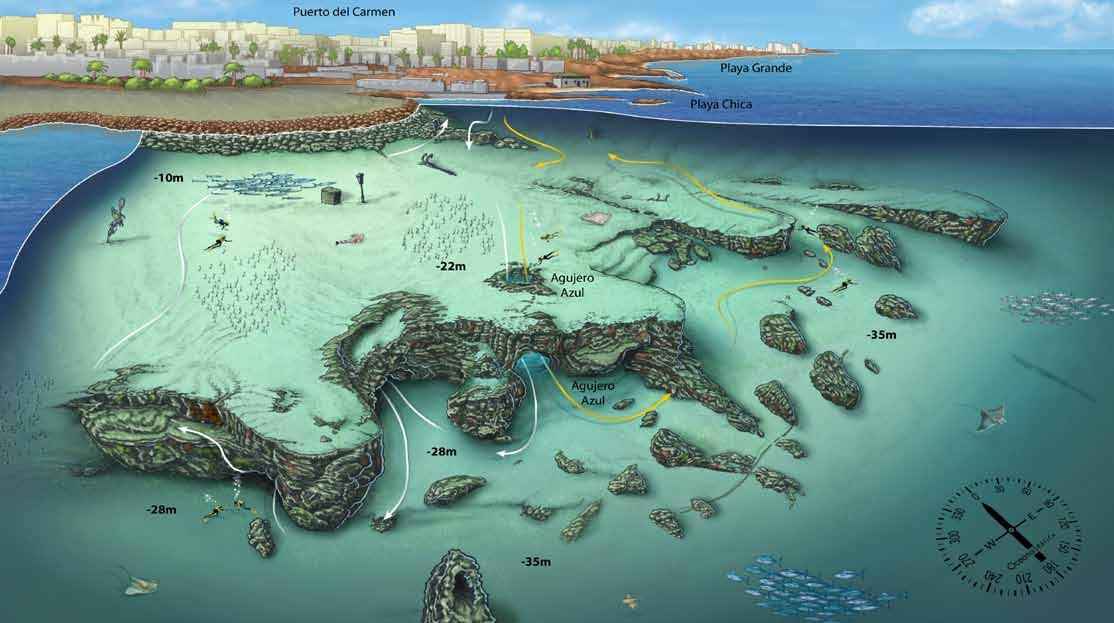
Illustration: Oceanografica / Reserva de la Biosfera de Lanzarote (2011)
Puerto del Carmen has walls, caverns, and shore reefs in the same boat radius, so the trail format is what sets this site apart. Most wreck dives in the area are single hulls or single decks. Here the dive is a vertical tour: one hull per depth band, with the guide adjusting the maximum to suit the certification mix on board. The same trail serves a newly certified OW diver staying on the shallow end and a Deep-trained diver dropping to the propeller.
The other distinguishing element is the angel-shark association. The Canary Islands hold one of the last remaining populations of Squatina squatina, an IUCN Critically Endangered species that has largely vanished from the rest of its Atlantic range. Operators flag the sand between the hulls as a likely resting substrate without promising the encounter. That single overlap of a recreational wreck circuit on top of one of the species' few remaining strongholds is the dive's strongest pitch.
Historical accounts describe the wooden boats as having been sunk to seed dive tourism somewhere in the 1970s-1980s, though specific vessel names and sinking dates are inconsistent.
Buoyancy and trim do most of the work here. The sandy bottom silts up in seconds with poor finning, and divers behind you will lose the next hull in the chain if the group ahead settles or drags through the sand. Hover, don't settle.
The 38m hull sets the gas budget. Bottom time at the propeller is short on either air or nitrox, and the rest of the dive needs to fit on the way back up. Agree the turnaround depth with the guide before splashing. A delayed surface marker on the ascent is sensible, given small-craft traffic above the harbour entrance. A torch helps for looking inside the wooden hulls and for the sponge cave on the wall return.
What makes this dive site stand out.
Five wooden fishing boats and one metal vessel arranged along the harbour wall.
Same site serves OW, AOW, and deep-trained divers depending on how deep the guide goes.
Critically endangered Squatina squatina rest on the sandy patches between the hulls.
Departure from the old harbour of Puerto del Carmen; one of the shortest boat rides on the island.
Deepest hull retains a large intact propeller, the most-cited single feature of the dive.
28.9193°N, 13.6761°W
The old-harbour shelter keeps the site bookable on most days when other Puerto del Carmen sites are still diveable.
Standard guided boat-dive pricing applies; no site-specific fee is published. Verify current rates with your operator.
OW reaches the shallow hull at 12-15m. AOW unlocks the mid-depth hulls at 20-25m. The 38m propeller hull suits AOW divers with Deep specialty or equivalent experience. Wreck Diver specialty is required for any swim-through entry.
Summary
Trail format makes depth creep easy. The 38m hull is at the edge of the recreational limit and tightens gas planning sharply.
Safety considerations
What can go wrong here, and what divers do about it. Conditions change - take the briefing from the operator on the day.
Book a guided dive at this site.
PADI 5-Star CDC in Playa Blanca with 5.0 rating across thousands of reviews, daily shore and boat dives at 30+ sites, and full IDC training pathway.

SSI Diamond, PADI 5-Star, and BSAC centre 100 m from Playa Chica with free Nitrox 30%, free boat dives, and a custom trimaran hard boat.

SSI Diamond ITC in Playa Blanca with 4 boats across two sectors, daily Museo Atlantico excursions, tech diving to 100m+, and Lanzarote's only Mermaid School.

PADI 5-Star Dive Resort on Playa Chica in Puerto del Carmen, one of 9 MOD ComMac-approved centres worldwide, with 40+ years on the island.

PADI 5-Star IDC in Puerto del Carmen, the only Halcyon dealer in the Canary Islands, with 5.0/5 across 386 reviews and Playa Chica shore-diving access.
Get in touch to add or claim your dive center listing on DiveCodex.
Operators describe six small vessels in total (five wooden fishing boats and one metal hull) staged along the harbour wall. A single recreational dive typically takes in two to four of them, since the deepest hull sits at about 38m and the rest of the air budget is spent ascending through the mid-depth and shallow boats.
The deepest hull lies at roughly 38m and is the one with a large intact propeller, which is what most divers come down to see. It is at the edge of the recreational depth limit, so most centres treat it as a Deep specialty dive with strict gas planning rather than a casual stop.
Angel sharks (Squatina squatina) rest on the sandy patches around the hulls and are flagged by operators as a possible sighting at this specific site. The Canary Islands hold one of the last remaining populations of the species, so an encounter is plausible but not guaranteed; sightings appear more common in the cooler winter and spring months across Lanzarote generally.
Yes for the shallow end of the trail. The hull closest to the jetty sits at about 12-15m, which is within OW limits. The mid-depth hulls at 20-25m need Advanced Open Water, and the 38m propeller hull is for divers with deep training and disciplined air management.
The boats are small and degraded, so most operators run it as a recreational swim-through circuit rather than a true penetration dive. Entering enclosed spaces requires a wreck-diver specialty (PADI Wreck Diver, SSI Wreck Diving, or equivalent) regardless of depth.
Yes. The site sits in the lee of the old harbour wall, so it stays bookable on most days when north-coast Lanzarote sites are wind-shut. Water temperature drops to about 18-19°C in winter, so plan on a 7mm wetsuit with hood and gloves, or a drysuit if you are doing multiple dives a day.
Operators in Puerto del Carmen describe it as a two-minute boat crossing from the old harbour (Muelle Viejo). Most trips are run as standard guided boat dives with a centre based in Puerto del Carmen itself.
Log your dives - notes, photos, conditions and the marine life you saw - and share them as one public diver profile. What you share helps the next diver, too.
Log every detail
Depth, duration, conditions, gear, buddy, notes — all in one place. Import from Suunto and other dive computers.
Track marine life
Record species sightings on each dive. Build a personal catalogue of everything you've seen underwater.
Your public dive profile
Share your dive history, stats, and experiences with a profile page you control. Show the world where you've been.