
Calypso Diving Estartit
Family-run PADI centre in L'Estartit, run by Peter and Jacqueline Lane for nearly 40 years, with PADI Green Star and four other environmental credentials.
PADI5 services8 languages
Also known as: la Pedra de Déu, La Pedra de Déu, Pedra de Deu
Deep gorgonian wall on Meda Gran's northeast end with yellow fans from 15 m, blue-gorgonian canyons toward 44 m, and a dual OW/AOW shotline.
Last updated May 2026
One shotline, two dives. The line drops onto a pinnacle top near 6 m, and the yellow-gorgonian zone arrives almost at once as you descend the slopes and platforms toward 20 m, with damselfish clouding the upcurrent face and scorpionfish tucked against the rock. Open Water profiles work this upper terrain, sometimes called Pedra de Déu i La Cuetera by local centres, picking apart the pinnacle structure and the schoolers that hold station off it. The Advanced profile drops over the wall edge below 25 m, where the rock face folds into a series of canyons carpeted in Paramuricea clavata and falls toward 40-44 m. Large groupers hold station along the canyon walls, and the gaps between fans open onto the blue. Crawfish and conger eels live deeper in the cracks. The dive returns up the wall to the 5 m platform near the boat, leaving the deep canyons behind on a slow ascent.
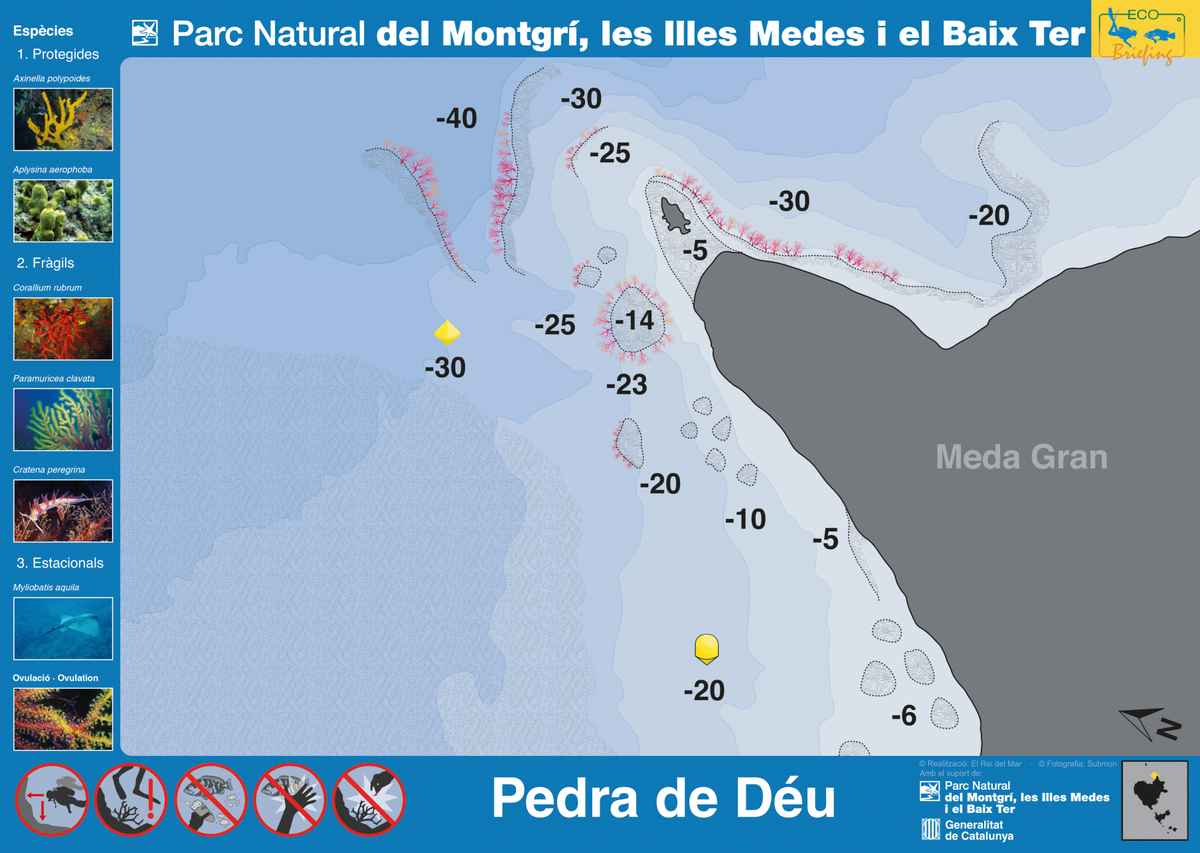
Illustration: Parc Natural del Montgrí, les Illes Medes i el Baix Ter — Generalitat de Catalunya
Pedra de Déu is the Medes wall centres pick when the brief is colour and depth, not the easy reef. The gorgonian density on the deep face is what local operators consistently flag as defining: yellow Eunicella above, blue Paramuricea below, and a wall described by Costa Brava centres as among the strongest gorgonian displays on this coast. That framing comes from the operators who book the site, not an audited survey, but it rhymes across the Estartit centres consistently enough to land. The dual-profile design is the other lever. Most Medes points dictate one route by depth or weather; this one runs OW and AOW off the same shotline, which is why it ends up on a lot of mixed-cert boats. Visibility decides the deep day. On clear summer water the canyon descent is the dive; on poor days the pinnacle alone still carries it.
The site is sheltered from south winds, which is a useful fact when southern Medes points get cancelled on a Garbi morning, but tramontana and levante still close it. The deep profile is not a casual extension of the shallow one. Forty-four metres is near the recreational AOW limit, and EAN32 buys back the bottom budget centres will plan with. Buoyancy matters here in a way that is more than a reminder. Gorgonians are colonial animals that break under fin contact and dragged gauges, and centres reinforce a 1-2 m standoff for a reason. Stay off the structure, hover rather than settle, and tuck whatever is dangling. Pack a torch to bring out gorgonian colour and to scan crevices for crawfish on the deeper run. Permits, eco-briefing, and the daily diver cap are handled centre-side per the reserve rules.
What makes this dive site stand out.
Eunicella cavolini from 15 m, Paramuricea clavata canyons below 25 m
OW works the 6-20 m pinnacle while AOW drops the wall toward 40-44 m
Wall-edge gaps occasionally turn up eagle rays and a summer Mola mola passing past
Stays operational when southern Medes points get rough on a Garbi day
Large Epinephelus marginatus hold station along the deeper canyon walls
42.0501°N, 3.2247°E
Sweet spot September. Pelagic chances (eagle rays, summer sunfish) peak July-August.
Park permit included in dive center prices
Open Water with a guide handles the 6-20 m pinnacle and platforms. Advanced Open Water (or SSI Advanced) is required for the wall and gorgonian canyons toward 40-44 m.
Summary
Moderate to advanced depending on the route. The shallow pinnacle is straightforward; the deep canyon profile pushes recreational limits.
Safety considerations
What can go wrong here, and what divers do about it. Conditions change - take the briefing from the operator on the day.
Book a guided dive at this site.
Family-run PADI centre in L'Estartit, run by Peter and Jacqueline Lane for nearly 40 years, with PADI Green Star and four other environmental credentials.

PADI 5 Star centre on L'Estartit seafront with stay-and-dive packages, four daily boat dives between Illes Medes and Montgrí, plus tec diving.

Family-run PADI 5 Star Resort and SSI centre in L'Estartit since 1990, with two 30-diver boats running hydraulic lifts to the Illes Medes reserve.
Long-running L'Estartit dive centre (founded 1969) running a four-boat fleet to the Illes Medes reserve and Montgrí coast, with SSI training and a strong family/snorkel programme.

Family-run hotel and dive centre in L'Estartit since 1985, with two dedicated boats and four daily departures to the Illes Medes reserve.
Owner-led PADI centre on Carrer Salines in L'Estartit, capping each guide at 5-6 divers across the Illes Medes, Montgrí, and Cap de Begur.
L'Estartit's oldest dive centre (est. 1965), a PADI 5 Star CDC running daily boat trips to Illes Medes and the Montgrí Coast with volume dive packages.
Get in touch to add or claim your dive center listing on DiveCodex.
Dive centres in Catalonia must require insurance from every diver on their dives, and must be able to offer a policy to anyone who has none.
The pinnacle tops near 6 m and the wall drops through gorgonian canyons toward 40-44 m. Most Estartit centres run a single shotline at the pinnacle and split by certification: Open Water groups work the 6-20 m slopes and platforms, while Advanced divers drop over the wall edge into the blue-gorgonian canyons. Both groups end at the 5 m safety-stop platform near the boat.
Two species and two zones. Yellow gorgonians (Eunicella cavolini) drape the upper pinnacle and wall from around 15 m, and the deeper vertical walls and canyons below 25 m carry dense Paramuricea clavata, the violet-and-red sea fan that defines the Medes' deep look. Centres consistently describe the wall as one of the strongest gorgonian displays on this coast.
Possibly, not reliably. One Estartit centre frames the wall-edge looks into the blue as turning up eagle rays and the occasional summer Mola mola more often here than at other Medes points. That sits as one centre's directional claim rather than a statistic. Both species are seasonal July-August visitors and any single dive is a roll of the dice.
It varies, and the variance decides the deep day. Calm summer water delivers the 15-25 m the canyon route is built for. Earlier visits have produced both crisp wide-angle conditions and disappointing low-visibility days. The deep profile is worth it on clear days; on poor days, centres trim the dive to the shallow pinnacle and still get a satisfying gorgonian dive.
Open Water with a guide is enough for the 6-20 m pinnacle and platforms route. The 25-44 m wall and gorgonian canyons require Advanced Open Water (or SSI Advanced equivalent). Centres run mixed-cert groups by splitting on the shotline, so an OW and an AOW buddy can book the same boat and dive their own profile.
It is sheltered from south winds, so when southern points like Carall Bernat or the Tascons get rough on a Garbi day, this site stays operational. Centres reach for it as a frequent mixed-wind rotation pick. North or east winds (tramontana, levante) are the conditions that close it down.
Yes, it is worth packing one even though the dive is a wall and not an overhead environment. A torch brings out the colour of both gorgonian species, particularly the deep Paramuricea clavata canyons where ambient light drops fast, and helps work crevices for crawfish and conger eels. Most local centres recommend it explicitly.
Log your dives - notes, photos, conditions and the marine life you saw - and share them as one public diver profile. What you share helps the next diver, too.
Log every detail
Depth, duration, conditions, gear, buddy, notes — all in one place. Import from Suunto and other dive computers.
Track marine life
Record species sightings on each dive. Build a personal catalogue of everything you've seen underwater.
Your public dive profile
Share your dive history, stats, and experiences with a profile page you control. Show the world where you've been.