

Manta Diving Lanzarote
SSI Diamond, PADI 5-Star, and BSAC centre 100 m from Playa Chica with free Nitrox 30%, free boat dives, and a custom trimaran hard boat.
SSI3 languages
Also known as: El Muellito y La Playa, House Reef, Playa Chica Bay
Sheltered shore-dive bay in Puerto del Carmen with a 0-12m sand-and-rock training profile and at least six named routes off the same entry.
Last updated May 2026
The bay reads first as a place and second as a dive. A small protected beach in the centre of Puerto del Carmen, two short jetties on either side, a low pier on the right with a steel-ladder entry. You can walk in past resort towels or step off the pier in one move, regulator and mask braced with one hand. The floor sits at five to eight metres within a few fin kicks; sand-and-rock mixed, the inside of each jetty acting as a low artificial wall. Work left or right along a jetty and the sequence is consistent: octopus tucked into rock joints, vieja and ornate wrasse picking over the volcanic rock, fula negra schooling above your head, breams and trumpetfish in the gaps. Cross the sand shelf back to the beach and the dive closes shallow enough to use as a safety-stop playground after deeper work elsewhere.
The night route is the one centres treat as the bay's signature. After dusk the same shallow profile shifts character: cuttlefish out in courtship behaviour, octopus active on the sand, parrotfish sleeping wedged into rock joints, nudibranchs picked out under torchlight on rocks that read empty by day.
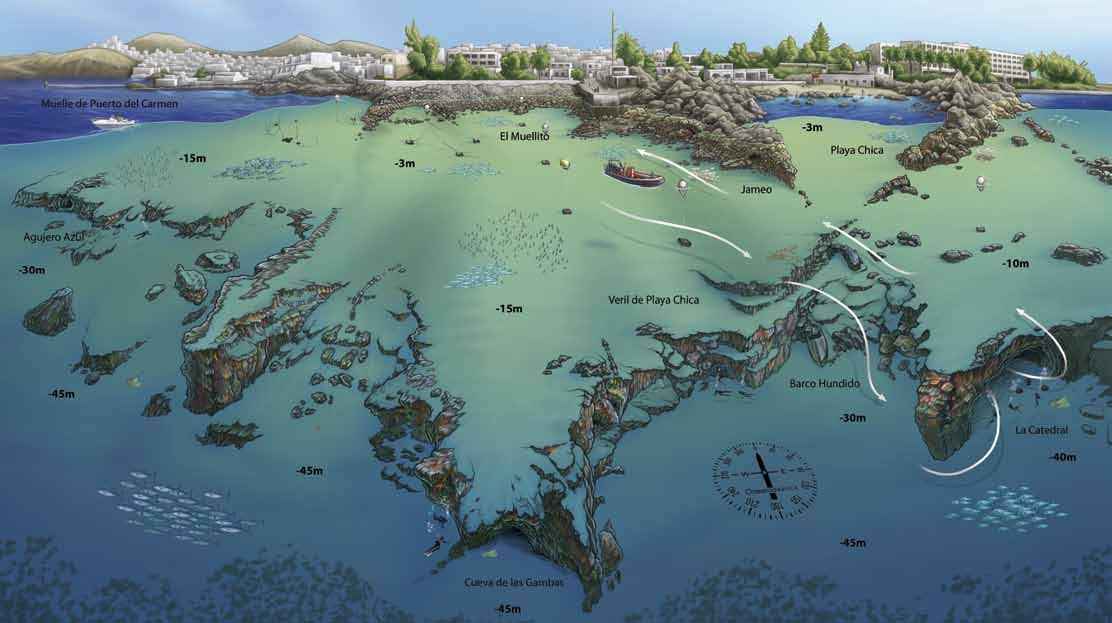
Illustration: Oceanografica / Reserva de la Biosfera de Lanzarote (2011)
A diver of any level launches from the same step here. A snorkeller, a supervised try-dive, an Open Water student and a tech diver heading for the 40m wall can all start from the same beach. The bay itself is not a destination dive: it is a shore-dive entry, and at least six named dives radiate from it, each catalogued as its own site. Centres assemble level-appropriate groups and route them to different parts of the system from one car park, which is why a visitor's week on Lanzarote often passes through this beach three or four times.
The second draw is the fauna staging around the bay. The deeper sand off Puerto del Carmen is where angel sharks rest in winter, and the wider entry zone catches a seasonal pelagic rotation. Encounters happen on the routes off the bay more than in the bay itself, but it is the same step that puts a diver within reach of all of them.
Macro is the strongest case here. The shallow rocks along the inside of each jetty hold nudibranchs, small shrimp and tube-dwelling anemones, and the rock joints harbour octopus that sit still once they recognise the light. A focus torch and a slow pass over the same metre of rock pay better than covering ground. Wide-angle works on the jetty walls for larger fish and on the sand for the seasonal angel-shark possibility in winter. The night dive is the one most photographers come back for: cuttlefish in courtship behaviour close to the bottom, octopus out hunting, parrotfish wedged motionless into joints for sleep.
Wind chill, not water temperature, is the comfort issue. Surface temperatures sit at 22-24C in summer and 18-19C in winter, but the south-facing exposure picks up brisk wind between dives even on calm-water days; a hood and a windproof layer outside summer make the second dive bearable. The pier ladder needs care in chop: time a wave to lift you onto the landing, take the rail, and step off quickly.
Crowding is real in July and August. Vans converge on the same parking and the same step in peak season, and pleasure boats use the bay entry zone too, so an SMB on ascent is sensible. An early start gives the calm version of the dive.
The night dive is worth a separate visit. The species shift after dusk is the reason centres run it as a standing offering. Bring a primary torch and a backup; the macro on the rocks rewards a careful, slow pass.
What makes this dive site stand out.
Walk-in from the beach or giant-stride from the pier; the bay stays calm on windy days.
At least six named dives radiate from this entry, from training shallows to a 40m wall.
Sand-and-rock floor between two jetties suits try-dives, OW modules and macro night work.
Centres run the bay as a regular night-dive offering for cuttlefish, octopus and sleeping reef fish.
Octopus, vieja (Canary parrotfish), ornate wrasse and Canary damselfish are the residents.
28.9182°N, 13.6689°W
The bay almost never closes for weather; angel-shark season in the wider Puerto del Carmen sand runs December to April for adults and July to September for juveniles.
Free shore entry. Standard Puerto del Carmen guided shore-dive rates apply when booking through a centre.
The 0-12m bay route is open to supervised try-dives and OW students. The wall, cavern and tunnel routes off this entry run their own certification floors (AOW for the wall and tunnel, AOW with overhead awareness for the caverns).
Summary
The bay route is easy and sheltered. Routes off the same entry are catalogued separately and range up to advanced and tech.
Safety considerations
What can go wrong here, and what divers do about it. Conditions change - take the briefing from the operator on the day.
Book a guided dive at this site.
SSI Diamond, PADI 5-Star, and BSAC centre 100 m from Playa Chica with free Nitrox 30%, free boat dives, and a custom trimaran hard boat.

SSI Diamond ITC in Playa Blanca with 4 boats across two sectors, daily Museo Atlantico excursions, tech diving to 100m+, and Lanzarote's only Mermaid School.

PADI 5-Star Dive Resort on Playa Chica in Puerto del Carmen, one of 9 MOD ComMac-approved centres worldwide, with 40+ years on the island.

PADI 5-Star IDC in Puerto del Carmen, the only Halcyon dealer in the Canary Islands, with 5.0/5 across 386 reviews and Playa Chica shore-diving access.
Get in touch to add or claim your dive center listing on DiveCodex.
No permit, no fee. Lanzarote is a UNESCO Biosphere Reserve (1993) with no diver-specific restrictions; the Chinijo Archipelago Marine Reserve covers the northern islets only.
The bay itself is a sheltered 0-12m shore dive on a sand-and-rock floor between two short jetties, with low rock walls along the inside of each jetty. The deep wall, the cavern (Cathedral), the lava tube (Agujero Azul) and the shrimp cave (Cueva de las Gambas) are separate sites that simply share this beach as their walk-in. A trip to Lanzarote often visits the bay several times because every centre on the island works from this step.
Not for the bay itself. The 0-12m sand-and-rock profile is open to supervised try-dives and the first practice dives of an Open Water course. The deeper wall and cavern routes off the same entry require Advanced Open Water or higher and are catalogued as their own dives, with their own certification floors.
Yes, and it is the standing highlight. Centres treat it as a standing offering; the recurring sightings are cuttlefish in courtship behaviour, octopus active on the sand, and parrotfish wedged into rock joints to sleep. Bring a working torch and a backup.
Adults move onto the deeper sand off the bay between December and April; juveniles have been reported inside the shallow bay between July and September. The Canary population is one of the few healthy populations of Squatina squatina remaining, so encounters are realistic without being guaranteed.
Busy. Vans from every centre in Puerto del Carmen converge on the same parking and the same step, so peak summer mornings concentrate traffic on a small area. Pleasure boats also use the bay entry zone. Early starts and shoulder-season visits give the calmer experience.
5mm in summer, when surface temperatures sit at 22-24C. 7mm with hood and gloves in winter and spring, when bottom temperatures hold around 18-19C. Surface wind chill between dives is the discomfort divers mention most often, even on warm-water days; a hood helps outside summer.
No. Lanzarote is a UNESCO Biosphere Reserve, designated in 1993, but that is a sustainability-framework status without diver permits, fees or quotas. The only marine reserve on Lanzarote, the Chinijo Archipelago, covers the northern islets and does not extend to Puerto del Carmen.
Log your dives - notes, photos, conditions and the marine life you saw - and share them as one public diver profile. What you share helps the next diver, too.
Log every detail
Depth, duration, conditions, gear, buddy, notes — all in one place. Import from Suunto and other dive computers.
Track marine life
Record species sightings on each dive. Build a personal catalogue of everything you've seen underwater.
Your public dive profile
Share your dive history, stats, and experiences with a profile page you control. Show the world where you've been.