

Dive College Lanzarote
Family-run PADI 5-Star IDC in Playa Blanca with beachside pool, house reef, 12 rotating dive sites, and a formal partnership with Safari Diving.
PADI6 languages
Also known as: Flamingo Beach, Flamingo Wall
Easy shore-or-boat dive on a Playa Blanca breakwater in southern Lanzarote, with grunt schools and angel sharks on the sand outside the jetty.
Last updated May 2026
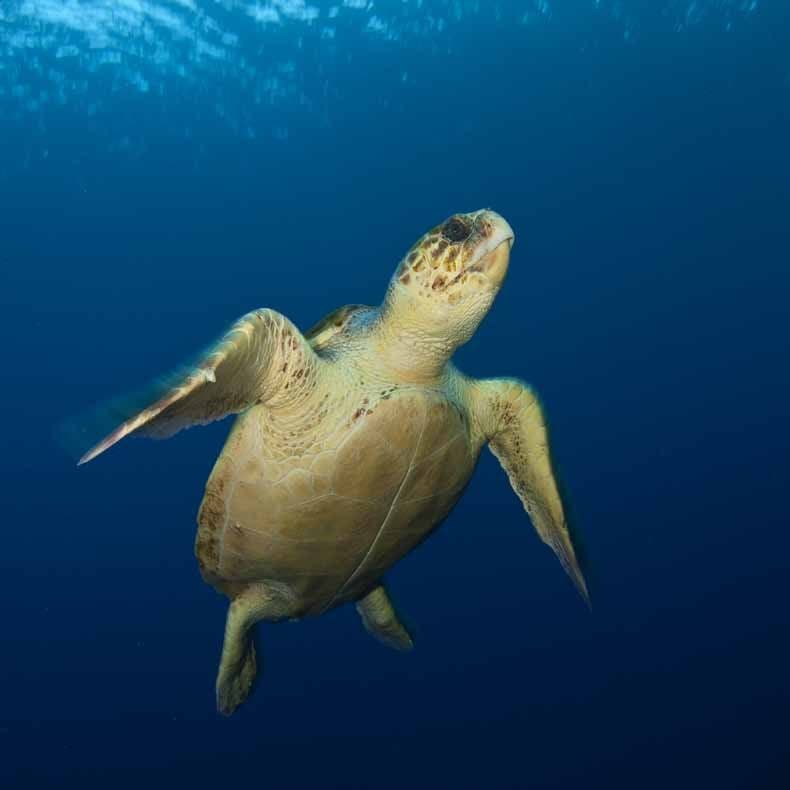
Playa Flamingo is the gentle dive of the Playa Blanca rotation. The bay is small, the two stone jetties that frame it are obvious from the surface, and the bottom never drops past 18m, so the dive sells itself on what swims past rather than what looms below. Walk in from the beach or drop from a short boat ride into the protected interior; the first stretch is shallow and forgiving, room to settle buoyancy before the dive matters. The interest builds when you cross the line of the breakwater and follow its outer face. The block work has been colonised by reef fauna, and the white sandy bottom cuts away on the open side. Schools of grunt, salema, and yellow-mouth barracuda hold position where the shoreline current slackens against the structure; bogue, sand smelt, and tuna pass along the coast. The block wall itself rewards close inspection, with dusky grouper, glasseye, and cardinal fish tucked into the cavities. The standout is the angel shark, lying flat under a thin layer of sand: divers who scan the line where sand meets rock are the ones who find them. Spotted torpedo and spiny butterfly rays use the same cover. Most dives end where they began, back inside the bay for a slow safety stop in shallow water with the breakwater between the open sea and the surface.
Within the Playa Blanca cluster, Playa Flamingo is the choice for divers who want fish density at low effort. Papagayo is the more scenic shore entry; Pechiguera is the deeper current dive for advanced certifications; Museo Atlantico is the booked-in cultural option at fixed centres and premium price. Playa Flamingo sits in a different space: open to all certifications including try-dives, accessible from shore or by short boat ride, and offering on a typical day what the deeper Playa Blanca dives offer only sometimes. Large schools of grunts, salema, and barracuda, and a real chance of an angel shark on the sand. The local appeal is straightforward: the dive impresses by its simplicity and by the quantity and variety of fish schools. For a Lanzarote week, it is the warm-up that still earns a place in the dive log.
The exterior of the breakwater is where the dive happens. The interior of the bay is calm but quiet, useful for buoyancy practice or a try-dive and less interesting otherwise, so plan the route to spend most of your bottom time on the open-sea side. Visibility is described as unbeatable outside the jetty most of the year, and winter often clears further as plankton drops. The site sits in standard Lanzarote coastal waters, not inside the Chinijo Archipelago Marine Reserve, so there is no permit, fee, or quota; the island's UNESCO Biosphere Reserve status is a sustainability framework only and imposes nothing at this site. Independent divers need full Spanish recreational documentation and insurance; rental tanks are available from Playa Blanca centres. A 5mm wetsuit covers summer; in winter the bottom drops to around 18C and a 7mm wetsuit with hood and gloves is the standard call. The line where sand meets rock outside the breakwater is the one to scan slowly: that is where the angelotes lie.
What makes this dive site stand out.
Two stone jetties shape a calm bay; the outer face becomes the dive's reef wall
Schools concentrate against the jetty's outer face where shoreline current slackens
Squatina squatina rests under thin sand outside the breakwater, peak Nov to Apr
Bottom never exceeds 18m; interior is shallow and forgiving for try-dives
Walk in from the beach or drop in three minutes from Playa Blanca centres
28.8569°N, 13.8408°W
Sheltered south coast is the most reliable dive zone on Lanzarote. April to October bring the warmest water and longest light.
Centres quote standard Lanzarote guided-dive rates without site-specific pricing. Verify with the operator before booking.
Try-dives run inside the bay with an instructor. Open Water and above for the full exterior route to 18m.
Shallow profile, light current, sheltered surface, and an obvious topographic landmark in the breakwater itself.
Book a guided dive at this site.
Family-run PADI 5-Star IDC in Playa Blanca with beachside pool, house reef, 12 rotating dive sites, and a formal partnership with Safari Diving.
PADI 5-Star CDC in Playa Blanca with 5.0 rating across thousands of reviews, daily shore and boat dives at 30+ sites, and full IDC training pathway.

SSI Diamond ITC in Playa Blanca with 4 boats across two sectors, daily Museo Atlantico excursions, tech diving to 100m+, and Lanzarote's only Mermaid School.

PADI 5-Star Dive Resort on Playa Chica in Puerto del Carmen, one of 9 MOD ComMac-approved centres worldwide, with 40+ years on the island.

PADI 5-Star IDC in Puerto del Carmen, the only Halcyon dealer in the Canary Islands, with 5.0/5 across 386 reviews and Playa Chica shore-diving access.
Get in touch to add or claim your dive center listing on DiveCodex.
No site-specific permit, fee, or booking system. Lanzarote's UNESCO Biosphere Reserve status is a sustainability framework with no diver quotas at this site.
Yes. The bay interior is shallow and sheltered enough for try-dives with an instructor, and the maximum depth across the site is 18m. Local divers describe it as the most relaxed of the Playa Blanca options.
Adult angel sharks rest on the sand outside the breakwater most reliably from November through April. The wider mating window in the Canaries runs September to February. Scan the line where sand meets rock.
Outside. The bay interior is calm but quiet; local divers say it serves for buoyancy practice. The fish schools, the wall, and the angel-shark sand are all on the open-sea side of the jetty.
Both. Walk in directly from Playa Flamingo beach, or take a short boat ride from a Playa Blanca centre — the boat run is about three minutes.
Yes, with full Spanish recreational documentation (FEDAS or equivalent certification plus insurance) and your own or rented equipment. The site is easy to find from the surface and the depth limits are conservative.
Museo Atlantico is the booked-in cultural dive on a fixed concession with an authorised centre; Playa Flamingo is the open shore-or-boat option in the same Playa Blanca area, with natural reef life rather than sculptures.
A 5mm wetsuit covers summer, when the water sits at 22-24C top to bottom. In winter the bottom drops to around 18C, and a 7mm wetsuit with hood and gloves is the standard call. Drysuits are advisable for repeat-dive days in cooler months.
Log your dives - notes, photos, conditions and the marine life you saw - and share them as one public diver profile. What you share helps the next diver, too.
Log every detail
Depth, duration, conditions, gear, buddy, notes — all in one place. Import from Suunto and other dive computers.
Track marine life
Record species sightings on each dive. Build a personal catalogue of everything you've seen underwater.
Your public dive profile
Share your dive history, stats, and experiences with a profile page you control. Show the world where you've been.