

Aquatica Illes Medes
SSI Diamond ITC in L'Estartit since 1996, specialising in small-group, low-impact diving in the Illes Medes Marine Reserve from a campsite-based dive school.
SSI6 services5 languages
Also known as: La Pota del Llop, Pota de Llop, Wolf's Paw
A north-east gorgonian wall on Meda Gran dropping to 50 m, weather-gated and less-dived than its neighbours.
Last updated October 2026
The rock formation named for the wolf's paw silhouette above the waterline sits on Meda Gran's north-east tip, and the dive it gives reaches around 50 m. The descent lands on a gorgonian-carpeted wall from around 20 m, with red Paramuricea clavata across the face and the upper ledges offering a macro stop for nudibranchs on cooler stretches. The route runs the wall. Past 25 m the gorgonian cover thickens, large fans described by local centres as stretching as far as you can see. The wall keeps going past 40 m. At the deepest point a small cave opens, and from inside a short chimney rises back up the rock, the structural feature that separates this dive from Pedra de Déu next door. The cave sits at a depth and in an overhead setting that park guidance advises recreational divers to avoid, so it marks the place to turn, not to enter. The return climbs the wall. Because the site sees far fewer dives per season than the south-facing Medes points, groupers and octopuses tend to hold their ground rather than retreating into crevices, and dentex pass on hunting runs without the reflex flight that crowds produce.
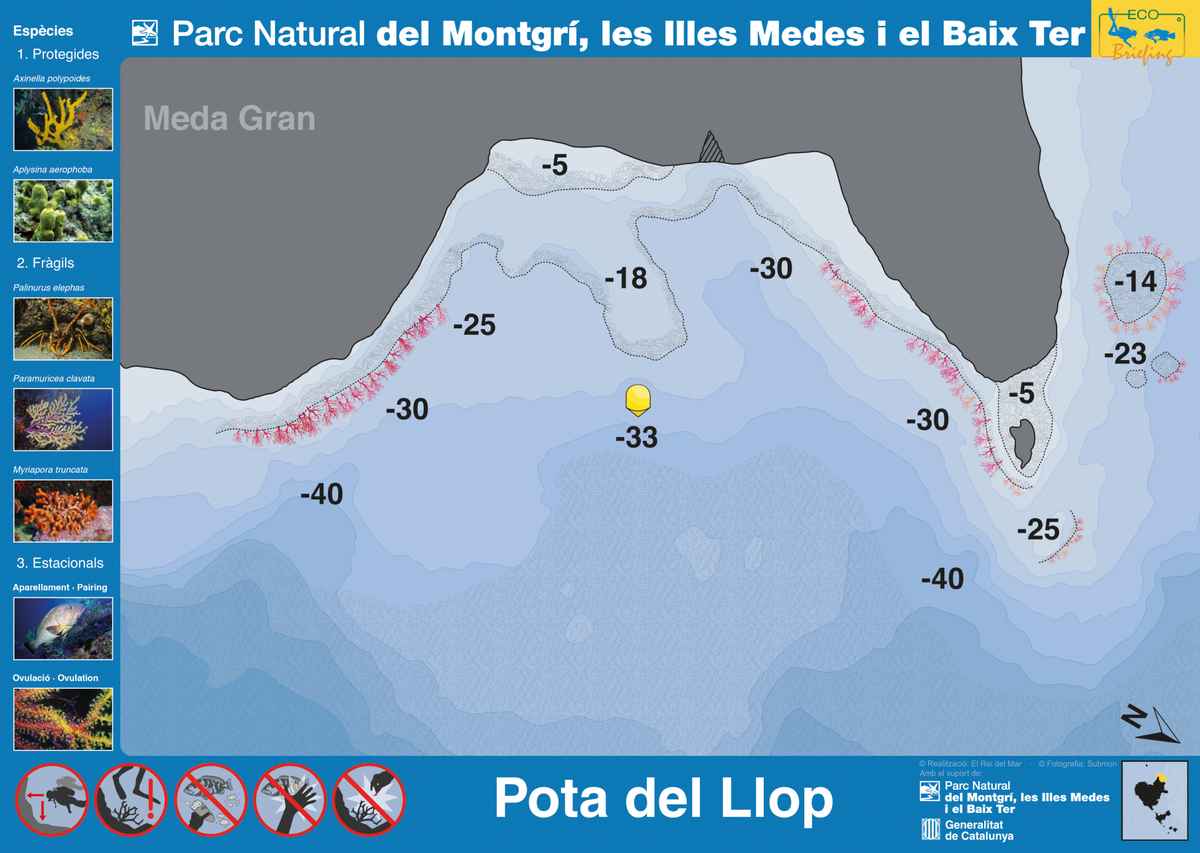
Illustration: Parc Natural del Montgrí, les Illes Medes i el Baix Ter — Generalitat de Catalunya
Two things set Pota del Llop apart from the other Medes wall sites. The cave-and-chimney is one: Pedra de Déu has denser gorgonian canyons, Carall Bernat has the open-water pinnacle and the grouper clusters, Pota del Llop has the overhead feature. The other is traffic. North-east exposure closes the site routinely, and the lower dive frequency changes the wildlife dynamic. The wall also continues deeper than park guidance for recreational dives, and what the group does there is the centre's call on the day.
Conditions decide whether the dive happens, and they decide it late. Build flexibility into any Pota del Llop booking, centres swap to a sheltered Medes alternative when north or east wind builds, sometimes on the morning itself. Set a maximum depth on the boat, not at the wall. The base at 50 m is deeper than park guidance for recreational dives, and what the group does is the centre's call on the day. The cave-and-chimney is overhead and lies where daylight is lost, so leave it out of the plan and look from the wall. The upper wall is the macro stop on the way back up. The Medes are a regulated marine reserve; most visitors dive with a local centre, which arranges the day. Ask yours what the reserve asks of divers before you go.
What makes this dive site stand out.
Wall drops past 40 m to a sand base around 50 m, beyond standard recreational limits
Small cave near the wall base opens into a short chimney rising back up the rock face
Paramuricea clavata covers the vertical face from around 20 m down
North-east exposure means tramontana or levante closes the site, often on short notice
Lower traffic than south-face Medes sites; resident fish hold ground differently here
42.0490°N, 3.2262°E
April-November is the area dive season, but the site is most reliably accessible July-September when north-east winds are less frequent.
Dives here are booked as part of a centre's boat-dive package.
Advanced Open Water is the level the dive itself asks for on the upper wall. The profile toward 50 m sits beyond recreational limits and is not a recreational dive. The reserve's own entry requirement is shown in the regulations module.
Summary
Advanced throughout. The wall descends past recreational depth limits and the cave-chimney adds an overhead component.
Safety considerations
What can go wrong here, and what divers do about it. Conditions change - take the briefing from the operator on the day.
Book a guided dive at this site.
SSI Diamond ITC in L'Estartit since 1996, specialising in small-group, low-impact diving in the Illes Medes Marine Reserve from a campsite-based dive school.
Family-run PADI centre in L'Estartit, run by Peter and Jacqueline Lane for nearly 40 years, with PADI Green Star and four other environmental credentials.

PADI 5 Star centre on L'Estartit seafront with stay-and-dive packages, four daily boat dives between Illes Medes and Montgrí, plus tec diving.

Family-run PADI 5 Star Resort and SSI centre in L'Estartit since 1990, with two 30-diver boats running hydraulic lifts to the Illes Medes reserve.

Long-running L'Estartit dive centre (founded 1969) running a four-boat fleet to the Illes Medes reserve and Montgrí coast, with SSI training and a strong family/snorkel programme.

Family-run hotel and dive centre in L'Estartit since 1985, with two dedicated boats and four daily departures to the Illes Medes reserve.

Owner-led PADI centre on Carrer Salines in L'Estartit, capping each guide at 5-6 divers across the Illes Medes, Montgrí, and Cap de Begur.
Get in touch to add or claim your dive center listing on DiveCodex.
Dive centres in Catalonia must require insurance from every diver on their dives, and must be able to offer a policy to anyone who has none.
The site sits on Meda Gran's north-east tip, directly exposed to tramontana from the north and levante from the east, the two winds that most often close diving on the Costa Brava. Either one builds surface chop quickly on this face and the boat does not run. Because those winds are common, the site dives far less per season than south-facing classics like La Vaca or Carall Bernat. Even confirmed bookings can be swapped to a sheltered alternative on the morning.
The wall drops past 40 m to a sand base around 50 m. The upper section, roughly 20-30 m, carries the densest gorgonian cover and is the part the dive itself asks Advanced Open Water for, in calm conditions. The base is deeper than park guidance for recreational dives, and what the group does is the centre's call on the day. Agree your turn depth on the boat before descent.
A small cave opens near the deepest point of the wall, and from inside a short chimney rises a few metres back up the rock face. It sits at a depth and in an overhead setting that park guidance advises recreational divers to avoid, so it is something to know about, not a dive objective. Look at it from the wall and keep your own plan in open water.
Different rather than simply better. The site's weather-gating means it sees fewer dives per season than the daily-traffic sites, and the resident groupers, dentex, and octopuses tend to be less habituated to divers. Photographers willing to commit to a deep, weather-uncertain dive get cleaner natural-behaviour encounters. The trade-off is that the boat does not always go.
Centres strongly recommend EAN32 for time below 25 m and most operators assume you have it before booking. Ask yours what the group's plan is on the day.
Possibly, not reliably. Older Spanish-language centre pages mention eagle rays at the site, and very occasional summer sunfish sightings are part of the wider Medes wall picture. Neither species is a statistical bet on any single dive. Treat both as a pelagic bonus, a reason to look into the blue at the wall edge, not a reason to choose the site.
Book through a dive centre working the Medes, well ahead in summer, since the centre arranges the reserve side and the pre-dive briefing. Keep the day flexible: north and east winds often move the dive to a sheltered site on the morning. Advanced Open Water is the level the dive itself asks for; the reserve's own entry requirement is shown in the regulations module.
Log your dives - notes, photos, conditions and the marine life you saw - and share them as one public diver profile. What you share helps the next diver, too.
Log every detail
Depth, duration, conditions, gear, buddy, notes — all in one place. Import from Suunto and other dive computers.
Track marine life
Record species sightings on each dive. Build a personal catalogue of everything you've seen underwater.
Your public dive profile
Share your dive history, stats, and experiences with a profile page you control. Show the world where you've been.