

Costa Brava Divers
PADI 5 Star centre on L'Estartit seafront with stay-and-dive packages, four daily boat dives between Illes Medes and Montgrí, plus tec diving.
PADI6 services5 languages
Also known as: Puig Sardina
Three-peaked underwater mountain off the Montgrí coast, with red and yellow gorgonian walls and amberjack banks in the open water.
Last updated October 2026
Les Illes fix the mooring buoy at 21 m and work the site between 21 and 38 m; Xaloc quotes 12 to 40 m. The route starts at the bottom and climbs the mountain in a slow circle, taking in the peaks at 27, 22 and 14 m on the way up. Operators on this coast say a dive to 30 or 35 m is enough to see the whole site, which keeps both deeper peaks and their walls inside the profile. The east-side walls carry the richest cover: red and yellow gorgonians, clouds of castanets and anthias, shoals of bream, large scorpionfish and, with luck, a moray. Deeper down there are crawfish and shellfish in the rock. Away from the structure, look out into the open water, where eagle rays or barracuda sometimes pass.
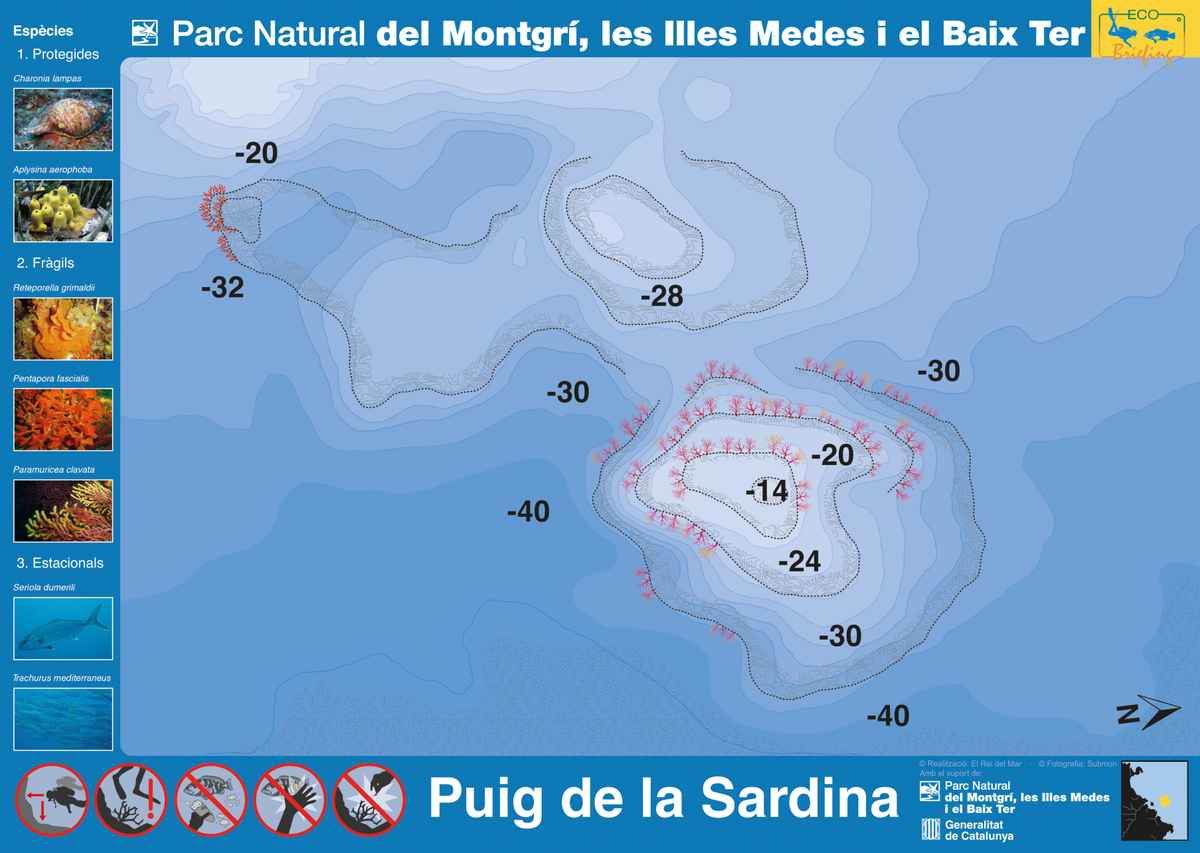
Illustration: Parc Natural del Montgrí, les Illes Medes i el Baix Ter — Generalitat de Catalunya
Three rocky peaks rise off the Montgrí shore, their walls wrapped in red and yellow gorgonians, with open water around them that holds large banks of amberjack and horse mackerel. One local operator ranks the wall among the best gorgonian walls of the Costa Brava. The park authority lists it as an official dive itinerary and publishes an eco-briefing sheet for it.
One operator asks divers to keep one to two metres off the gorgonians and recommends a dive torch, which brings out their colour. Set the maximum depth at the briefing, since the wall keeps falling below the working ranges quoted. Les Illes recommends Nitrox 32% for the profile.
What makes this dive site stand out.
Peaks listed at 14, 22 and 27 m, about 200 m off the coast
Dense cover on the walls, richest on the east side
Amberjack and horse mackerel swim in large banks outside the peaks
Les Illes fix it at 21 m; the route climbs the mountain in a circle
42.0730°N, 3.2080°E
Operators grade the site Advanced, one network of centres Advanced to Expert, and Les Illes recommends it for experienced divers. That is their requirement, not a regulation: the shallowest stated depth is 12-14 m, so depth alone would not set the level.
Summary
Operators' working ranges run to 38-40 m over a seabed far deeper, so the dive is graded on depth and gas planning.
Safety considerations
What can go wrong here, and what divers do about it. Conditions change - take the briefing from the operator on the day.
Book a guided dive at this site.
PADI 5 Star centre on L'Estartit seafront with stay-and-dive packages, four daily boat dives between Illes Medes and Montgrí, plus tec diving.

L'Estartit's oldest dive centre (est. 1965), a PADI 5 Star CDC running daily boat trips to Illes Medes and the Montgrí Coast with volume dive packages.

SSI Diamond Instructor Center in L'Estartit, authorized Illes Medes operator since 2008. Full spectrum from try dives to cave and technical diving.
Get in touch to add or claim your dive center listing on DiveCodex.
Dive centres in Catalonia must require insurance from every diver on their dives, and must be able to offer a policy to anyone who has none.
The operators' working ranges, 21 to 38 m at one centre and 12 to 40 m at another, reach well past the peaks, and they set their own requirement at Advanced. No regulation sets that grading, so an Open Water diver should ask the operator which part of the route the group will dive.
Log your dives - notes, photos, conditions and the marine life you saw - and share them as one public diver profile. What you share helps the next diver, too.
Log every detail
Depth, duration, conditions, gear, buddy, notes — all in one place. Import from Suunto and other dive computers.
Track marine life
Record species sightings on each dive. Build a personal catalogue of everything you've seen underwater.
Your public dive profile
Share your dive history, stats, and experiences with a profile page you control. Show the world where you've been.