
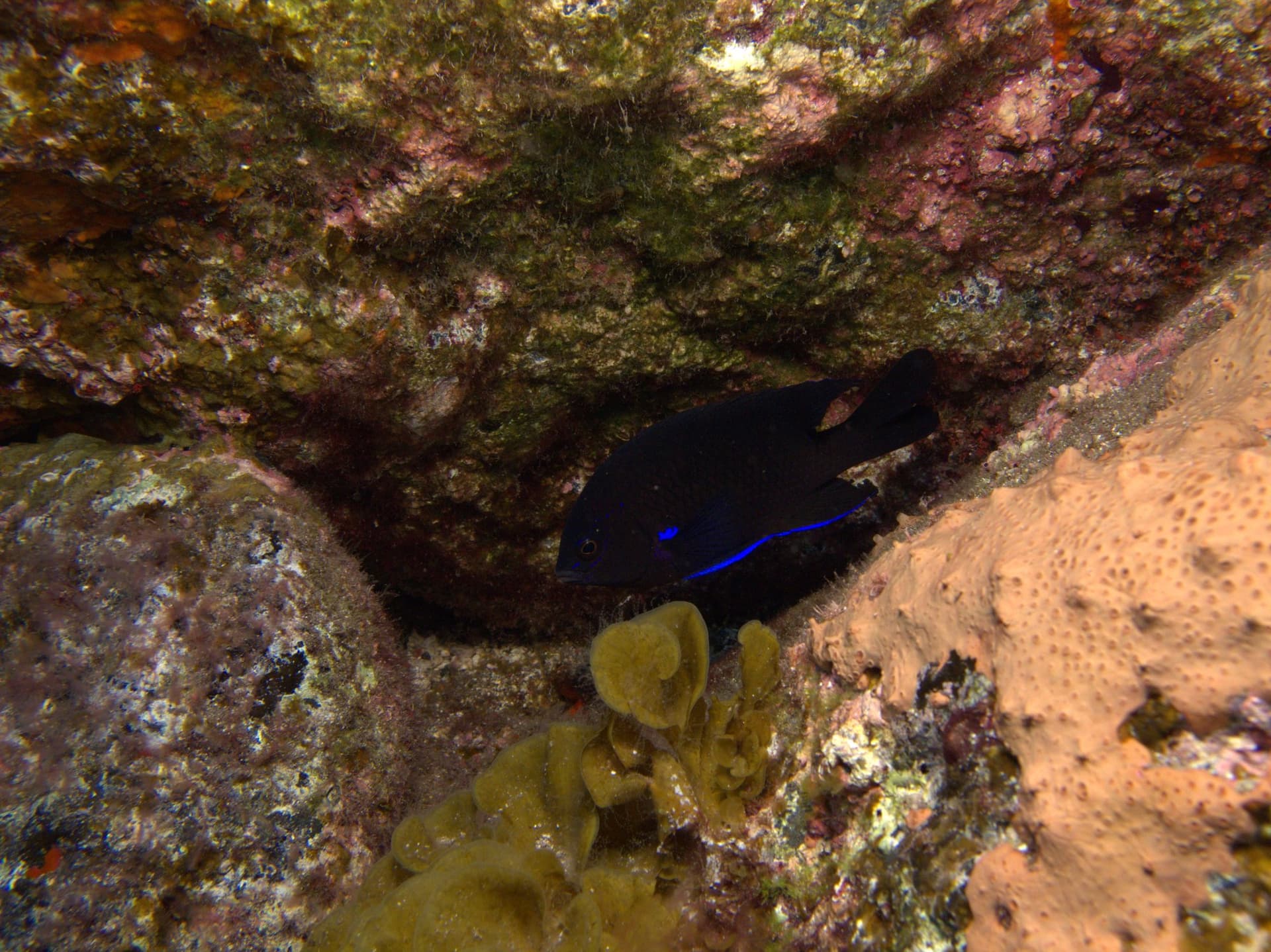

Buceo La Restinga
SSI center in La Restinga, El Hierro, highly rated by divers, with 24+ volcanic sites, a 30m depth cap, and the top recommendation on Spanish dive forums.
SSI2 languages
Also known as: Punta de La Restinga
Volcanic lava tongue at Spain's southernmost point with four named dive routes from a single mooring, from shallow canyons to a 40m arch carpeted in black coral.
Last updated April 2026
The mooring drops you at 11 metres onto the edge of a submarine lava tongue extending from Spain's southernmost point. Four named routes depart from the same buoy, and which one you take depends on conditions and what your guide reads at the surface. The typical approach for El Arco follows a flat run of lava and calcareous algae out to 30 metres before the terrain suddenly drops to a rock arch at 40m — its surface colonised by black coral. Shallower routes through Los Cañones offer canyon navigation and crevice hunting at recreational depths. Stingrays cross sandy platforms between volcanic formations, trumpetfish trail larger fish in open water above, and large groupers station themselves at every depth level. The terrain shifts every few fin kicks: cliffs, drop-offs, caves and open plateaus in quick succession.
A single mooring giving access to the full spectrum of recreational diving is unusual. Beginners run the shallow canyons with no current pressure. AOW divers head for the vertical veril or the deep arch with its overhead section. The volcanic seabed has a quality that the 2011-2012 eruption renewal reinforced: since then, marine life density climbed, and the groupers here are among the larger specimens found in the Canaries.
The geographic position matters. This is the southernmost dive site in Spain, on an island in the middle of the Atlantic. Visibility at 30 metres is unremarkable. On the best days it reaches 40.
Current is the main variable. Centres rate it medium to high on average, but individual dives range from barely noticeable to demanding. Always ask which route fits the day's conditions before you leave the dock. For El Arco, carry a torch — the arch is an overhead environment, and crevices on the way hold moray eels and lobsters invisible without light. Fire worms are common throughout La Restinga sites. They look soft. They are not — contact embeds bristles in skin. An SMB is standard kit; drift diving is not permitted and you must return to the mooring. If planning the deep route, Nitrox is worth the extra cost at this depth.
What makes this dive site stand out.
El Arco, El Veril, Los Cañones, El Desfiladero all accessible from a single buoy.
El Arco route ends at a rock arch colonised by black coral. Requires AOW.
Typically 30m. Rarely below 20m, occasionally reaching 40m.
Shallow canyons suit OW divers; deep arch at 40m with current is advanced terrain.
27.6409°N, 17.9801°W
Diveable all year. Water 18-25°C range. Peak season June-October for warmest water and best pelagic activity.
Verify current rates with your dive centre in La Restinga.
OW sufficient for canyon and drop-off routes (Los Cañones, El Veril). AOW recommended for El Arco: 40m depth, medium-high variable current, overhead arch environment.
Summary
Moderate for canyon and veril routes accessible to OW divers. Advanced for El Arco (40m, variable strong current, overhead section).
Safety considerations
What can go wrong here, and what divers do about it. Conditions change - take the briefing from the operator on the day.
Book a guided dive at this site.
SSI center in La Restinga, El Hierro, highly rated by divers, with 24+ volcanic sites, a 30m depth cap, and the top recommendation on Spanish dive forums.

Dive centre in La Restinga, El Hierro, operating since 1978 and certified under PADI, FEDAS/CMAS and ESA, with a stable, named team and bundled trip logistics.
Francophone owner-run dive centre in La Restinga, El Hierro. Triple eco-certified, six divers per zodiac, top-rated across both major review platforms.
Get in touch to add or claim your dive center listing on DiveCodex.
Dive centres in the Canary Islands check that you hold the certification the dive needs.
El Arco (the arch, reaching 40m with black coral), El Veril (the main drop-off), Los Cañones (the canyon system, shallower and suitable for OW divers), and El Desfiladero (the gorge). All depart from the same mooring buoy. On a single dive you can cover two or three routes depending on depth and gas.
Open Water is sufficient for the canyon and drop-off routes, which stay around 20-30m in manageable conditions. AOW is recommended for El Arco, which drops to 40m with variable medium-high current and includes an overhead arch section. Your dive centre will advise on route suitability based on your level and the day's conditions.
The arch on the El Arco route sits at 40m. The typical approach involves advancing on flat lava to around 30m, then a sudden drop to the arch. Black coral grows on the rock arch itself. A torch is essential for this route.
El Bajón is an exposed open-ocean seamount with 80-metre walls and strong currents suited to experienced divers. Punta Restinga is more versatile: four routes from beginner canyons to an advanced arch dive, all from one mooring. Most visitors to La Restinga dive both on the same trip.
Large dusky groupers, trumpetfish, and stingrays gliding over sandy platforms are the most consistently reported. Schools of barracuda appear regularly. Black coral grows on the arch at 40m. In late summer, devil rays occasionally pass through the area.
Yes. Typical visibility is around 30m, with occasional days reaching 40m. It rarely drops below 20m. The clear Atlantic water around El Hierro is one of the island's main draws and Punta Restinga benefits from it consistently.
Night dives in La Restinga are generally run in the harbour rather than at Punta Restinga itself. Stingrays and lobsters are the main targets. The harbour dive concentrates nocturnal fauna on a sandy bottom and is specifically recommended for after-dark trips. Ask your centre which site they use.
Log your dives - notes, photos, conditions and the marine life you saw - and share them as one public diver profile. What you share helps the next diver, too.
Log every detail
Depth, duration, conditions, gear, buddy, notes — all in one place. Import from Suunto and other dive computers.
Track marine life
Record species sightings on each dive. Build a personal catalogue of everything you've seen underwater.
Your public dive profile
Share your dive history, stats, and experiences with a profile page you control. Show the world where you've been.