

Lanzarote Non Stop Divers
PADI 5-Star CDC in Playa Blanca with 5.0 rating across thousands of reviews, daily shore and boat dives at 30+ sites, and full IDC training pathway.
PADI6 languages
Also known as: Richie's Place, Richies Reef, Ritchie's Reef
Boat-access lava reef off Playa Grande in Puerto del Carmen with canyons, arches and a memorial plaque set into the wall near the main arch.
Last updated May 2026
The boat ride from the old harbour is under ten minutes. Divers drop on the line of buoys that mark the swim zone at the back of Playa Grande, settle to about 20m on sand, and follow the reef edge to the working depth around 25m. The first landmark is a single-diver swim-through arch in the lava wall. It frames the rest of the route.
From the arch the route runs with the cliff on the right to the memorial plaque set into the wall for Richard. Turning back at the arch and keeping the wall on the left, the dive drops into the canyon. The wall steps down, the canyon floor opens at the base, and a large cave on the canyon floor holds the first branch of Dendrophyllia ramea, the orange coral that guides anchor the site on. Across the canyon outlet a single tall pointed rock holds the main refuge for the narwhal-shrimp swarm. Smaller fissures around it shelter the same species in lower numbers.
The exit climbs the cliff over a group of rocks onto a wider overhang where the second Dendrophyllia branch grows. Curtains of Gerardia macaronesica hang under the reef edge here, dense enough that older trip reports single them out as the visual highlight. From this point divers either retrace toward the descent buoy or, if conditions allow, the guide turns the dive into a drift west along the back of Playa Grande. The safety stop runs in mid-water on the guide's SMB line; there is no wall or bottom at stop depth.
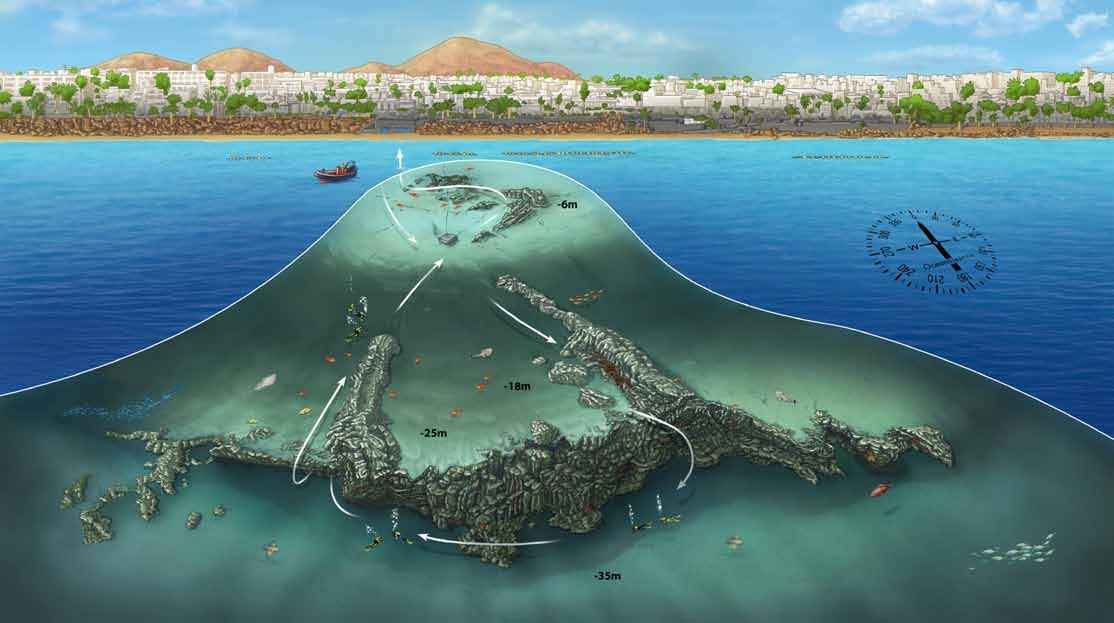
Illustration: Oceanografica / Reserva de la Biosfera de Lanzarote (2011)
Three things separate Richies from the rest of the Puerto del Carmen boat rotation. The orange-coral branches are predictable enough that the route is built around them, which is rare. The memorial plaque to Richard gives the dive a human anchor most lava reefs in Lanzarote do not have. And the depth structure delivers what the shallower Puerto del Carmen sites cannot: the 30-35m sand fans below the reef are where divers regularly turn up Squatina squatina and where Bodianus scrofa shows in numbers that older accounts treat as unusual for the Canary Islands.
The site is read by local guides as scenery first, fish second. Walls, drop-offs, sharp rocks, caves, canyons, sand and arches — the landscape is the reason to come down here. The fish list is a bonus.
Richies Place is named for Richard Lieftink, a Dutch guide who showed it to centres in Puerto del Carmen and gave it its place in the local rotation. He died abroad of non-diving causes while on vacation; the surviving local centres set a memorial plaque into the reef wall near the main arch. Divers pass the plaque a few metres after coming through the first arch on the standard route. The exact year of the site's discovery is not on public record. The name predates the early-2010s catalogue era when the dive first appeared in published Lanzarote diving guides under the spelling used by international operators.
Carry a torch. The two Dendrophyllia branches and the narwhal-shrimp refuge read dull without one, and the colour of the orange coral is most of the reason to look at it. The mid-water safety stop is the part of the dive that catches people off guard. There is no wall or bottom at stop depth; you hold depth on the guide's SMB line and your own buoyancy. Carry a personal SMB regardless of group size, because the boat captain finds the surface group by SMB.
Plan around 25m. The canyon and the sand let depth slide easily, and at 30-35m the NDL closes fast. Nitrox at EAN32 buys useful bottom time and is worth the surcharge. Surface conditions occasionally shut the site even when Puerto del Carmen looks calm from shore, so check with the operator the morning of the dive.
What makes this dive site stand out.
A plaque set into the reef wall near the main arch commemorates the Dutch guide who first showed the site.
Dendrophyllia ramea grows in two specific overhangs along the route.
A dense Plesionika narval swarm holds inside a small recess by the canyon outlet.
Canyon and sand reach where guides regularly turn up Squatina squatina and Bodianus scrofa.
Lava walls, gulleys and a single-diver swim-through arch set the working profile around 25m.
28.9199°N, 13.6591°W
Playa Grande sits in the lee of the prevailing NE trade winds, so weather days are uncommon.
No site-specific fees. Standard Puerto del Carmen guided boat-dive rates apply; some operators add a small boat fee on top of the dive.
Centres disagree. Some rate it basic at the shallow end, others require AOW; the canyon and sand at 30-35m and the mid-water safety stop on the guide's SMB put the working profile into AOW territory.
Summary
Easy to creep past 30m in the canyon. The safety stop runs in mid-water on the guide's SMB line, with no bottom or wall reference at stop depth.
Safety considerations
What can go wrong here, and what divers do about it. Conditions change - take the briefing from the operator on the day.
Book a guided dive at this site.
PADI 5-Star CDC in Playa Blanca with 5.0 rating across thousands of reviews, daily shore and boat dives at 30+ sites, and full IDC training pathway.

SSI Diamond, PADI 5-Star, and BSAC centre 100 m from Playa Chica with free Nitrox 30%, free boat dives, and a custom trimaran hard boat.

SSI Diamond ITC in Playa Blanca with 4 boats across two sectors, daily Museo Atlantico excursions, tech diving to 100m+, and Lanzarote's only Mermaid School.

PADI 5-Star Dive Resort on Playa Chica in Puerto del Carmen, one of 9 MOD ComMac-approved centres worldwide, with 40+ years on the island.

PADI 5-Star IDC in Puerto del Carmen, the only Halcyon dealer in the Canary Islands, with 5.0/5 across 386 reviews and Playa Chica shore-diving access.
Get in touch to add or claim your dive center listing on DiveCodex.
No permit, no site-specific fee. The Chinijo Archipelago Marine Reserve sits well to the north and does not cover Puerto del Carmen.
The site is named for Richard Lieftink, a Dutch dive guide who showed it to centres in Puerto del Carmen and put it into the local rotation. After he died abroad of non-diving causes, the surviving centres mounted a memorial plaque in the reef wall near the main arch. Divers pass it a few metres after the first swim-through on the standard route.
Most Puerto del Carmen operators ask for Advanced Open Water or equivalent. Centres disagree on this in their published material, but the practical reconciliation is depth-driven: the canyon floor and sand reach 30-35m and the safety stop runs in mid-water on the guide's SMB line. Experienced OW divers can stay on the shallower reef sections, but the dive plan that takes in the canyon and the second orange-coral branch is an AOW dive.
Two specific branches of Dendrophyllia ramea, a Macaronesian stony coral that grows in shaded overhangs. Guides build the route around them: one inside the canyon-floor cave, the second under a wider overhang on the climb out of the canyon. Bring a torch. The colour reads dull without one.
Possible, not guaranteed. Squatina squatina rests on the deeper sand fans below the reef, and Lanzarote is one of the species' last strongholds. Sightings tend to peak in cooler months. The angel shark is one of three signature species linked to this site, alongside the dusky grouper and the round stingray (Taeniura grabata) on the sand fans.
Top of the reef sits around 18m, the working profile runs about 25m, and the canyon and sand floor reach 30-35m. The 35m figure is the recreational deep limit for most centres on the site. The deeper section is short by design; bottom time at the working depth is the priority.
Both. A torch makes the orange-coral branches and the narwhal-shrimp refuge visible. An SMB is required for every diver: the safety stop runs in mid-water without a wall or bottom reference, and the boat captain locates surface groups by SMB only.
Yes. Guides sometimes run it as a westward drift along the back of Playa Grande when current and surface conditions cooperate, linking with the Waikiki area before the boat pickup. On standard days it slots into a two- or three-dive day with the Puerto del Carmen wreck trail or one of the Playa Chica shore routes. Winter (December to March) holds 18-20C at depth with thicker exposure suits the norm, and angel-shark activity on the surrounding sand at its strongest.
Log your dives - notes, photos, conditions and the marine life you saw - and share them as one public diver profile. What you share helps the next diver, too.
Log every detail
Depth, duration, conditions, gear, buddy, notes — all in one place. Import from Suunto and other dive computers.
Track marine life
Record species sightings on each dive. Build a personal catalogue of everything you've seen underwater.
Your public dive profile
Share your dive history, stats, and experiences with a profile page you control. Show the world where you've been.