

Emperor Asmaa
Compact 18-guest, 9-cabin wooden liveaboard focused on Deep South and St John's routes from Port Ghalib, reaching remote Rocky Island and Zabargad.
Liveaboard18 guestsPort Ghalib
Also known as: Gota Sharm, Sha'ab Sharm, Shoab Sharm
Exposed offshore wall reef with a strong-current eastern plateau, a sheltered western plateau and a cave entrance at 45 m.
Last updated October 2026
Steep walls run down the north and south sides of the reef, densely grown over and circled by shoals of snappers and jacks, and most dives go to the eastern tip, where a plateau breaks the wall. The eastern route takes about 40 minutes. The group enters at the north side, descends quickly to the plateau at around 30 m and drifts with the current toward the eastern tip, reef on the right shoulder. Where a boat is moored at the western end of the plateau, the drift runs along the reef edge to reach it, and the current can change once mid-plateau. The southern side is sheltered and serves for the safety stop. Below the plateau, at 45 m, a cave entrance opens into the reef.
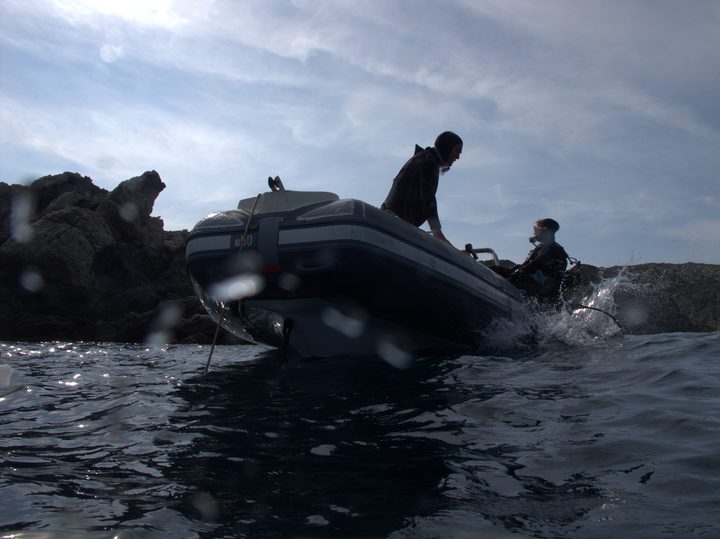
The western route is the longer and gentler dive, about 60 minutes. A RIB drops the group at the western tip, the descent goes to 25 m, and the ledge is followed with the reef on the left shoulder while the plateau shallows and lets the ascent come gradually. Operators point to the north side of this plateau, where the current meets the reef, as the place to look for big fish such as hammerheads.
One reef gives two dives of different weight: an eastern plateau worked as a strong-current drift with open blue beside it, and a western plateau that sits sheltered from the flow. Grey reef sharks come by the eastern plateau now and again, and one August 2022 liveaboard group was engulfed by a shoal of sardines thousands strong that closed round the divers and vanished into the blue.
The eastern plateau also carries two cleaning stations that give the drift fixed points to watch: young tuna in the middle of the plateau, and surgeonfish at a large block on the south side.
The current on the eastern plateau is usually very strong, and the open sea starts at the plateau end, so carry a surface marker buoy and keep close to the reef. The cave entrance at 45 m is for trained divers only: it reaches far into the reef and should not be penetrated without proper training. Big waves at the northern drop-in make a negative-buoyancy descent the sensible choice, and the walls fall away past 100 m, so check depth as you leave the plateau top.
What makes this dive site stand out.
Eastern plateau at 17-35 m in strong current, western plateau at 15-25 m in shelter.
Opens below the eastern plateau and reaches far into the reef.
Young tuna mid-plateau and surgeonfish at a large block on the south side.
Grey reef sharks come by the eastern plateau now and again.
24.7864°N, 35.1786°E
Advanced Open Water is our minimum, set by the very strong current on the main route and the open sea beyond the plateau end, not by depth; the site is described as unsuitable for beginners. It is not a regulation.
Summary
The eastern plateau is the advanced route; the western plateau is moderate and sheltered from the current.
Safety considerations
What can go wrong here, and what divers do about it. Conditions change - take the briefing from the operator on the day.
Multi-day safari boats with this site on their itinerary.
Compact 18-guest, 9-cabin wooden liveaboard focused on Deep South and St John's routes from Port Ghalib, reaching remote Rocky Island and Zabargad.

26-guest sister of Superior with Junior and Executive suites, ranging across Emperor's Egypt catalogue from northern wrecks and offshore Brothers, Daedalus and Elphinstone to the Deep South.
44m, 28-guest wooden liveaboard and the Sea Serpent Fleet's technical flagship, running the fleet's shared Egyptian Red Sea route pool: offshore Brothers-Daedalus-Elphinstone, northern wrecks and the Strait of Tiran, and southern St John's and Fury Shoals.

Teak-finished 42m, 24-guest liveaboard running Seawolf's full Egypt catalog from Hurghada and Port Ghalib, from northern wrecks and the Strait of Tiran to the Brothers, Daedalus, Elphinstone and the Deep South.
40m, 26-guest wooden liveaboard (SS Glorious Miss Nouran) running the Sea Serpent Fleet's shared Egyptian Red Sea pool: Brothers-Daedalus-Elphinstone, northern wrecks and Tiran, St John's and Fury Shoals, with a panoramic suite and rebreather support.
Book a guided dive at this site.

Eco-diving resort south of Marsa Alam with 3 villages, unlimited house reef diving, 60+ sites, and access to Elphinstone Reef.
Get in touch to add or claim your dive center listing on DiveCodex.
One liveaboard operator suggests the eastern plateau in the morning and the western plateau in the afternoon, to catch the light on the reef face.
Operator descriptions differ. One gives the reef as 700 m at its longest; another gives 250 m long and 100 m wide, wedge-shaped from west to east, under the name Gota Sharm. A dive covers one plateau, about 40 minutes on the eastern route and about 60 on the western, so the difference changes the plan very little.
It is not. Shaab Sharm is an offshore reef about 12 km off the Marsa Alam coast in the southern Egyptian Red Sea, reached by boat. Sharm El Sheikh is a separate resort region on the Sinai peninsula, far to the north, and searches for the reef's name often return its dive sites. The reef also appears as Sha'ab Sharm, Shoab Sharm and Gota Sharm.
Log your dives - notes, photos, conditions and the marine life you saw - and share them as one public diver profile. What you share helps the next diver, too.
Log every detail
Depth, duration, conditions, gear, buddy, notes — all in one place. Import from Suunto and other dive computers.
Track marine life
Record species sightings on each dive. Build a personal catalogue of everything you've seen underwater.
Your public dive profile
Share your dive history, stats, and experiences with a profile page you control. Show the world where you've been.