
Calypso Diving Estartit
Family-run PADI centre in L'Estartit, run by Peter and Jacqueline Lane for nearly 40 years, with PADI Green Star and four other environmental credentials.
PADI5 services8 languages
Also known as: El Tascó Gross, Tascó Gran, Tasco Gros
Large 210 m islet at the southern Illes Medes; gorgonian walls, easy circumnavigation, and a Garbí-sheltered buoy that holds when others blow out.
Last updated May 2026
Two hundred and ten metres of islet, large enough that a single dive can circle the whole rock without retracing ground. The mooring sits on the north face, in the lee of Garbí, and the standard entry drops along the buoy line into 10-15 m on the islet's vertical face. The wall is the visual signature — red Paramuricea clavata and white Eunicella singularis layered across the rock from about 15 metres down, damselfish and Mediterranean fairy basslets hovering in front of the fans, sea bream working the edges. Past 22 metres the wall meets a platform of large fallen blocks at 22-28 metres, a labyrinth of cavities sheltering octopus, moray and slipper lobster; an attentive scorpionfish is usually findable within the first ten minutes. From there the guide picks: south across a 5 m channel into the canyon between this islet and Tascó Petit, gorgonian-covered walls dropping to about 40 metres at the reserve cap, or a perimeter loop around the rock, working back through the nudibranch-rich shallows on the rim. Resident dusky groupers are the regular significant sighting; barracuda, dentex and the occasional tuna pass through the blue water between the islets when the current runs.
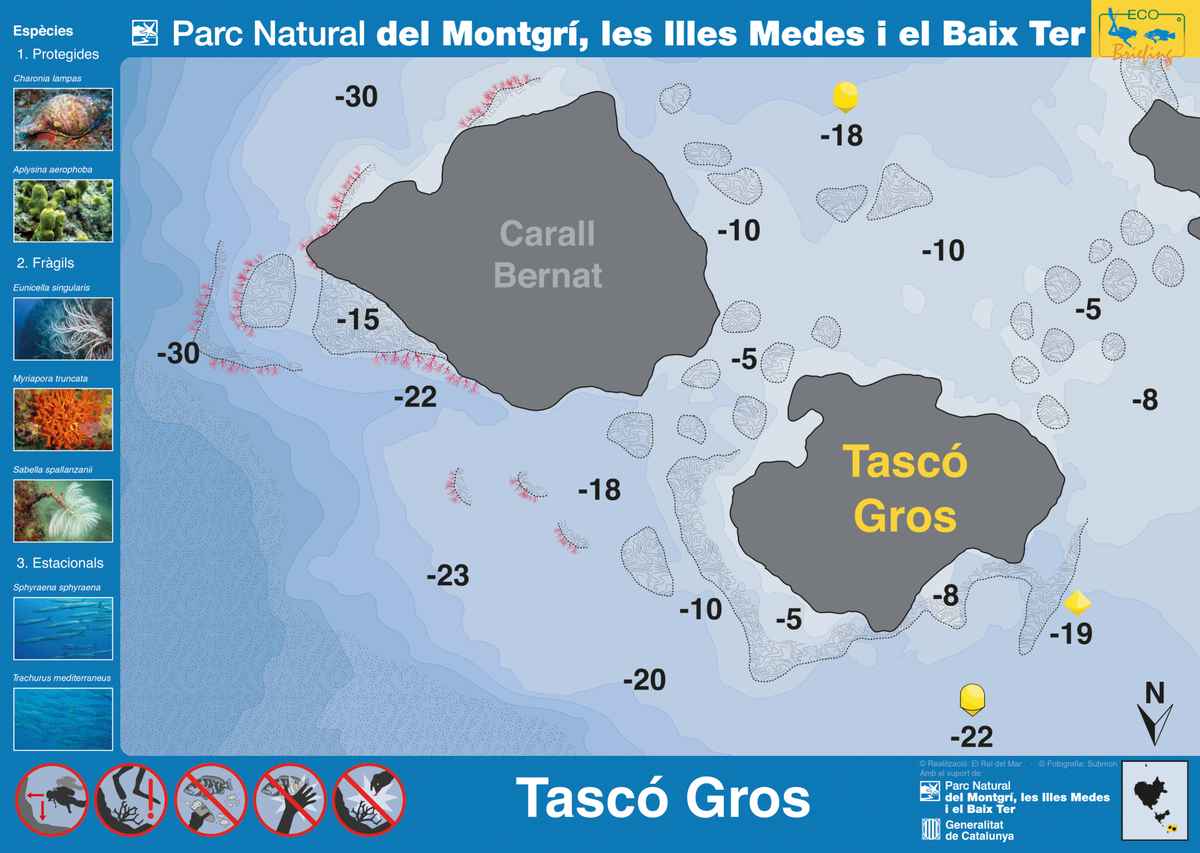
Illustration: Parc Natural del Montgrí, les Illes Medes i el Baix Ter — Generalitat de Catalunya
Scale and shelter, in that order. The 210-metre diameter gives the dive a meandering, exploratory feel rather than the spot-the-feature pattern of smaller Medes pinnacles — a guide can drop a group on one side and let the dive unfold around the rock without retracing. Shelter is the operational story. The Garbí-lee mooring means Tascó Gros stays workable when Carall Bernat's exposed face is too rough or when boats rotate off the north-and-east-facing pinnacles like Pota del Llop. Centres fall back to "the Tascons" when wind builds, which is one reason the site comes up so often when divers compare notes — it is the reliable card, not the bucket-list dive. In summer 2024, divers asking online where to spend a Medes day were told flatly that the Tascons were full of life. The second hook is the eagle-ray window: groups of ten to fifteen Myliobatis aquila gather here through summer, and one diver counted seven on a single dive in the sector in 2024. Single rays appear at many Medes sites; the cluster behaviour at this latitude is the distinctive variable. The third is more prosaic — the shallow rim is covered with nudibranchs through most of the diving season, a useful structural detail for safety stops and macro photographers planning a route.
Three setups off one mooring. The wall at 15-22 metres is the wide-angle stretch — red and white gorgonian fans layered across the rock with damselfish and Mediterranean fairy basslets in front, a moray usually in a cavity within the first ten minutes. Light fades on the boulder platform at 22-28 metres, so the deeper grouper-and-gorgonian frames reward an off-camera strobe or a steady backup torch. The shallow rim is the macro stretch and works as the return route: nudibranchs concentrate here through most of the season, slipper lobster turns up around the perimeter, and the 5 m channel toward Tascó Petit packs fish density into safety-stop depth. The summer eagle-ray window is a looking-up frame on the outer side of the islet — wide-angle, silhouetted against the blue.
Brief the day's wind with the guide before descent — that decides whether the dive runs the perimeter, the deeper wall, or the south canyon. On exposed corners current can build even when the lee side stays calm; on stronger days the team works one side and ascends back to the buoy. Set a hard depth ceiling before descent if the canyon is on the plan: the gorgonian slope draws divers deeper than they intend, and the reserve cap is 40 m. EAN32 is the standard recommendation for the longer profiles. The thermocline is the other planning input: surface temperature reads 22-24°C in July and August, but below 15-18 m it steps down to 16-17°C and diver logs at 25-30 m have read 15-16°C even in September. Plan exposure protection for the bottom rather than the boat. Reserve permits cost 5.30 EUR per diver on top of the centre tariff, daily quota is enforced and OWD/P1-qualified divers must be accompanied by an instructor or divemaster — centres handle the logistics, but summer slots need advance notice.
What makes this dive site stand out.
Buoy stays workable in south-west wind when Carall Bernat and exposed pinnacles are blown out
210 m diameter lets one dive loop the islet, mixing wall, boulder cavities and shallow rim
Shallow rim covered with nudibranchs through most of the diving season
Paired with Carall Bernat, Tascó Petit and Ferranelles as the southern grouper cluster
Groups of Myliobatis aquila documented in summer; not guaranteed on any given dive
42.0423°N, 3.2275°E
April-November dive season overall. June-September brings warmest water and the eagle-ray window; September is the local sweet spot for clarity and fewer crowds.
Reserve fee 5.30 EUR per diver per dive in 2026. Single Medes dive all-in typically around 59 EUR depending on centre. Verify rates with centre.
OW sufficient for the shallow circumnavigation and the boulder platform. AOW for the south canyon at 30-40 m. Reserve rules require OWD/P1 divers to be accompanied by an instructor or divemaster.
Summary
Easy to moderate on the shallow loop and boulder platform; advanced on the deeper wall and the canyon at the reserve's 40 m cap.
Safety considerations
What can go wrong here, and what divers do about it. Conditions change - take the briefing from the operator on the day.
Book a guided dive at this site.
Family-run PADI centre in L'Estartit, run by Peter and Jacqueline Lane for nearly 40 years, with PADI Green Star and four other environmental credentials.

PADI 5 Star centre on L'Estartit seafront with stay-and-dive packages, four daily boat dives between Illes Medes and Montgrí, plus tec diving.

Family-run PADI 5 Star Resort and SSI centre in L'Estartit since 1990, with two 30-diver boats running hydraulic lifts to the Illes Medes reserve.
Long-running L'Estartit dive centre (founded 1969) running a four-boat fleet to the Illes Medes reserve and Montgrí coast, with SSI training and a strong family/snorkel programme.

Family-run hotel and dive centre in L'Estartit since 1985, with two dedicated boats and four daily departures to the Illes Medes reserve.

Owner-led PADI centre on Carrer Salines in L'Estartit, capping each guide at 5-6 divers across the Illes Medes, Montgrí, and Cap de Begur.

L'Estartit's oldest dive centre (est. 1965), a PADI 5 Star CDC running daily boat trips to Illes Medes and the Montgrí Coast with volume dive packages.
Get in touch to add or claim your dive center listing on DiveCodex.
Dive centres in Catalonia must require insurance from every diver on their dives, and must be able to offer a policy to anyone who has none.
Yes, on the shallow circumnavigation and the boulder platform — OW certification is sufficient and the south side is sheltered. Reserve rules require an OWD or P1-qualified diver to be accompanied by an instructor or divemaster, which centres handle as standard. The south canyon at 30-40 m is AOW territory, and try dives are not permitted inside the reserve at all.
June through September is the window. Groups of ten to fifteen are reported at the site in summer; in 2024 one diver counted seven on a single dive in the Tascons sector. Cluster behaviour is not guaranteed on any one dive — single sightings are more common — but planning a trip in those months is the standard advice.
The mooring sits in the lee of Garbí (south-west wind). When the exposed outer faces of Carall Bernat or the north-east-facing pinnacles are too rough to work, this buoy usually stays calm enough to dive. That reliability is why the site shows up so often in centre rotations — it is the dependable card to play rather than the bucket-list dive.
Fifty to sixty minutes is typical, based on diver logs. The 60-minute cap is also the reserve regulation — no dive in the Medes can exceed it. A relaxed perimeter loop at 15-25 m fills the time; mixing the deeper wall and the boulder platform into the same dive uses it efficiently.
Yes, every scuba dive inside the Medes reserve requires a per-person permit. Centres handle this for clients. Budget 5.30 EUR per diver per dive on top of centre tariffs. Daily quota is enforced, so summer bookings need advance notice. OWD/P1 escort, 40 m depth cap, 60-minute time cap and a mandatory eco-briefing apply across the reserve.
Sharp thermocline. Surface runs 22-24°C in July and August; below roughly 15-18 m the temperature steps down to about 16-17°C, and diver logs at 25-30 m have read 15-16°C in September. A 5 mm hooded wetsuit handles the surface; 6-7 mm or a semi-dry is the safer call for the deeper wall and the canyon.
A cluster framing used by the Costa Brava centre association: Tascó Gros, Tascó Petit, Carall Bernat and Ferranelles together. The pitch is that this corner of the archipelago concentrates the largest groupers and the densest pelagic encounters, and centres often schedule a multi-dive day across the four.
Log your dives - notes, photos, conditions and the marine life you saw - and share them as one public diver profile. What you share helps the next diver, too.
Log every detail
Depth, duration, conditions, gear, buddy, notes — all in one place. Import from Suunto and other dive computers.
Track marine life
Record species sightings on each dive. Build a personal catalogue of everything you've seen underwater.
Your public dive profile
Share your dive history, stats, and experiences with a profile page you control. Show the world where you've been.