
Calypso Diving Estartit
Family-run PADI centre in L'Estartit, run by Peter and Jacqueline Lane for nearly 40 years, with PADI Green Star and four other environmental credentials.
PADI5 services8 languages
Also known as: Els Tascons, Els Tascons Petit, Tasco Petit
Small islet in the southern Illes Medes, twinned with Tascó Gros across a narrow channel; a shallow east route and a gorgonian wall on the south side.
Last updated October 2026
Two dives start from this islet. The east route runs toward Carall Bernat at 5 to 25 metres, past giant groupers, sea fans, sea bream and morays, with sea slugs among the stones in its lower part. The other follows the buoy down and then a sea-fan wall heading south, much deeper. Its bottom is quoted at 40 or 45 metres, deeper than the park recommends for recreational dives, so what the group does there is the centre's call on the day. Groupers hide on the wall, scorpion fishes and dentex sit on it, and barracuda hunt bogas in its higher part. Mind the dive computer on this route to avoid running off decompression time. On the south side, rocks at 22 metres hold nudibranchs, crabs and the full range of macro life before the gorgonian canyon.
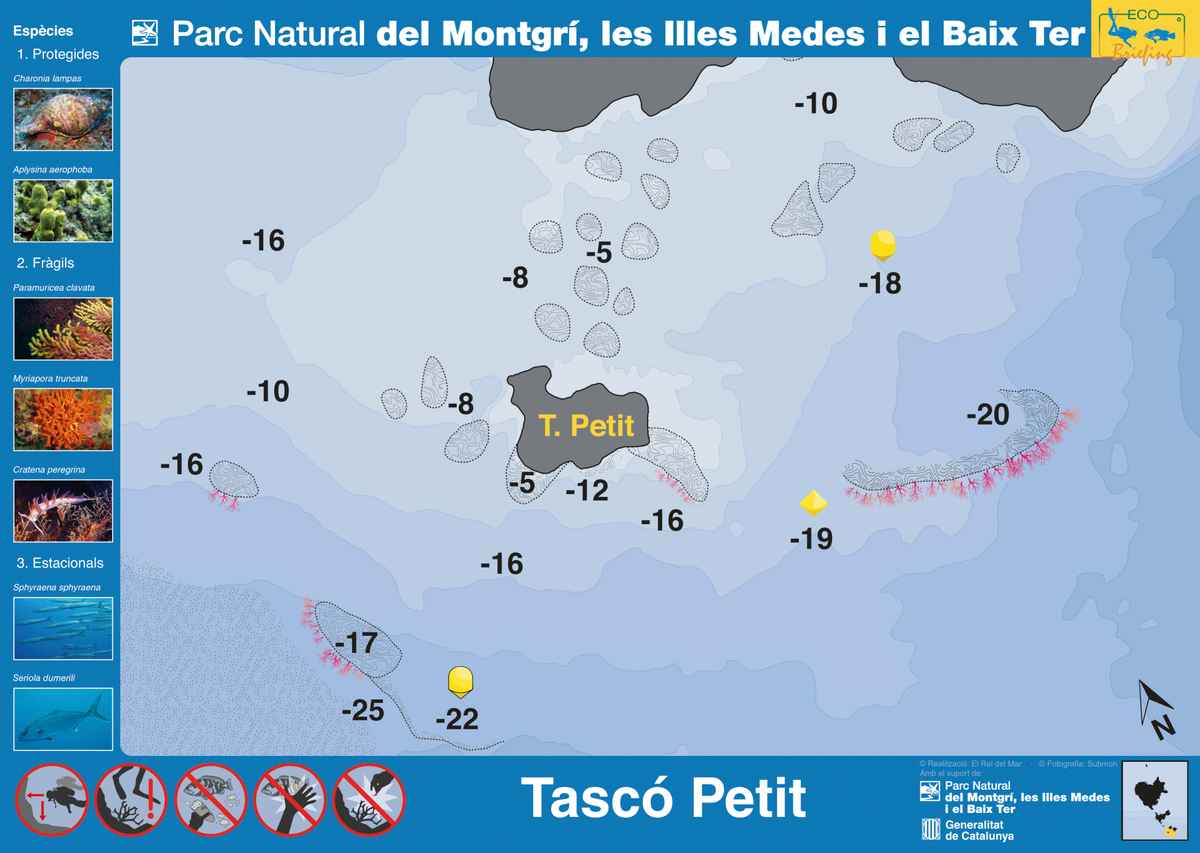
Illustration: Parc Natural del Montgrí, les Illes Medes i el Baix Ter — Generalitat de Catalunya
Red gorgonian reef is charted on four sides of the islet: about 16 m on the west, 17 to 25 m on the south-west, a short stretch at 12 to 16 m on the south-east foot and an arc at about 20 m on the east. That puts gorgonians at working depth, which is the draw here. The park lists the gorgonian, the bryozoan Myriapora truncata and the nudibranch Cratena peregrina as fragile, and barracuda and greater amberjack as seasonal visitors. Tascó Petit sits halfway between Les Ferranelles and Carall Bernat, and a channel about 5 m deep separates it from Tascó Gros.
Ask the guide about the current direction before descent. It decides whether the group can circle the islet, and it can be too strong to do so. The Tascons are among the exposed Medes sites where north and levante winds build strong current. On the wall route, watch the dive computer for unplanned decompression. Nitrox 32% is recommended for the site. The water cools sharply below about 15 to 18 metres, to roughly 17°C at 32 metres, so plan exposure protection for the water at depth.
What makes this dive site stand out.
A shallow east route toward Carall Bernat (5-25 m) and a south wall route that goes much deeper.
Red gorgonian patches are charted on four sides of the islet, at roughly 12-25 m.
A narrow channel, about 5 m deep, separates the two Tascó rocks.
Variable and often strong, the recurring condition at this exposed corner.
Nudibranchs, crabs and small life on the rocks of the south side.
42.0411°N, 3.2267°E
Operators split on level: some say all levels, a local group of dive centres grades it Advanced and Expert. The grading follows the route. Open Water is the level the shallow east route asks for; the south wall is deeper than the park recommends for recreational dives, and what the group does there is the centre's call on the day. The reserve's own entry requirement is shown in the regulations module.
Summary
Graded inconsistently because it is two dives: the shallow east route is the gentler one, the wall is recommended to more experienced divers, and current varies by day.
Safety considerations
What can go wrong here, and what divers do about it. Conditions change - take the briefing from the operator on the day.
Book a guided dive at this site.
Family-run PADI centre in L'Estartit, run by Peter and Jacqueline Lane for nearly 40 years, with PADI Green Star and four other environmental credentials.

Family-run PADI 5 Star Resort and SSI centre in L'Estartit since 1990, with two 30-diver boats running hydraulic lifts to the Illes Medes reserve.
Long-running L'Estartit dive centre (founded 1969) running a four-boat fleet to the Illes Medes reserve and Montgrí coast, with SSI training and a strong family/snorkel programme.

Family-run hotel and dive centre in L'Estartit since 1985, with two dedicated boats and four daily departures to the Illes Medes reserve.

Owner-led PADI centre on Carrer Salines in L'Estartit, capping each guide at 5-6 divers across the Illes Medes, Montgrí, and Cap de Begur.

L'Estartit's oldest dive centre (est. 1965), a PADI 5 Star CDC running daily boat trips to Illes Medes and the Montgrí Coast with volume dive packages.

SSI Diamond Instructor Center in L'Estartit, authorized Illes Medes operator since 2008. Full spectrum from try dives to cave and technical diving.
Get in touch to add or claim your dive center listing on DiveCodex.
Dive centres in Catalonia must require insurance from every diver on their dives, and must be able to offer a policy to anyone who has none.
Nobody has a measured figure. One operator describes a canyon falling to 40 m, others put the wall at 45 m, and the Park's chart prints soundings only from 5 to 25 m. The seabed at the buoy is also contested: 30 m by one operator, 22 m at the south buoy on the Park's chart. Either way the deep side is deeper than the park recommends for recreational dives, so settle with the centre what the group does there on the day.
Because it is two dives. Some operators call it a dive for all levels, while a local group of dive centres grades it Advanced and Expert. One operator sends less experienced divers to the shallow east route (5-25 m) and recommends the wall to more experienced divers, so the rating follows the route and the current that day.
Log your dives - notes, photos, conditions and the marine life you saw - and share them as one public diver profile. What you share helps the next diver, too.
Log every detail
Depth, duration, conditions, gear, buddy, notes — all in one place. Import from Suunto and other dive computers.
Track marine life
Record species sightings on each dive. Build a personal catalogue of everything you've seen underwater.
Your public dive profile
Share your dive history, stats, and experiences with a profile page you control. Show the world where you've been.