

Buceo Sur Gran Canaria
French-run family dive center at Playa de Arinaga, next to El Cabrón, running small (max 3 divers/instructor) shore and boat dives all around Gran Canaria.
PADI / SSI4 services4 languages
Also known as: Como Tu, Como Tu Wreck, Veneguera
Advanced wreck dive off Gran Canaria's southwest coast: a small fishing boat on open sand at 27-30m, with garden eels and angel sharks around the hull.
Last updated October 2026
The boat runs out from Puerto de Mogán in about 15 minutes to the wreck near Veneguera Beach. A backward roll off the boat, and the anchor line leads down to a small fishing vessel on open sand, with the shallowest part of the dive at 27 metres and the sand at 30. There is a single hull to work, so the 20 minutes go on the hull and on the sand beside it, where the rays and the garden eels are. Current is often moderate to strong, which is what the line is for: the return is made on the same line.
The hull is a small former fishing vessel, now an artificial reef, and the life gathers on and around it. Garden eel colonies stand out of the sand beside it, butterfly rays and stingrays pass over the bottom, and angel sharks are reported on the sand. Amberjack and tuna cruise in the open water above.
Advanced Open Water is the minimum at both operators that run the dive, and one of the two adds the Deep Speciality. A DSMB is highly recommended because of the potential for strong currents, and both descent and ascent follow the anchor line. Around the island, summer visibility runs 20 to 30 metres and winter 15 to 20, and the water at depth is about 22-23 C in summer and drops to 18-19 C in winter; a 5 mm suit is typical, with 7 mm or a semidry worn in winter and on deep or repeated dives.
What makes this dive site stand out.
One small former fishing vessel, now an artificial reef, resting at 27-30m.
Garden eel colonies on the sand, with angel sharks reported around the hull.
A DSMB and the anchor line are part of the plan.
Entry is a backward roll, then a descent along the line.
27.8377°N, 15.7908°W
These are the calmer months, with the best visibility and comfortable water; the wreck is dived year-round.
Both operators that run the dive require Advanced Open Water; one of them adds a Deep Speciality.
Summary
Both operators grade it Advanced: the shallowest point is 27m and the current is moderate to strong.
Safety considerations
What can go wrong here, and what divers do about it. Conditions change - take the briefing from the operator on the day.
Book a guided dive at this site.
French-run family dive center at Playa de Arinaga, next to El Cabrón, running small (max 3 divers/instructor) shore and boat dives all around Gran Canaria.
Hotel-based PADI 5-Star center inside Hotel Cordial Mogán Playa, running daily two-boat-dive trips across SW Gran Canaria since 2007.

Beachfront PADI 5-Star center in Puerto de Mogán, diving SW Gran Canaria's wrecks, reefs, and caves.

PADI 5-Star centre in Arguineguín, Gran Canaria, teaching small-group courses in a private training pool it bills as the island's only one.
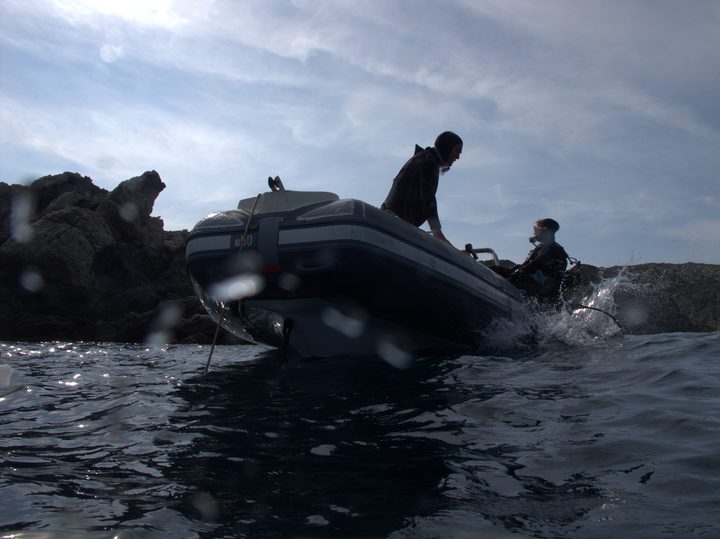
Get in touch to add or claim your dive center listing on DiveCodex.
Dive centres in the Canary Islands check that you hold the certification the dive needs.
It depends on who runs the trip. One of the two operators asks for Advanced Open Water plus the Deep Speciality, while the other names Advanced Open Water alone. Open Water divers are excluded either way, since the shallowest point is 27 metres.
Both are described as possible in summer only, and they are rare. The regulars are the garden eels and the angel sharks, and a turtle or a hammerhead is a bonus.
Veneguera is the beach and valley on the southwest coast. The wreck is sold as Veneguera Wreck Como Tu and lies off that beach, reached by boat from Puerto de Mogán.
Log your dives - notes, photos, conditions and the marine life you saw - and share them as one public diver profile. What you share helps the next diver, too.
Log every detail
Depth, duration, conditions, gear, buddy, notes — all in one place. Import from Suunto and other dive computers.
Track marine life
Record species sightings on each dive. Build a personal catalogue of everything you've seen underwater.
Your public dive profile
Share your dive history, stats, and experiences with a profile page you control. Show the world where you've been.