
Diving in Balicasag
Wall and slope diving off Panglao under a column of bigeye trevally, with turtles in the shallows, on a capped quota that is booked ahead.
Last updated October 2026
Overview
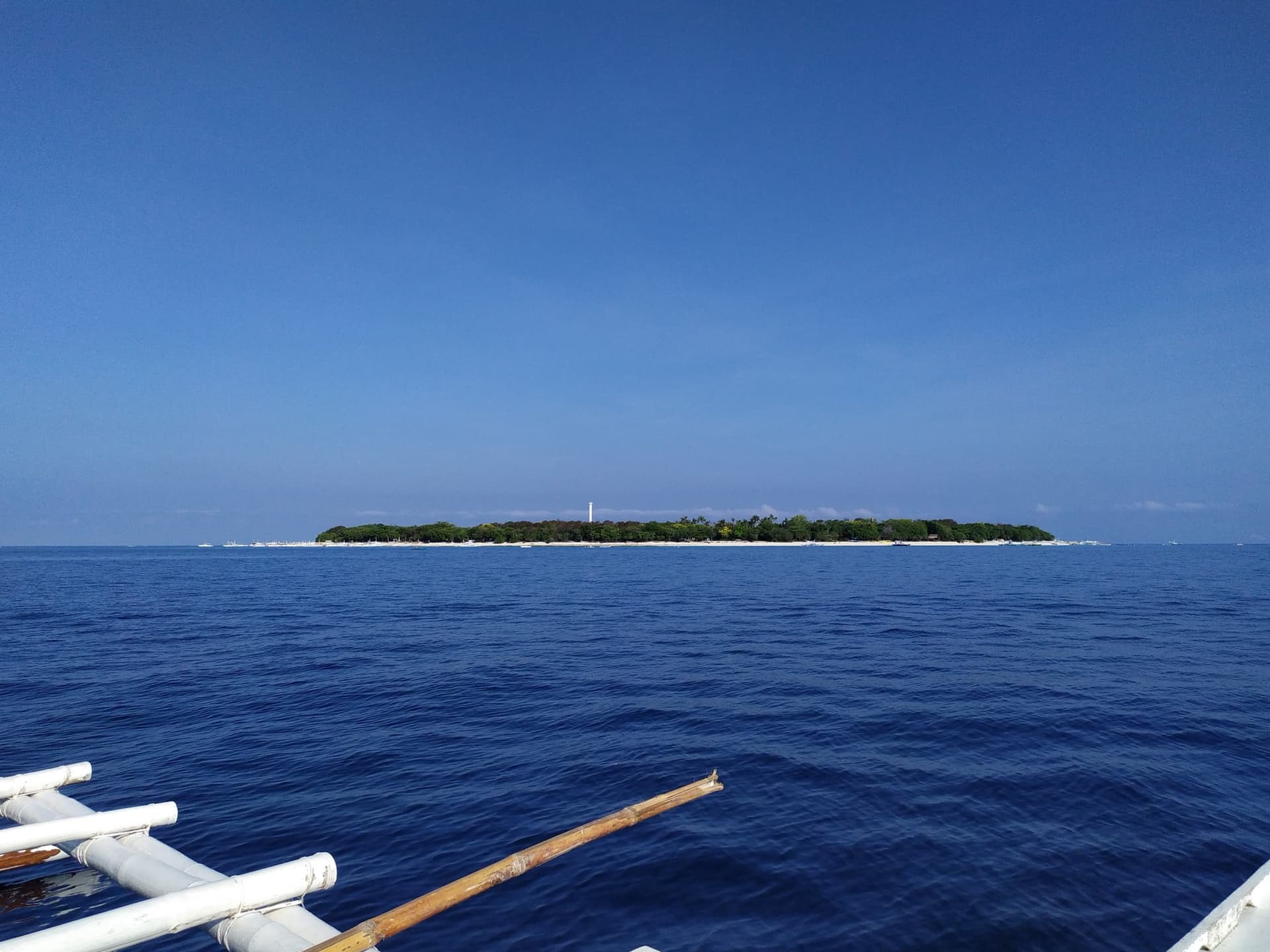
A column of bigeye trevally turning over a wall is the picture Balicasag sells, and operators place it at several of the island's five dive sites. A fringing shelf rings the island and breaks away on every side, so nearly every dive starts shallow and carries on past recreational depth.
Black Forest is the signature slope, started against the current and finished as a drift, with a black coral stand on the deep part that most divers will not reach. Cathedral holds the north point, with overhangs and gaps lit from above on a bright day. Rico's Wall runs along the west side in front of the sanctuary, with giant clams in the shallows. Diver's Heaven is the seagrass edge where green turtles graze, and Rudy's Rock is the southwest drop-off. Hawksbills turn up beside the greens.
A 1978 presidential proclamation listed Balicasag as a tourist zone and marine reserve, in an entry of its own beside Panglao and Cabilao1. Silliman University ran a conservation programme on the island in 1985 and 19862, and the Balicasag Island Fish Sanctuary, 3.44 hectares of west-side reef where nothing may be taken, was established in 1998 under Municipal Ordinance No. 083.
Planning your visit
Your shop books Balicasag and the slot comes before the boat; every dive is a day trip out of Panglao. Operators describe a municipal limit of 150 divers a day on two dives each, shared by every centre, which makes 300 dives a day, or 60 at each of the five sites. The 60-dive ceiling began as a 2014 provincial board recommendation to the Municipality of Panglao, made alongside an advance reservation system and a no ticket, no dive policy4. The same recommendation proposed barring introductory and training dives except at the island resort, and shops sell Balicasag to certified divers only.
You cannot turn up. Your shop applies to the town for you with a copy of your certification card, reservations on the day are refused, and a boat without bookings does not sail. Shops say they can secure tickets only about three months ahead, so anything booked earlier stays provisional. The booking system is described as assigning a dive site at a set date and time5, so you ask your shop which dive your slot carries and do not choose it.
An environmental fee is reported at 250 pesos per diver per day since 2015, while one operator's 2026 price list shows a 400 peso sea entry fee. Confirm the amount and ask what the trip price covers.
Operators sell the island to Open Water divers, and the walls drop well past that level, so agree a maximum depth with your guide. From about June to October the southwest monsoon is reported to confine diving to the sheltered northeast sites, Cathedral and Diver's Heaven, and boats are reported to crowd onto them. Ask your shop what the day's plan is before you pay for the trip.
Only three hyperbaric chambers were operating in the Philippines in February 2025, so do not count on one being near Bohol. Carry insurance with hyperbaric cover.
Geology & underwater terrain
A flat limestone island ringed by a fringing reef shelf that breaks into near-vertical walls and steep slopes on every side, with small caverns and overhangs cut into the west and north faces.
Dive sites in Balicasag
The diving here splits into 3 zones:
- North and northeast
- — Cathedral at the north point and Diver's Heaven on the northeast shoulder, the pair that stays diveable when the southwest monsoon blows.
- West side
- — Rico's Wall, the drop-off in front of the island resort and along the no-take sanctuary, with giant clams and a very shallow reef top.
- South and southwest
- — Black Forest on the southeast slope and Rudy's Rock on the southwest drop-off. The deep end of the island, with the black coral stand and the one site dived as a drift.
North and northeast
West side
Marine life
When to dive
- Best season
- December to May
- Water temperature
- 26 to 30 C
From about June to October the southwest monsoon is reported to confine diving to the sheltered northeast sites, so a summer booking may land on a different site than planned. December to April or May is the usual window for conditions and visibility.
Safety considerations
What can go wrong here, and what divers do about it. Conditions change - take the briefing from the operator on the day.
- Depth: Every site is a wall or a steep slope with no floor inside recreational range, and the black coral on the Black Forest slope sits below Open Water depth.Agree a maximum depth on the boat and treat every published maximum as the depth an operator turns divers around at.
- Current: Currents run from nothing to strong depending on the site and the day. Black Forest is normally started against the current and finished as a drift.Follow the guide's entry direction, carry an SMB for a drift finish and stay low over the sand on the first half of Black Forest.
- Surface and boat traffic: In swell the day fleet is reported to concentrate on the same sheltered sites.Deploy an SMB before surfacing, surface on the line and let your guide time the entry away from the group.
- Marine life: Triggerfish are reported aggressive from May to July.Leave a triggerfish's patch sideways and level, facing it, and do not ascend to escape one.
- Remote location: Balicasag is a day trip across open water from Panglao, so help is a boat ride away. Only three operational hyperbaric chambers were counted in the whole Philippines in February 2025, so do not count on one being close.Carry insurance with hyperbaric cover and confirm the evacuation plan with your shop before the boat leaves.
Rules and permits
Marine reserve · Managed by Municipality of Panglao · Permit required
An environmental fee is reported at 250 pesos per diver per day since 2015, while one operator's 2026 price list shows a 400 peso sea entry fee, so confirm the amount and what your trip price covers.
Frequently Asked Questions
Who sets the daily limit at Balicasag, and is it a law?▾
Operators present the limit as the Municipality of Panglao's rule, but its documented root is a recommendation. A provincial planning board proposed the 60 dives per site per day ceiling on 1 August 2014, and no statute with a number of its own carries the figure. Municipal Ordinance No. 08 of 1998, which often gets attached to Balicasag, created the fish sanctuary and sets no cap on diving.
Is Balicasag booked by lottery, and do I get to choose my dive site?▾
There is no lottery. Places are shared between centres first come, first served, in the order the town receives applications, which is why a shop that applies late can find a day full. The booking system then assigns a site at a set date and time, so the site arrives with the slot. Ask your shop which site yours carries, and expect weather to override it.
Can an Open Water diver dive Balicasag, and can you learn to dive there?▾
Open Water is the level operators sell the island at. Learning is different: the 2014 recommendation proposed barring introductory and training dives except at the island resort, and shops sell Balicasag to certified divers only, so courses run at Panglao's own sites. What Open Water does not cover is the deep end. The black coral on the Black Forest slope sits in Advanced or Deep territory.
Is Balicasag too crowded to be worth it?▾
Crowding follows the weather more than the quota. In calm water the picture is turtles in the shallows and jacks over the slope. In swell, boats are reported to converge on the same few sheltered sites, at the surface and below, so a calm morning and a staggered entry matter. Complaints about trampled reef concern the shallow snorkel zone, where monitoring is described as weak, and the deeper dive sites are described as healthier.
Which site should you ask for if you only get two dives?▾
The booking assigns the site, so this is a preference at most. Black Forest suits the slope, the jacks and, for those qualified, the black coral, and it is the one graded moderate because of its current. Cathedral is for the overhangs and the light through them. Rico's Wall is for the sanctuary shallows and giant clams. Rudy's Rock is a southwest drop-off with shallow coral on top. A newer diver should ask for Diver's Heaven, where the dive spends most of its time on a shallow shelf and reef crest and the green turtles graze.
Is Rico's Wall the same dive as the Marine Sanctuary?▾
For anything you can book today, yes. The west side fronts the Balicasag Island Fish Sanctuary, and the wall along it is called Rico's Wall by some shops and the Marine Sanctuary or the Sanctuary by others. The sanctuary name began as a label for the whole stretch of coast in front of the no-take zone, which is why older accounts sometimes attach it to the neighbouring Rudy's Rock end. Rudy's Rock is a separate site about 400 metres to the southwest.
References
- 1.Office of the President, Republic of the Philippines (Lawphil Project reproduction), November 10, 1978 — Proclamation No. 1801: Declaring Certain Islands, Coves and Peninsulas in the Philippines as Tourist Zones and Marine Reserve
- 2.Coastal Conservation and Education Foundation, February 12, 2019 — MPA Database: Balicasag Island Fish Sanctuary
- 3.Coral Triangle Atlas (CTI-CFF) — MPA record 4007000: Balicasag Island Fish Sanctuary
- 4.Bohol Provincial Planning and Development Office, August 2014 — PIEC for SEPP Board recommends measures for diving and cave usage
- 5.Bohol Island News, March 18, 2023 — Bholdex 23 adopts EUF, ABS, ensures dive site protection
Every dive has a story. Share yours.
Log your dives - notes, photos, conditions and the marine life you saw - and share them as one public diver profile. What you share helps the next diver, too.
Log every detail
Depth, duration, conditions, gear, buddy, notes — all in one place. Import from Suunto and other dive computers.
Track marine life
Record species sightings on each dive. Build a personal catalogue of everything you've seen underwater.
Your public dive profile
Share your dive history, stats, and experiences with a profile page you control. Show the world where you've been.