
Diving in Cabilao
A quiet island off western Bohol whose west-coast wall is hung with giant gorgonians and pygmy seahorses, dived from the resorts on the island.
Last updated October 2026
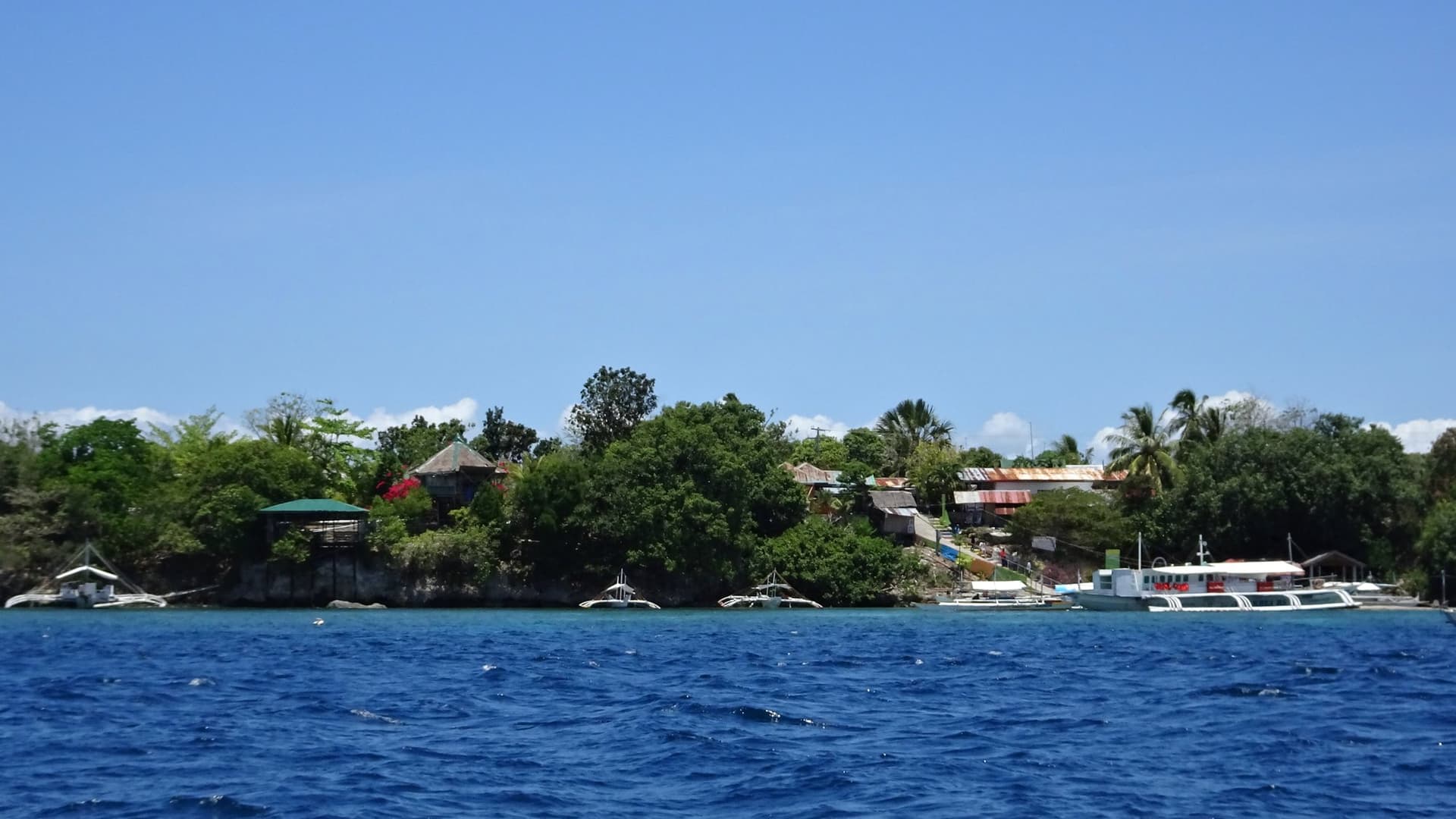
Overview
From the lighthouse headland down to South Point, the reef flat on Cabilao ends at about five metres and the rock goes vertical. The resident operator describes that wall running to around 60 metres at several sites and about 50 at another, hung with giant gorgonian fans, barrel sponges and soft corals, with small caves and overhangs. Those figures describe the terrain and are no dive profile; the interest starts at the top of the wall, and the deeper fans that hold the pygmy seahorses sit around 25 metres. Boats work this coast in the afternoon, when the light lands on the face. Gorgonia Wall is the signature dive, South Point adds caves where whitetip reef sharks sometimes rest at about 20 metres, and Cambaquiz pairs a deeper wall with stargazers and octopus after dark.
On the north and east the reef slopes into sand, seagrass and coral blocks, and the diving turns to macro. Ghost pipefish, sea moths, leaf scorpionfish and stargazers work the Lighthouse sand, giant frogfish turn up on the slopes, and night dives off the house reefs are routine. Green turtles appear on most dives. Two pygmy seahorse species, Bargibant's and Denise's, have both been photographed on the deeper fans on one trip.
Schooling scalloped hammerheads gave Cabilao its name in the 1990s. They are reported fished out around 1999 and 2000, and divers have reported none since. Tour and catalogue copy still sells a December to April hammerhead season, one catalogue putting the schools at 40 to 45 metres, which would be a depth target on a wall with no bottom in recreational range for an animal absent since the early 2000s.
The shallow coral is reported damaged since the December 2021 typhoon: the reef flat and the Lighthouse 1 and South Point walls were mostly rock and rubble with algae in 2025, while the deep fans on Gorgonia Wall were reported intact. That rests on a single account of four dives, so the reef may read differently on your visit.
Planning your visit
A bed here comes with the diving: the resorts pair accommodation with a dive centre, so the resort you pick is the operator you get. The island is not bridged to Bohol and every route ends in a boat, about two hours door to door on a resort transfer from Tagbilaran or the Panglao airport and three hours by boat from Alona Beach. Panglao shops run day trips only when they can fill a boat, and the usual advice is to stay three or four days. Once you are here the sites are minutes away, the boats come back between dives, and guiding is often one to one because the resorts are rarely full. Nitrox is available at some centres and is worth taking on a wall profile.
A 1978 proclamation declared Cabilao a tourist zone beside Panglao and Balicasag, which controls development and puts no rule on divers1. The island also sits inside the Cabilao Sandingan Islands Mangrove Swamp Forest Reserve, a forest instrument with no diving effect, whose standing is unresolved: the 2018 Expanded NIPAS Act legislates 94 protected areas and Cabilao is not among the five Bohol entries2, while the environment department still publishes the reserve's profile3. A 2017 House Bill is often cited as having removed the protection; a bill only proposes, and the legislated list above is what can be checked. What reaches you is local: two barangay no-take marine protected areas, enlarged by 50 acres in 2010 in return for restoring the Spanish-era lighthouse4, and a small daily fee collected for them.
Two things need settling before the first dive. The wall offers no natural stop, so set a maximum depth on the surface. And plan the evacuation chain: the island has no hospital and no chamber, definitive care means a boat crossing plus an hour or two of road to Tagbilaran, and public boats stop around six in the evening. Carry insurance with evacuation cover and ask your resort how it would run one.
Geology & underwater terrain
A small triangular island in the Cebu Strait ringed by a fringing reef, steeply asymmetric underwater: a near-vertical wall on the west, gentle slopes of sand, seagrass and coral blocks on the north and east.
Dive sites in Cabilao
The diving here splits into 2 zones:
- West coast (lighthouse to South Point)
- — The wall diving. The reef flat ends near five metres and the face drops away under giant gorgonians, barrel sponges and soft corals, with small caves and overhangs. Boats work it in the afternoon, when the light lands on the wall.
- North, east and the neighbouring islands
- — Slopes, sand, seagrass, coral blocks and pier pilings, the macro and night half of the island. Cambaquiz is the exception, a deeper wall as well as a slope, and the piers on Sandingan and Pangangan add structure.
West coast (lighthouse to South Point)
Gorgonia wallTop dive
A big-fan wall dive for divers who will set their own depth limit
LighthouseTop dive
Slow macro and night diving on shallow seagrass and sand
South pointTop dive
Divers comfortable in moving water who want caves and overhangs on a wall dive
Shark view point
Deep macro in current, for divers comfortable working near 30 m
Marine life
When to dive
- Best season
- December to May
- Water temperature
- 25 to 29 C, diveable year-round
The dry months are the settled window, and the island is dived in every month of the year, late July and August included. Visibility of 18 to 25 metres is the working expectation, about 10 on a poor day, and a 3 mm full suit covers the water.
Safety considerations
What can go wrong here, and what divers do about it. Conditions change - take the briefing from the operator on the day.
- Depth: The west-coast walls are described by the resident operator as running to around 60 metres at several sites and about 50 at another, so nothing on the wall stops a descent inside recreational range. Destination copy that still sells schooling hammerheads in a December to April season, one catalogue placing them at 40 to 45 metres, gives a diver a reason to go deep repeatedly for an animal divers have not reported here since about 2000.Set a hard maximum depth and a gas plan before descending any west-coast wall, and read the deep hammerhead copy as advertising. The sea fans, the coral and the macro start at the top of the wall.
- Overhead: Caves and overhangs at working depth at South Point, around 20 metres, and and along Gorgonia Wall and Cambaquiz.Stay guided and inside the light zone. Depth plus overhang on one dive is a gas-planning problem.
- Remote location: The island has no hospital and no recompression chamber. Definitive care is in Tagbilaran, across the strait by boat and then roughly an hour to two hours by road, and public boats stop running around 18:00. A chamber in Bohol cannot be counted on.Conservative profiles, nitrox where the resort has it, dive insurance with evacuation cover, and a plan that does not depend on a boat after dark.
- Current: Current View Point is named for its current, South Point runs a mild flow around the headland and the Fallen Tree stretch turns into a drift when the water moves.Let the centre choose the site by the day's conditions and carry a surface marker buoy on the point dives.
- Marine life: Stonefish and scorpionfish sit on the sand and rubble sites, and the fire urchins that carry commensal shrimp are a magnet for photographers.No contact with the substrate; hover over the sand. The exposure is on the macro sites, not on the walls.
Rules and permits
National rules also apply: Rules and permits in Philippines
Frequently Asked Questions
Are there still hammerhead sharks at Cabilao?▾
Divers do not report them. Schooling scalloped hammerheads were the island's fame in the 1990s, and they are reported as fished out around 1999 and 2000. The date comes from a single journalist's account of a week on the island in 2019, with a vague recollection of twenty or more years earlier behind it, so 1999 to 2000 is a reported window and not a documented one. What is well supported is the absence since: dive reports from 2007 onward, including a structured record from 2013 and an eleven-dive stay in 2017, list no sharks, and the largest animals mentioned are turtles and wrasse. Tour and catalogue copy still sells a December to April hammerhead season. Do not plan a dive around it.
Is Cabilao worth diving without the hammerheads?▾
For wall and macro diving, yes. The west coast is a gorgonian wall hung with sea fans, barrel sponges and soft coral, with two species of pygmy seahorse on the deeper fans, and the north and east add ghost pipefish, frogfish, sea moths and night dives. Green turtles are routine. Divers who rate it highly say so on coral and colour, and say in the same breath that there are no big fish. If pelagics are the point, this is the wrong island.
Cabilao or Balicasag, if there is only time for one?▾
They are different trips. Balicasag is known for its jackfish school and coral slopes and is usually dived as a boat day from Panglao. Cabilao is an island you stay on, and what it offers is coloured walls and macro with no big fish. Several divers rate Cabilao's reef above Balicasag's, though most of those comparisons were made before Typhoon Odette. If you want to be somewhere quiet with nothing to do but dive, Cabilao is the one; if your week is already based on the Panglao strip, Balicasag is the easier add.
Did Typhoon Odette damage the reef at Cabilao?▾
Reportedly yes in the shallows and much less on the deep wall, though the only post-typhoon account is one observer's four dives at three sites between 31 July and 3 August 2025, made to look at hard coral. The reef flat at Lighthouse 1 and South Point was mostly rock and rubble with algae where hard coral stood before 2021, with sparse small recruits at nine to twelve metres, while Gorgonia Wall was still a very nice wall with large sea fans at around 27 metres. The glowing coral descriptions of Cabilao all predate the typhoon, so expect less hard coral in the shallows than older trip reports promise.
Do you need Advanced Open Water to dive Cabilao?▾
Ask your resort what it expects; the real question is depth more than the card. The west-coast walls continue past recreational limits, so your certification depth limit is a decision you take on the surface. Open Water divers have plenty at the top of the wall and on the sand, slope and coral-block sites, which suit a newly certified diver. The deeper fans that hold the pygmy seahorses sit around 25 metres, beyond the Open Water limit, so Advanced training opens up the macro the island is known for.
How many days do you need on Cabilao?▾
Three or four, a figure divers have repeated for years. The island has a modest set of sites, all close, and no single attraction that holds a diver for a fortnight, the way a shoal or a shark station does. There is a restored Spanish-era lighthouse with a small museum and quiet roads, and not much nightlife. Longer stays suit divers who want exactly that, or who pair it with Panglao, Dauin or Moalboal.
How do you get to Cabilao?▾
Every route ends in a boat, because the island is not bridged to Bohol the way its neighbours Sandingan and Pangangan are. A resort transfer from Tagbilaran or the Panglao airport takes about two hours door to door by van and banca. Independently, a bus from Tagbilaran's Dao terminal toward Talibon or Tubigon runs about an hour to the Moalong bridge for around 120 pesos, then a tricycle to Mocpoc pier for about 100, then a boat; when no scheduled crossing is running, a boat hired straight to the resort cost about 1,000 pesos in 2025. A bus to Loon port and a banca from there is another option, and a public banca has crossed the Cebu Strait from Argao, landing at Talisay pier.
Can you dive Cabilao as a day trip from Alona Beach?▾
It can be done and it is a long day. Panglao shops run the trip only when they can fill a boat, and the crossing is three hours by boat or about an hour and a half by road plus a short boat ride. Divers who know the island say the best way to dive it is to stay, which also gets you afternoon dives on the west wall, where the light is best.
Is Cabilao a marine reserve, and was its protection removed?▾
It carries several labels and only one affects a diver. A 1978 proclamation named the island a tourist zone beside Panglao and Balicasag, which is a development control with no diving rule. The island also sits inside a mangrove swamp forest reserve, a forest instrument that does not govern diving. Online you will read that its protection was removed in 2017; that rests on a House Bill, and a bill is only a proposal and changes no law by itself. What can be checked is that the Expanded NIPAS Act of 2018 legislates 94 protected areas and Cabilao is not among the five in Bohol, while the environment department still publishes the reserve's profile. The reserve's standing today is unresolved. For a diver, what counts is local: two barangay-level no-take marine protected areas.
How do you choose a resort on Cabilao?▾
On Cabilao the resort and the dive centre come as a pair, so the choice of bed is the choice of operator. The resorts sit in Pantudlan and Cambaquiz and run boats that reach any site on the island in minutes. Because occupancy is low, private guides and private boats have been reported cheap, from 4 to 9 US dollars a dive on top of the dive price in 2018, and some resorts have few or no other guests. Ask about boat size, nitrox, which sites the boat will run on the day you want, and confirm directly that the resort is taking guests before you book.
References
- 1.Office of the President, Republic of the Philippines (Lawphil Project reproduction), November 10, 1978 — Proclamation No. 1801: Declaring Certain Islands, Coves and Peninsulas in the Philippines as Tourist Zones and Marine Reserve
- 2.Congress of the Philippines (Lawphil Project reproduction), June 22, 2018 — Republic Act No. 11038: Expanded National Integrated Protected Areas System Act of 2018
- 3.Protected Area Information System, DENR Biodiversity Management Bureau — Cabilao Sandingan Islands Mangrove Swamp Forest Reserve, record DENRR700014
- 4.Seacology (with PROCESS Bohol), January 2010 — Pantudlan, Cabilao Island project record
Every dive has a story. Share yours.
Log your dives - notes, photos, conditions and the marine life you saw - and share them as one public diver profile. What you share helps the next diver, too.
Log every detail
Depth, duration, conditions, gear, buddy, notes — all in one place. Import from Suunto and other dive computers.
Track marine life
Record species sightings on each dive. Build a personal catalogue of everything you've seen underwater.
Your public dive profile
Share your dive history, stats, and experiences with a profile page you control. Show the world where you've been.