

Costa Brava Divers
PADI 5 Star centre on L'Estartit seafront with stay-and-dive packages, four daily boat dives between Illes Medes and Montgrí, plus tec diving.
PADI6 services5 languages
Also known as: El Baix de Cols
Easy Costa del Montgrí wall dive: a submerged rock breaks 1 m below the surface, drops as a gorgonian-covered cliff to 15 m, and ends in a short sponge-lined swim-through.
Last updated May 2026
The rock crowns just under the surface and the cliff falls away from there. Drop along the wall and the white gorgonians appear almost immediately, dense across the rock face down to about 15 m. The route hugs that wall: clean buoyancy is part of the dive, not a separate skill, because the coral is close enough to brush. At the base the wall meets sand, and a 15 m wide corridor opens between this rock and the next pinnacle. Spider crabs sometimes sit on that sand. Stingrays cross it occasionally.
Following the cliff to the right brings you to the tunnel. About 10 m of sponge-lined passage, wide and naturally lit, conger eels visible in the crevices on either side. In spring there are more of them, settled into the tunnel walls. Out the other end the route loops back along the rock toward the ascent. Most teams get 40-50 minutes of bottom time on a single tank at this profile.
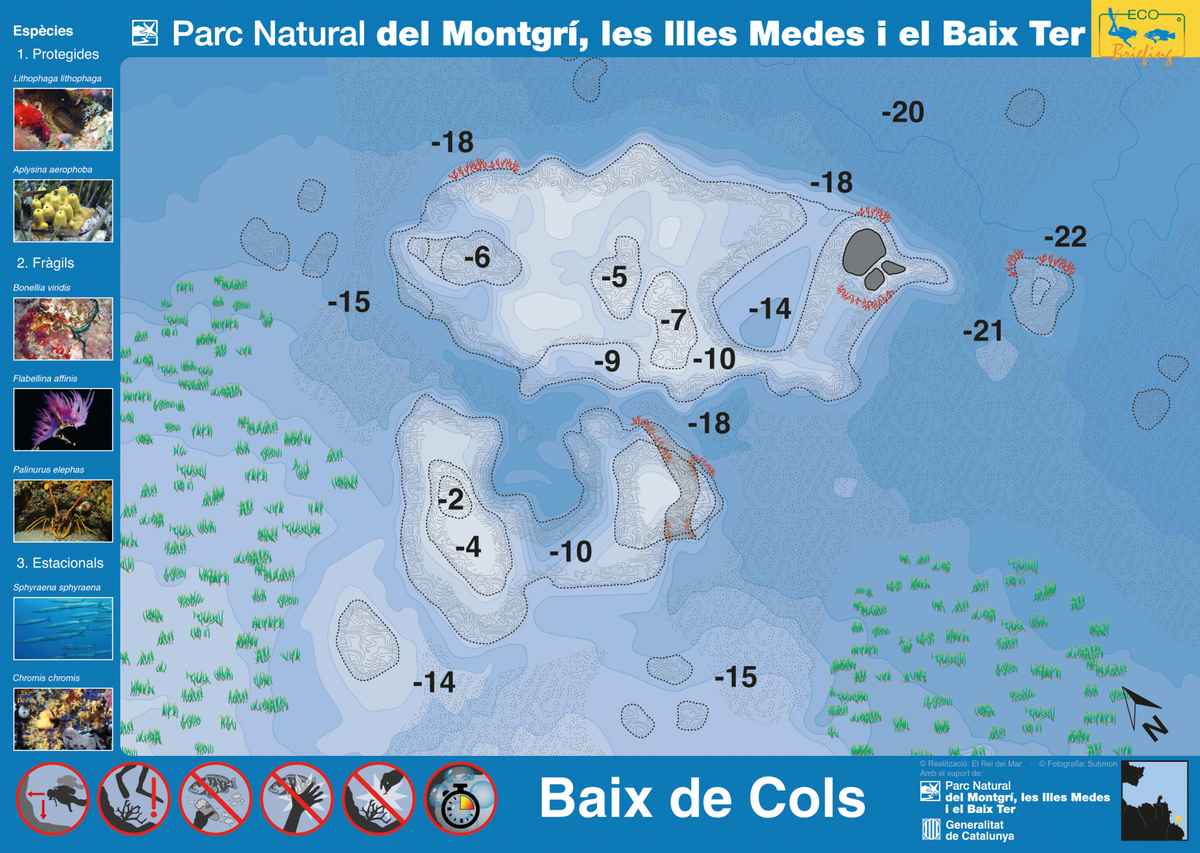
Illustration: Parc Natural del Montgrí, les Illes Medes i el Baix Ter — Generalitat de Catalunya
Three features stacked into one easy dive: a wall covered in Eunicella singularis, a sandy corridor, and a real swim-through, all inside Open Water depth limits. That combination is what the Medes-side dives are known for, and it's what divers travel for. Baix de Cols offers it on the coast, with no permit, no reserve quota, no booking window. Spanish divers asking online for advice on what to dive between L'Escala and L'Estartit have named this site in a four-dive shortlist alongside the Reggio Messina wreck and Cala Pedrosa, which is the company you want.
Bring a torch. The tunnel crevices and the darker patches of the wall are where the conger eels, lobsters, and octopus sit, and a light is the difference between seeing them and swimming past. Macro lenses do well here on nudibranchs, scorpionfish, and the gorgonian detail. Wide-angle catches the wall.
Departures generally run from L'Escala port rather than L'Estartit, so check with your centre. No permit is needed and there's no booking system, but local boats fill on summer weekends, so call ahead. Spanish dive insurance is mandatory and is sold by all operators.
What makes this dive site stand out.
White gorgonians coat the cliff from near the surface down to about 15 m
About 10 m of sponge-lined tunnel, naturally lit, no overhead training needed
Inside the Natural Park, outside the Medes marine reserve. No permit, quota, or fee.
Park itinerary is rated for beginners, max around 20 m, typical profile 15-20 m
42.0999°N, 3.1869°E
Conger eels concentrate inside the tunnel in spring. Summer brings warmer water and the most reliable visibility.
Dive Paradis publishes a low-season Baix de Cols line item at €35 for 2026 (boat, tank, weights). Other Costa del Montgrí coast rates apply at most local centres. No reserve fee.
The park itinerary classes the site as suitable for beginners. Open Water depth limits cover the full profile.
Summary
Shallow profile, no overhead environment, no current on the single logged dive. Buoyancy must stay clean along the gorgonian wall.
Protecting this site
What this site protects, and what divers do to avoid damaging it.
Book a guided dive at this site.
PADI 5 Star centre on L'Estartit seafront with stay-and-dive packages, four daily boat dives between Illes Medes and Montgrí, plus tec diving.
Get in touch to add or claim your dive center listing on DiveCodex.
Dive centres in Catalonia must require insurance from every diver on their dives, and must be able to offer a policy to anyone who has none.
Yes. The Generalitat de Catalunya itinerary lists it as a beginner-suitable dive, and local operators class it as all-levels. The full profile sits inside Open Water depth limits and the tunnel is a short, lit swim-through, not a cave penetration.
It runs about 10 m through the rock, with sponges lining the walls and conger eels in crevices. Both ends are lit, and the passage is wide enough that you don't need overhead-environment training. Local centres compare it to a smaller version of La Vaca on the Medes.
No. The site is on the mainland Costa del Montgrí coast, inside the Natural Park but outside the Medes marine reserve. The €5.30 reserve tax and the diver-quota permits apply only to Medes-side dives, not here.
The defining feature is the white gorgonian wall (Eunicella singularis). Conger eels and sponges fill the tunnel, especially in spring. Crevices hold octopus and lobsters. Spider crabs and stingrays cross the sandy corridor between the rocks from time to time.
May-October for water temperature and visibility. Summer (July-August) gives the warmest water (22-25 C surface) and the most stable visibility. Spring is the time to dive specifically for the conger eels gathering inside the tunnel.
Costa Brava Divers from L'Estartit and several L'Escala-based operators (Dive Paradis, Orca Diving) offer Baix de Cols as part of their Costa del Montgrí coast programme. Most departures are out of L'Escala port.
Log your dives - notes, photos, conditions and the marine life you saw - and share them as one public diver profile. What you share helps the next diver, too.
Log every detail
Depth, duration, conditions, gear, buddy, notes — all in one place. Import from Suunto and other dive computers.
Track marine life
Record species sightings on each dive. Build a personal catalogue of everything you've seen underwater.
Your public dive profile
Share your dive history, stats, and experiences with a profile page you control. Show the world where you've been.