

Adventure Divers
PADI and SSI center operating from Cabo de Palos port and La Manga Club resort, 25 years in the area.
PADI / SSI2 languages
Also known as: Bajo de En Medio, Bajo de Enmedio
Submarine mountain inside Cabo de Palos reserve from 40m to 3m, with a traversable cave exiting at 9m, gorgonian walls, and resident groupers.
Last updated September 2026
Most guided dives at Bajo de Dentro begin on the surface buoy and descend the chain to a 15m platform. The plan from there is a north-face drop to roughly 25m, a cave traverse exiting at 9m, and a choice for the second half: range east along the white-gorgonian wall, or push west to Las Agujas before returning to the summit for a safety stop. The summit comes up at 3-5m in three peaks, the shallowest top in the reserve, and the structure stacks vertically enough that staying around 9-18m still gives the cave exit, the wall edges, and most of the resident fish life. Groupers usually appear within metres of the descent line. The cave traverse is short - the 9m exit comes up fast - and the moment that surfaces in trip reports is the cave-mouth backlight, where divers exiting see open water lit through the upper opening. Las Agujas adds a 40m horizontal swim at depth and is usually framed as the destination feature for the second half. Barracudas circle the channel between the two needle pinnacles in the way that gets photographed in nearly every centre's portfolio. Time is the hard constraint: 45-50 minutes from boat-drop to surface, with reserve rules and boat rotation enforcing the cap. Real bottom time can be shorter than the total once descent and safety stops are counted.
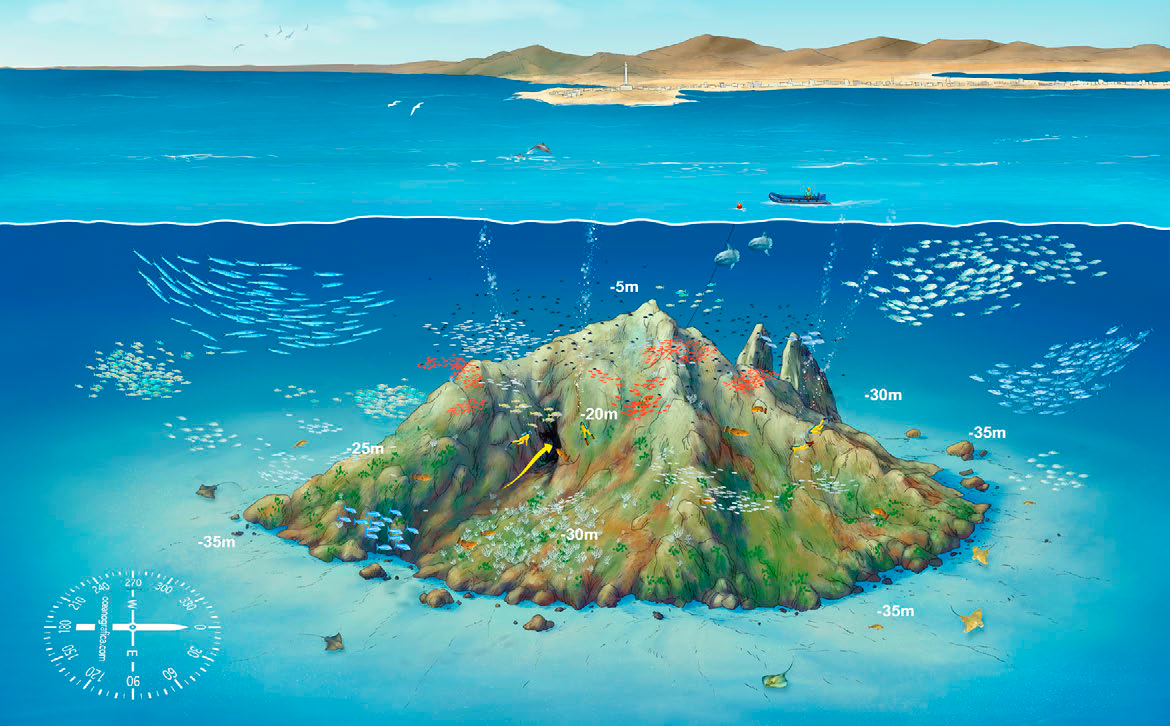
Illustration: © Oceanográfica (2021). Guía de Inmersiones de Cartagena - Cartagena Diving Guide. Boyra, A., C. Fernández-Gil, D. Balcarcel, A. Cánovas y M. A. G. Gallego.
Several reserve bajos offer reef structure and reserve-density fish life. Three things make this one the rotation default rather than an interchangeable option. First, the summit reaches 3-5m. Most other reserve bajos top out at 8m or deeper, so the off-gassing terrain at Bajo de Dentro is photographable rock rather than open blue. Second, the traversable cave on the north face is unique in the reserve. It is wide enough to see the exit from the entry, sits at 9m, and is decorated inside with yellow encrusting anemones; groupers and corvinas use it. Not a true overhead, but it functions narratively as the cave dive of Cabo de Palos. Third, the pinnacle structure compresses the depth range. From the 9m cave exit a diver can descend a wall to 25-30m, swim 40m west to Las Agujas, and ascend back to the summit - three distinct features without the long horizontal swims that flatter bajos require. Both the Cartagena dive guide and the centre that runs the most dives in the reserve mark this as the flagship rather than the technically deeper Bajo de Fuera, which is permit-capped and sold as a special trip.
The site reads two ways through a lens. Wide-angle work concentrates around the cave mouth and Las Agujas: the cave-mouth backlight is the recurring shot in trip reports, and the barracuda channel between the needles is the staple wide-angle scene most centres use in their portfolio. Macro is the second face of the dive. The cave interior carries dense yellow encrusting anemones, and underwater photographers in the regional forums describe Dentro as the bajo they prefer for shooting compared with the other inner-reserve sites. Visibility tracks the season. Winter and shoulder months deliver 25-30m of clarity for wide-angle; summer plankton and boat traffic compress it to 15-20m and push the case for macro. A torch earns its place for the cave colour even on bright days. The east face transitions from white Eunicella singularis gorgonians at 25-30m to red and yellow deeper, and the south wall holds anthias near the cave entrance.
Conditions are the variable, not the dive. Currents range from absent to strong and the mooring chain is where they hit hardest; descend and ascend on the line and stay close to the structure on the way up. The cave is a swim-through but not endless space - confident buoyancy matters and a torch helps. Carry a compass and SMB. Open-water exposure means a surfaced diver in current can be a long way from the boat fast; standard reserve practice, never optional. Reserve rules cap the dive at 60 minutes and one boat per site at a time underwater; centres typically run 45-50 minute total times. The 15-day advance medical paperwork is only for Bajo de Fuera. Some centres allow self-guided diving for known divers with sufficient certification; Naranjito Buceo lists it as optional. For solitude, regular advice is consistent: first dive of the morning, weekday, shoulder season. August catamaran drops are when group dynamics, not water conditions, become the limiter.
What makes this dive site stand out.
Wide swim-through with light at both ends, exit at 9m, interior walls of yellow encrusting anemones.
The shallowest top in the reserve, doubling safety-stop time as photographable terrain.
Two rock needles 40m west of the mooring at 30-35m, with barracuda schools cycling the channel.
Eunicella singularis meadows from 25-30m down, transitioning to red and yellow gorgonians.
Resident groupers, corvinas in the cave, and dentex on patrol along the walls.
37.6461°N, 0.6656°W
Strongest combined window: water still 20C+, plankton settled, fewer boats. May-June second-best. April runs cold and quieter on life per local divers.
Inner-reserve dive band across local centres. Centre-set; package and winter-discount pricing exists. Verify current rates with the dive centre.
Open Water or FEDAS B1 minimum for the summit, cave traverse, and upper walls. AOWD recommended for the east-face gorgonians and the deeper end of Las Agujas. Centres and guides disagree on the cert minimum because the answer is route-dependent.
Summary
Moderate is route-dependent. An OW diver with confident buoyancy can dive Bajo de Dentro on a calm day staying above 18m and traversing the cave; the deeper east-wall and the full Las Agujas circuit belong to AOWD divers. Current management is the deciding skill, not depth.
Safety considerations
What can go wrong here, and what divers do about it. Conditions change - take the briefing from the operator on the day.
Book a guided dive at this site.
PADI and SSI center operating from Cabo de Palos port and La Manga Club resort, 25 years in the area.

Long-running multi-agency dive centre in Cabo de Palos running daily boats into the Islas Hormigas Marine Reserve and the local technical wrecks.

Cabo de Palos dive centre operating since 2004, boating divers into the Islas Hormigas reserve and onto the namesake Naranjito wreck.
SSI and PADI dive centre off the main strip in Cabo de Palos, with a 140 m² shorefront base and small-group RIB trips into the Islas Hormigas marine reserve.

PADI 5-Star Career Development Center on the Cabo de Palos harbour, run by Dutch course-director couple Martin and Brenda van Gestel since March 2023.

Nature-and-education dive center in Cabo de Palos, the first National Geographic Dive Center in Spain and the first Avelo center in Europe.
Get in touch to add or claim your dive center listing on DiveCodex.
Yes, on the right route. The summit at 3-5m, the cave traverse exiting at 9m, and the upper walls keep within Open Water limits. Centres tailor the profile to the group, taking OW divers along the summit and cave and routing AOWD divers down the east-face gorgonians and the full Las Agujas circuit. Current management is the deciding skill, not depth.
It is a swim-through, not a true overhead. The entry is on the north face, the exit comes up at 9m, and the interior is wide enough to see daylight at both ends. Walls are decorated with yellow encrusting anemones and groupers and corvinas use it for shelter. A torch is worth carrying for the colour. Confident buoyancy is required, but the cave is wide and short.
September and October. Water still around 20-22C, plankton settled, and the busiest summer crowds gone. May and June run as second-best. April is the explicitly weaker month per long-running forum veterans, with cold water and less life. Winter dives are quieter and pull in occasional sunfish.
Different dives. Dentro is the flagship inner bajo: 3-40m, cave traverse, gorgonian east face, all-levels with the right profile. Fuera is the outer wreck site, 32-50m, requiring AOWD or B2, full medical certification, and 15 days of advance booking. Marine life is similar across both reserve bajos. Most centres market Dentro as the rotation default and Fuera as a special trip.
Plan 45-50 minutes from boat-drop to surface. Reserve rules cap the dive at 60 minutes and centres run a tight rotation between groups. Real bottom time is often shorter than the total - one diver criticised a 2017 trip where 20 minutes of bottom time was followed by 20 minutes of decompression circling the mooring rope. Bajo de Dentro is an intensely structured dive where the budget gets spent fast.
Resident dusky groupers are the constant on the upper walls and inside the cave. Brown meagre school in the cave shadows. Yellowmouth barracuda cycle Las Agujas and the summit in summer and autumn. Dentex are frequent enough that guides have a refrain about them. Moray eels, octopuses, slipper lobsters, anthias near the cave, and white gorgonians on the east slope round out the regulars.
August is peak. One forum diver compared the catamaran-drop scene to the opening of a department-store sale. The shoulder season is materially calmer. Forum veterans repeatedly cite Sunday at first light as the day they had the bajo to themselves. Reserve rules cap one boat per site at a time underwater.
Log your dives - notes, photos, conditions and the marine life you saw - and share them as one public diver profile. What you share helps the next diver, too.
Log every detail
Depth, duration, conditions, gear, buddy, notes — all in one place. Import from Suunto and other dive computers.
Track marine life
Record species sightings on each dive. Build a personal catalogue of everything you've seen underwater.
Your public dive profile
Share your dive history, stats, and experiences with a profile page you control. Show the world where you've been.