
Adventure Divers
PADI and SSI center operating from Cabo de Palos port and La Manga Club resort, 25 years in the area.
PADI / SSI2 languages
Also known as: Bajo de Piles 2, Piles 2, Piles II
Elongated rocky seamount in the middle of the Cabo de Palos reserve, topping out near 10m with a 20m plateau and barracuda on current days.
Last updated October 2026
The centre likens the bajo to a loaf of bread: a long rocky barra lying in open water in the middle of the reserve, with sand, gravel and posidonia around its base. A boat from Puerto de Cabo de Palos takes divers out, and the transfer is part of the dive's price. The top climbs to about 10m, the plateau is flat at 20m and the flanks drop to 27-28m, with the length quoted anywhere from 75 to 110m. Dusky groupers of every size live in the rock, false cod and morays use the holes and cracks, damselfish gather in clouds over the plateau and two-banded bream cruise in loose groups. Ornate and rainbow wrasse are among the regulars, and nudibranchs sit on the walls.
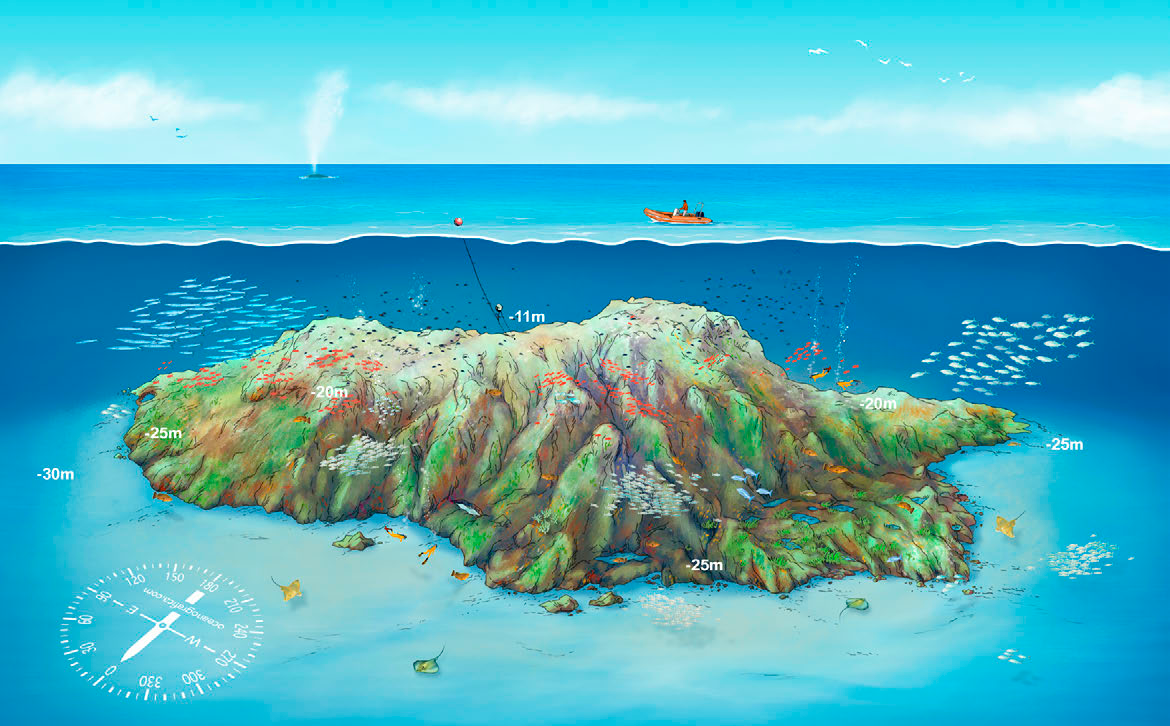
Illustration: © Oceanográfica (2021). Guía de Inmersiones de Cartagena - Cartagena Diving Guide. Boyra, A., C. Fernández-Gil, D. Balcarcel, A. Cánovas y M. A. G. Gallego.
The draw is the vertical spread of one rock: a single ridge holds shallow, middle and deeper routes. Barracuda gather close to the bajo, and the groupers and false cod keep to the rock at every depth. In autumn, schools of bogue are reported to bring bullet tuna, skipjack and Atlantic bonito through the same water.
Surface water reaches 24-28C in July and August, but from about 25m down it holds 15-18C under a sharp thermocline, so pick the suit for the lower number. Spring and autumn run 18-24C at the surface and 15-20C at depth, and in January and February the whole column sits at 13-15C. Visibility is 15-20m in summer, 20-30m in spring and autumn and drops to 5-10m after storms.
The centre asks for a valid certification, valid insurance and a signed health declaration on the day of the dive, and handles the authorisation for the reserve. Nothing shelters the ridge from open water, and the current runs from mild to strong, stronger in November and December. A running current brings the barracuda in to hunt, which makes it the best day for them and the day to agree the route and the return leg with the guide before descending. When it blows hard, the area falls back on Bajo de Testa, the more sheltered bajo.
What makes this dive site stand out.
A rocky plateau at about 20m on a ridge that climbs to a top near 10m, so routes run shallow or deeper.
A long rocky ridge at the centre of the reserve, reported between 75 and 110m in length.
Schools gather close to the bajo and hunt most actively when the current runs.
Dusky groupers of all sizes live in the rock, with false cod and morays in the holes.
In autumn, bogue schools reportedly draw bullet tuna, skipjack and Atlantic bonito.
37.6412°N, 0.6771°W
Warm water around 20-24C and fewer crowds.
Divers Cabo de Palos lists reserve dives at 55 EUR with the official fees included. Confirm the current rate with the centre.
The centre grades the dive for all levels with a route for each. The top at about 10m is the Open Water part; the 20m plateau is past the usual 18m of Open Water training and the flanks reach 27-28m, so those routes are for divers certified to that depth.
Summary
The top and plateau sit at 10-20m; the flanks reach 27-28m, and the open-sea position makes the day more demanding than the depths suggest.
Safety considerations
What can go wrong here, and what divers do about it. Conditions change - take the briefing from the operator on the day.
Book a guided dive at this site.
PADI and SSI center operating from Cabo de Palos port and La Manga Club resort, 25 years in the area.

Long-running multi-agency dive centre in Cabo de Palos running daily boats into the Islas Hormigas Marine Reserve and the local technical wrecks.

Cabo de Palos dive centre operating since 2004, boating divers into the Islas Hormigas reserve and onto the namesake Naranjito wreck.
SSI and PADI dive centre off the main strip in Cabo de Palos, with a 140 m² shorefront base and small-group RIB trips into the Islas Hormigas marine reserve.

PADI 5-Star Career Development Center on the Cabo de Palos harbour, run by Dutch course-director couple Martin and Brenda van Gestel since March 2023.

Nature-and-education dive center in Cabo de Palos, the first National Geographic Dive Center in Spain and the first Avelo center in Europe.
Get in touch to add or claim your dive center listing on DiveCodex.
The operator runs a different route for each level. The top at about 10m is the part an Open Water card covers. The 20m plateau is past the usual 18m of Open Water training and the flanks drop to 27-28m, so those routes belong to divers certified for that depth. Settle which route you are given with the guide before the dive.
Bogue schools. They gather around the ridge in autumn and are reported to bring bullet tuna, skipjack and Atlantic bonito hunting through them.
Log your dives - notes, photos, conditions and the marine life you saw - and share them as one public diver profile. What you share helps the next diver, too.
Log every detail
Depth, duration, conditions, gear, buddy, notes — all in one place. Import from Suunto and other dive computers.
Track marine life
Record species sightings on each dive. Build a personal catalogue of everything you've seen underwater.
Your public dive profile
Share your dive history, stats, and experiences with a profile page you control. Show the world where you've been.