

Adventure Divers
PADI and SSI center operating from Cabo de Palos port and La Manga Club resort, 25 years in the area, 298 TripAdvisor reviews at 4.9-5.0 stars.
PADI / SSI2 languages
Also known as: Bajo de la Testa, Testa
Sheltered submarine plateau at 5-22m inside Cabo de Palos marine reserve, used as the calmer alternative when current closes the outer bajos.
Last updated May 2026
The boat from Cabo de Palos harbour rarely leaves sight of the coast. The mooring drops onto a rocky plateau that tops out around 5 metres and slopes to sand at 22. From the mooring block the dive splits two ways. The south route runs across blocks and small caverns where the rock has been scoured into channels, the river-carved feel that local guides point out on the briefing. Photographers tend to work this side for the geometry. The east route reaches the cut-off, the narrow passage where the main plateau separates from a rocky cord. This is the productive corner of the dive. Large groupers hold position in the gap and corvinas school above them. Watch the blue side of the passage as well. Dentex move in from open water to hunt boga schools that drift across the plateau top. Barracuda and garfish patrol higher up than you might expect, so periodic upward glances pay off. Most of the dive runs at 8-18 metres, well above the sand boundary.
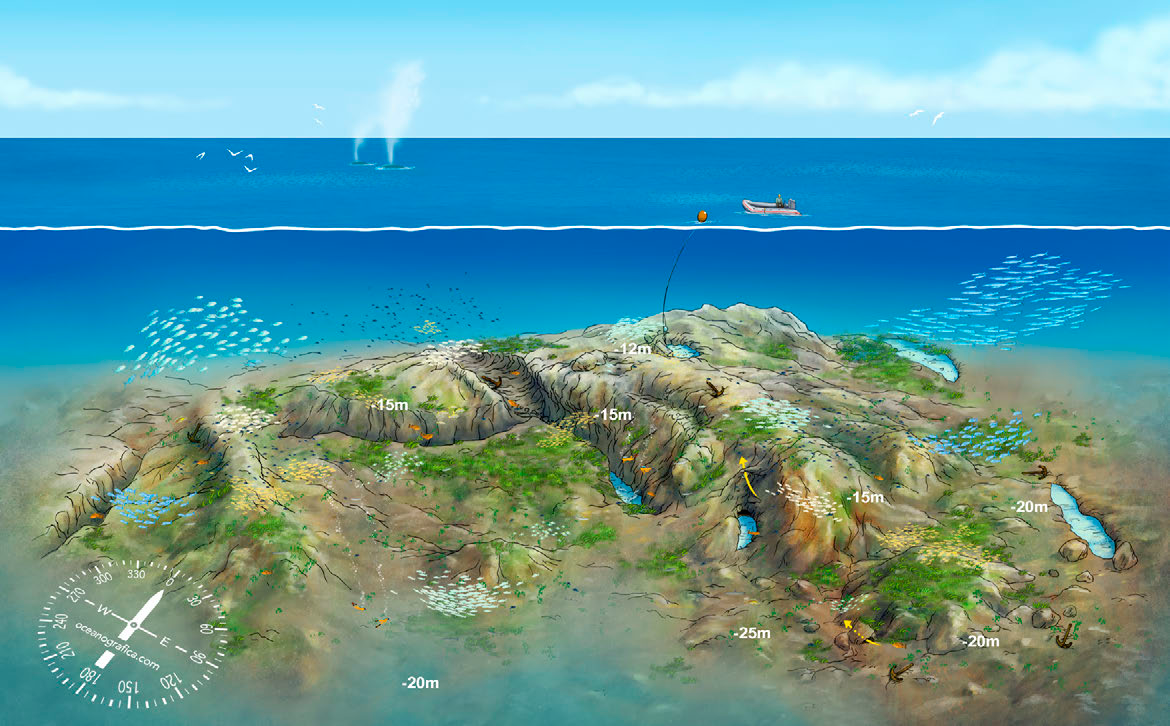
Illustration: © Oceanográfica (2021). Guía de Inmersiones de Cartagena - Cartagena Diving Guide. Boyra, A., C. Fernández-Gil, D. Balcarcel, A. Cánovas y M. A. G. Gallego.
Testa fills a specific role in the reserve rotation. When the lead centre cancels Dentro or Piles for current, Testa is the in-reserve plan B. The inshore position and topography hold currents milder than the outer bajos, and the plateau profile keeps OW-level divers on the main feature for the entire dive. Older accounts also note several large anchors scattered across the shallows, heavily camouflaged by marine growth. No archaeological record has surfaced for them, so their period and identity stay open. The east cut-off, the south-face geology, and the calmer water are what divers actually choose Testa for. Spanish diving forums in the early 2010s flagged Testa as the quiet bajo of the reserve. The pattern has held since: it is the second or third dive of the morning, not the headline of the day.
Testa does not require the 15-day advance booking that Bajo de Fuera demands. Any authorised reserve centre can run it on the day. The sheltered position cuts cancellation rates relative to the outer bajos, but conditions still rule. The forum line that does the work here is "podréis bucear sin problemas si no hay corriente", meaning you will dive without trouble if there is no current. With max depth around 22 metres, the dive sits above the deep-bajo summer thermocline ceiling, so bottom temps run closer to the surface reading than the cold figures published for Dentro or Fuera. A 3-5mm suit covers summer; 7mm semi-dry from late autumn. Plan to spend the productive minutes of the dive at the east cut-off rather than racing the perimeter. The anchors are an opportunistic find on the shallower edges; ask the guide for the locations rather than searching blind.
What makes this dive site stand out.
Closer to coast than the outer bajos and used as the calm-conditions backup.
A passage between the main plateau and a rocky cord concentrates groupers and corvinas.
Blocks, small caverns, and grooves shaped like channels of an imaginary river.
Plateau top at 5m and typical 15-18m profile keep the dive within Open Water limits.
37.6394°N, 0.6842°W
Water still 20-24C, peak visibility, and lighter crowds than July-August.
Single reserve dive at Divers Cabo de Palos: 55 EUR. Range across local centres: 50-55 EUR. Verify current rates with the dive centre.
Plateau top at 5m and typical profile of 15-18m sit within OW limits. Forum trip reports confirm OWD-level divers run Testa comfortably.
Summary
Sheltered position and shallow profile make Testa one of the gentlest dives in the reserve. Centres still gate it on day-of conditions.
Safety considerations
What can go wrong here, and what divers do about it. Conditions change - take the briefing from the operator on the day.
Book a guided dive at this site.
PADI and SSI center operating from Cabo de Palos port and La Manga Club resort, 25 years in the area, 298 TripAdvisor reviews at 4.9-5.0 stars.

Long-running multi-agency dive centre in Cabo de Palos running daily boats into the Islas Hormigas Marine Reserve and the local technical wrecks.

Cabo de Palos dive centre operating since 2004, boating divers into the Islas Hormigas reserve and onto the namesake Naranjito wreck.
SSI and PADI dive centre off the main strip in Cabo de Palos, with a 140 m² shorefront base and small-group RIB trips into the Islas Hormigas marine reserve.

PADI 5-Star Career Development Center on the Cabo de Palos harbour, run by Dutch course-director couple Martin and Brenda van Gestel since March 2023.

Nature-and-education dive center in Cabo de Palos, the first National Geographic Dive Center in Spain and the first Avelo center in Europe.
Get in touch to add or claim your dive center listing on DiveCodex.
Reserva Marina de Cabo de Palos e Islas Hormigas
Individual permits not available. All diving runs through authorised licensed dive centres only. Testa does not require the 15-day advance booking that Bajo de Fuera demands.
Yes. The plateau top sits at 5 metres and the typical profile runs 15-18 metres, both inside Open Water limits. Spanish diving forums confirm OWD-level groups running Testa as a comfortable reserve dive. The sheltered position relative to other bajos means current days are less likely to cancel the trip.
A 2011 forum post by a local diver labelled it 'el gran olvidado', the forgotten one, and the line stuck. The reasoning given then was less marine life than its siblings paired with interesting small canyons. Forum threads since have reinforced the pattern: trip reports from Cabo de Palos lead with Dentro, Piles, or Naranjito, while Testa shows up as the second or third dive of the day.
Centres rotate Testa in as the in-reserve backup when Dentro or Piles are too exposed for the day's conditions. The inshore position and topography keep currents milder than at the outer bajos. It is also the standard pick when the boat carries Open Water divers who would not be cleared for Bajo de Fuera or the Naranjito wreck.
Groupers and corvinas concentrate in the narrow east passage where the rocky cord splits from the main plateau. Dentex move in from the blue to hunt boga schools that drift across the plateau top, and barracuda and garfish sit above the plateau in summer. Damselfish, sea bream, moray eels, and octopus fill the rock surfaces. The east cut-off is the productive corner of the dive.
Several large old anchors lie scattered across the shallows, heavily camouflaged by marine growth. They are flagged on the briefing by the dive centre that runs regular trips here. No archaeological documentation has been published, so their period and origin are unknown. Without a guide pointing them out, they are easy to miss.
September and October combine 20-24C water, the best visibility of the year, and lighter crowds than the July-August peak. Summer brings the highest fish counts but also plankton and catamaran traffic that the area pack documents at the more popular bajos. The site is diveable year-round, though winter dives at Testa specifically are sparse in the logs.
Both are OW-friendly bajos with grouper and barracuda populations. Piles I draws more boats and more attention, often with five or six craft on the mooring during peak weekends. Testa rarely fills. The two species mixes overlap, but Testa adds a distinct east-passage chokepoint and the south-face carved-rock topography that Piles I does not have.
Log your dives - notes, photos, conditions and the marine life you saw - and share them as one public diver profile. What you share helps the next diver, too.
Log every detail
Depth, duration, conditions, gear, buddy, notes — all in one place. Import from Suunto and other dive computers.
Track marine life
Record species sightings on each dive. Build a personal catalogue of everything you've seen underwater.
Your public dive profile
Share your dive history, stats, and experiences with a profile page you control. Show the world where you've been.