

Adventure Divers
PADI and SSI center operating from Cabo de Palos port and La Manga Club resort, 25 years in the area.
PADI / SSI2 languages
Also known as: Bajo Piles 1, Piles 1, Piles I
Bread-loaf seamount inside Cabo de Palos reserve, 8-27m, the all-levels workhorse of the inner-bajo rotation with resident groupers and seasonal barracuda schools.
Last updated May 2026
Most Piles I dives start on a fixed mooring and run as a slow perimeter circuit around the long axis of the bajo. The ridge tops out at 7-8 metres, slopes through 75 metres of bread-loaf shoulder and meets sand at 27. The shallows carry the lighter biomass: bream, mojarras, and the occasional barracuda passing through. Dropping deeper along the foot of the structure picks up moray density and larger groupers, with dentex on patrol in the open water. Centres tailor the profile to the group, taking OW divers along the summit and southern shelter and routing AOWD divers to the satellite formations. Dos Hermanas, two smaller rocks off the northeast face, rises from 25 metres to 18 and pulls a different cast of fish than the main ridge. Piedra del Francés, a separate small reef just to the north, gives the dive a third option when air and conditions allow. Posidonia meadows surround the base of the structure, blurring where the rock ends and the sand begins.
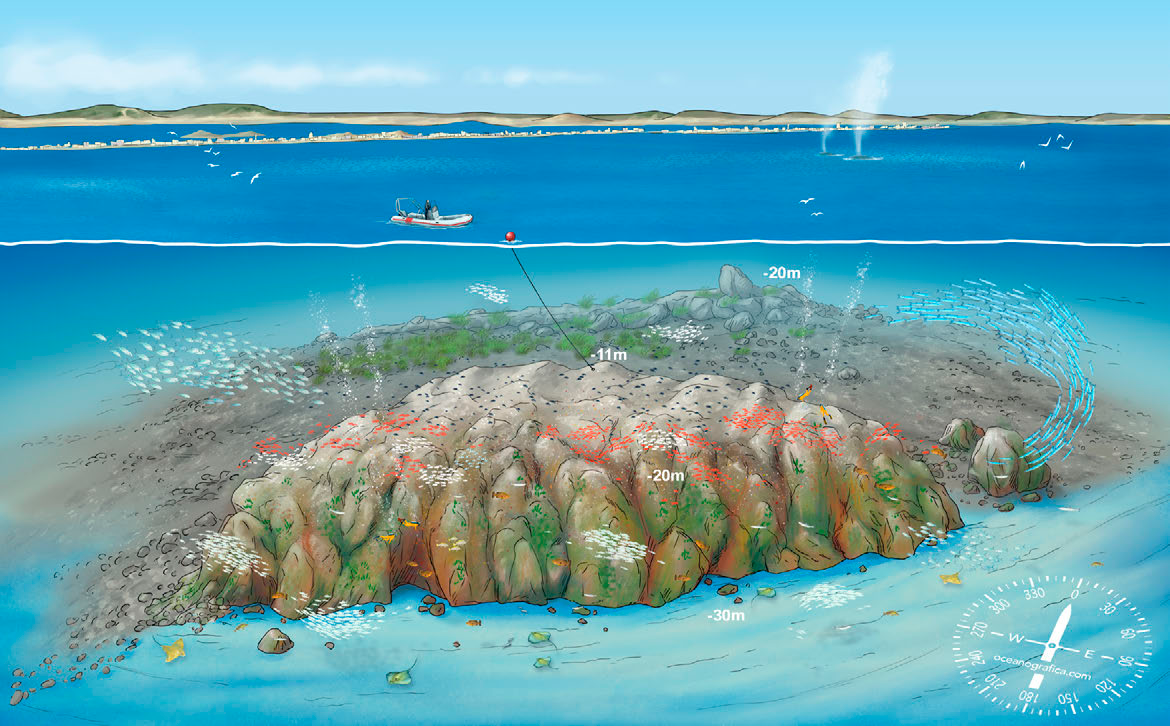
Illustration: © Oceanográfica (2021). Guía de Inmersiones de Cartagena - Cartagena Diving Guide. Boyra, A., C. Fernández-Gil, D. Balcarcel, A. Cánovas y M. A. G. Gallego.
Piles I trades vertical drama for accessibility. The shallow summit, the multiple route options and the long ridge geometry let a centre run the same site for an Open Water novice and a guide-side AOWD on the same boat. That is the case for choosing it over Dentro or Fuera: reserve-density biology at depths that do not require the cert step-up. Two faces anchor what divers actually meet here. On calm days the walls deliver macro in a single dive — moray eels, ringneck and black-faced blennies, white sea-whip gorgonians, turban snails and hermit crabs — the macro reef hiding behind the big-fish reputation centre marketing usually leads with. When current runs, it can pin a group along the buoy line until they shelter against the bajo and finish on a barracuda school. Both pictures are recognisably Piles I. The site rewards repeat dives because the satellite outcrops and the depth bands read as different sites, and the bait-ball window in late summer brings a second face of pelagic activity worth planning a trip around.
Conditions are the variable, not the dive. Currents range from absent to strong, and the buoy line is where they hit hardest. Use it on descent, stay close to the structure on the way up, and accept that the line can be the hard part on a bad day. Visibility tracks the season: 20-30 metres in winter and shoulder months, 15-20 in summer with plankton and boat traffic, lower in turbid weather. The summer thermocline matters here. Surface readings of 24-28C can sit over 15-18C bottom water at 25 metres-plus, so plan exposure accordingly: 5mm in summer, 7mm semi-dry from late autumn. Standard reserve booking applies. The 15-day advance medical paperwork is only for Bajo de Fuera. Peak weekends fill the mooring with four to six boats, so weekday slots and September-October dates deliver the same biology in calmer conditions. Pack a strobe if macro is on the agenda, and something heavier for wide-angle if the bait-ball season is on.
What makes this dive site stand out.
Summit at 7-8m and the lowest cert floor of the inner-reserve set, with multiple route options at different depths.
Dos Hermanas (18-25m) and Piedra del Francés extend the dive area beyond the 75m main ridge.
Population of all sizes habituated to divers, sitting between 8 and 25m on the bajo.
Walls hold blennies, hermit crabs and gorgonians while barracuda schools and dentex work the open water.
The all-levels reputation makes it the bajo most likely to host four to six boats on peak weekends.
37.6398°N, 0.6793°W
Warm water at 20-24C, the year's best visibility, fewer crowds and the bait-ball window. May-June second-best. April flagged by local divers as poor.
Inner-reserve dive band across local centres. Centre-set; package and winter-discount pricing exists. Verify current rates with the dive centre.
Open Water or FEDAS B1 minimum. Lower-cert divers stay on the shallow summit and southern shelter routes; AOWD/B2-rated divers can run the deeper periphery and the satellite formations.
Summary
Easy on the summit and gentle perimeter routes; moderate when current builds. Open-water exposure means conditions can raise the real difficulty on the day.
Safety considerations
What can go wrong here, and what divers do about it. Conditions change - take the briefing from the operator on the day.
Book a guided dive at this site.
PADI and SSI center operating from Cabo de Palos port and La Manga Club resort, 25 years in the area.

Long-running multi-agency dive centre in Cabo de Palos running daily boats into the Islas Hormigas Marine Reserve and the local technical wrecks.

Cabo de Palos dive centre operating since 2004, boating divers into the Islas Hormigas reserve and onto the namesake Naranjito wreck.
SSI and PADI dive centre off the main strip in Cabo de Palos, with a 140 m² shorefront base and small-group RIB trips into the Islas Hormigas marine reserve.

PADI 5-Star Career Development Center on the Cabo de Palos harbour, run by Dutch course-director couple Martin and Brenda van Gestel since March 2023.

Nature-and-education dive center in Cabo de Palos, the first National Geographic Dive Center in Spain and the first Avelo center in Europe.
Get in touch to add or claim your dive center listing on DiveCodex.
Yes. The summit at 7-8m and multilevel route options keep the dive within Open Water limits. Centres tailor the profile to certification, with shallower tours for OW and deeper Dos Hermanas circuits for AOWD divers. The variable that can change the day is current, not depth.
Piles I is an all-levels inner-reserve bajo at 8-27m. Bajo de Fuera is the deep, exposed outer dive that requires AOWD or FEDAS B2, full medical certification and 15 days of advance booking. Piles I books on standard reserve lead times and has no special medical requirement.
It is the busiest bajo in the inner reserve. The site regularly sees four to six boats on the mooring on peak weekends. Centres co-ordinate descent windows and the open ridge geometry lets groups fan out at different depths, but expect company. Weekday slots and shoulder-season dives feel calmer.
Resident dusky groupers of all sizes are the constant. Goldblotch groupers, dentex, large moray eels and bream populations sit on the structure year-round. Barracuda schools are a notable encounter in summer and autumn, and bait-ball season from August to October pulls in tuna and leerfish. Macro on the walls includes nudibranchs, blennies, hermit crabs and white sea-whip gorgonians.
September and October. Water still 20-24C, the year's best visibility and the bait-ball window all overlap, with lighter crowds than July and August. May and June are second-best. April runs cold and quiet and local divers do not recommend it. Mangamar offers explicit winter discounts from November to February.
It works for both. The walls deliver macro on most dives: blennies, nudibranchs, hermit crabs, turban snails and white gorgonians have all been documented in single sessions. The open water around the ridge gives wide-angle on barracuda schools and grouper aggregations. December turbidity can cap macro visibility, so a strobe earns its place in the bag.
All reserve diving goes through authorised centres in Cabo de Palos. Standard lead times apply: a few days ahead is enough outside peak summer weekends, when the reserve's daily cap and the two-boat-simultaneous limit can fill slots earlier. The 15-day advance booking applies only to Bajo de Fuera, not to Piles I.
Log your dives - notes, photos, conditions and the marine life you saw - and share them as one public diver profile. What you share helps the next diver, too.
Log every detail
Depth, duration, conditions, gear, buddy, notes — all in one place. Import from Suunto and other dive computers.
Track marine life
Record species sightings on each dive. Build a personal catalogue of everything you've seen underwater.
Your public dive profile
Share your dive history, stats, and experiences with a profile page you control. Show the world where you've been.