
Cap de Creus Dive
PADI 5-Star center in El Port de la Selva with brand-new Aqualung gear, max 4 divers per guide, and year-round boat diving in Cap de Creus Natural Park.
PADI / SSI10 services4 languages
An exposed pinnacle and wall on Cap de Creus's Mar d'Amunt shore, gorgonian rock working 20 to 40 metres, reached by boat from Llançà or Port de la Selva.
Last updated September 2026
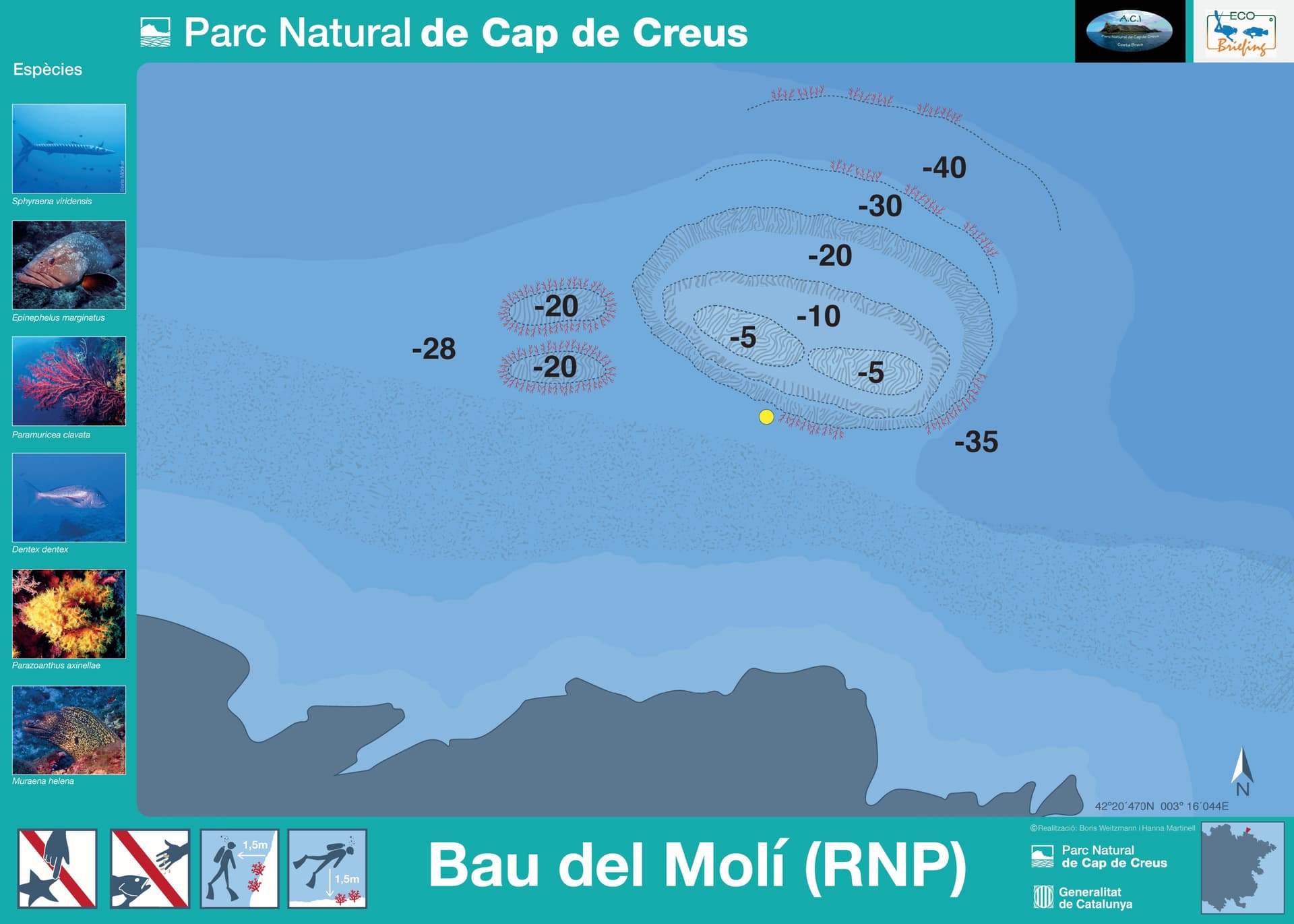
El Bau del Molí rises on Cap de Creus's Mar d'Amunt, the natural park's north shore, reached only by boat out of Llançà or Port de la Selva and tied off to one of the park's mooring buoys. The pinnacle's vertical wall faces run down through rock draped in gorgonians, with the guided route working a band between 20 and 40 metres. Follow your guide's briefing for the specific route: drop onto the pinnacle, follow the wall down through the gorgonian growth, and turn back well inside your planned maximum.
Red and white gorgonians cover this pinnacle's wall faces, growing thick enough down toward the 40-metre base to be the dive's signature. Anthias, groupers and dentex are commonly reported working the same rock, alongside occasional passing tuna and sunfish in summer. Two named centres hold the eco-guiding role for this exact point, one based in Llançà and one in Port de la Selva.
This is an exposed, north-facing point: its own guiding centre describes it directly as open to both wind and current, so treat the forecast, not the calendar, as the real gatekeeper for whether the boat goes out. Published depth figures for the route also vary widely, from a shallow catalog listing to a 20-40 metre band that reaches well past it; set your planned maximum and confirm it with the guiding centre before you descend, since the deeper end of that range calls for a deeper-rated certification than Advanced Open Water alone.
What makes this dive site stand out.
Red and white gorgonians cover the rock walls down toward the 40m base
Its own guiding centre names it directly as exposed to both wind and current
North shore of Cap de Creus, boat-only from Llançà or Port de la Selva
One based in Llançà, one in Port de la Selva, run the eco-guided route
42.3412°N, 3.2674°E
Best season for this specific point is unconfirmed; the park's broader diving season runs spring through autumn, and the Tramuntana can close this exposed, north-facing point for days at any time of year.
The working band of 20 to 40 metres sits below the roughly 30-metre ceiling most agencies set for Open Water-only divers for its shallower half, so Advanced Open Water covers the 20-30 metre portion. Reaching the full 40-metre base needs a deeper-rated level, such as a Deep Diver specialty.
Summary
Rated advanced, consistent with the point's exposure to wind and current and its 20-40 metre working depth. A separate catalog listing rates the same point beginner at a shallower depth, with no reviews or stated survey method behind it.
Safety considerations
What can go wrong here, and what divers do about it. Conditions change - take the briefing from the operator on the day.
Book a guided dive at this site.
PADI 5-Star center in El Port de la Selva with brand-new Aqualung gear, max 4 divers per guide, and year-round boat diving in Cap de Creus Natural Park.
SSI-affiliated dive centre in Llançà, the Cap de Creus Natural Park's northern access point, with air-only fills and a one-instructor-per-diver baptism dive.
PADI/CMAS/FFESSM centre in El Port de la Selva, running since 1994; daily boat dives across ~20 Cap de Creus sites including Massa d'Or, April-October.
Small PADI centre in Camping Sant Miquel, working Colera's Tramontana-sheltered coast into France's Cerbère-Banyuls reserve.

Get in touch to add or claim your dive center listing on DiveCodex.
Dive centres in Catalonia must require insurance from every diver on their dives, and must be able to offer a policy to anyone who has none.
Three sources name the same underwater pinnacle: the Port de la Selva centre that guides it lists it as 'El Bau del Moli', an operator further north on the coast calls it 'Bau del Molí', and a third spelling used for its eco-guided route is 'Bau de la Punta del Molí'. The Port de la Selva centre's full name, Centre d'Immersió Port de la Selva, is the operator listed for that eco-guided route, and its base port matches too, tying all three names to the same pinnacle. 'Molí' is Catalan for mill, a common place-name element on this stretch of coast.
No. This point's working depth runs 20 to 40 metres and it is rated for advanced divers, consistent with its exposure to wind and current. A crowd-sourced catalog listing gives a shallower maximum and a beginner rating, but carries no reviews and no stated survey method. Plan for the deeper, advanced profile and confirm it with your centre before booking.
Possibly, but it isn't officially confirmed. One diver's account groups it among the park's richer, no-fishing-protected points, contrasted with more heavily fished stretches nearby. The park's own 2025 route map, however, does not name this specific point under any spelling, so there is no official text confirming which of the park's partial reserves, if any, contains it. Either way, the park's standard no-touch, no-take rules apply to every diver here regardless.
Log your dives - notes, photos, conditions and the marine life you saw - and share them as one public diver profile. What you share helps the next diver, too.
Log every detail
Depth, duration, conditions, gear, buddy, notes — all in one place. Import from Suunto and other dive computers.
Track marine life
Record species sightings on each dive. Build a personal catalogue of everything you've seen underwater.
Your public dive profile
Share your dive history, stats, and experiences with a profile page you control. Show the world where you've been.