
Arenal Diving Ibiza
PADI 5 Star Dive Resort in San Antonio, operating since 2004 with a four-boat fleet covering Ibiza's west-coast caves, gorgonian walls, and the Don Pedro wreck.
PADI7 services3 languages
Also known as: El Faro de Santa Eulària, Faro de Santa Eulalia, Faro de Santa Eulària, Lighthouse, Los Faros, Seca Santa Eulalia, faro, The Lighthouse
Beacon-crowned reef platform off east Ibiza, from a bright 2m top to a canyon at the sand edge where a barracuda school often hovers.
Last updated October 2026
The dive starts on the shallow platform by the beacon, where the reef top sits about 2m below the surface and the opening minutes are bright. The route heads north-east along the reef side, descending gently over boulders and cracks. Moray eels and groupers show up within the first minutes, the groupers following divers from their holes. Look up and large schools of small fish that were easy to miss at first hang above the reef.
At around 26m, the depth the route itself reaches, the reef gives way to sand; operators quote the deepest point anywhere from 24m to 28m. A large school of barracuda often hovers here, and a canyon on the right is the turnaround. The way back climbs through the canyon and over the reef top, where octopus sit and a sea hare turns up now and then, then passes the beacon itself. With air left, divers can carry on over the gentler section of reef beyond it, where rays have occasionally been seen, and finish with a stop at 5m. Total time is about 50 minutes.
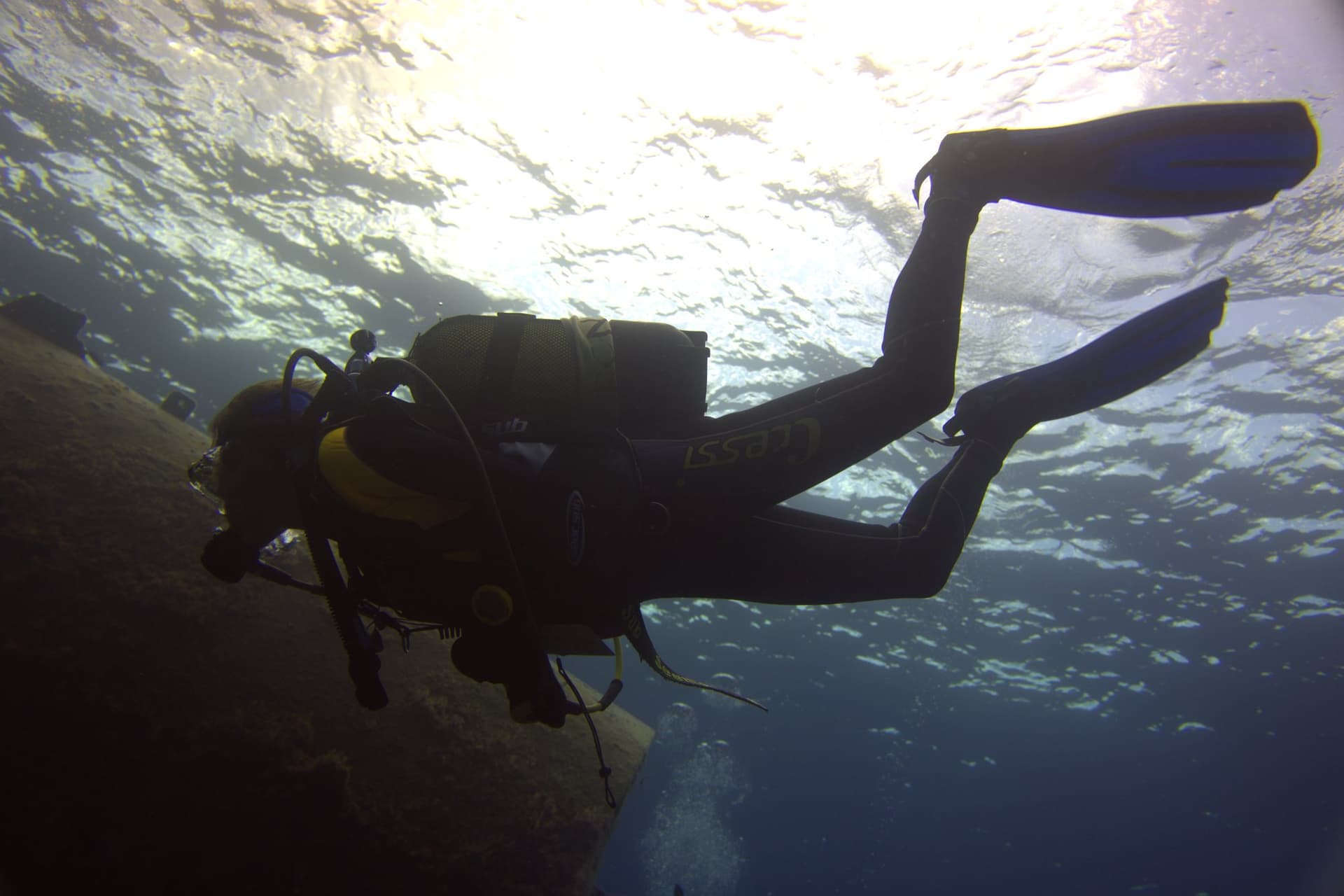
The name comes from the structure on the reef crown, a lighthouse to some operators and a baliza, a navigation beacon, to others. Because the top of the reef is so shallow the light stays good, and photography is where that pays off most in the first part of the dive.
The Seca de Santa Eulalia is described as holding three dive points, and the beacon dive is the famous one; La Chimenea is a separate point on the same reef. The reef is pitched at divers just starting out and at those who prefer calmer sites.
Cala Pada Diving sets Open Water Diver as the minimum for the whole dive, canyon turnaround included. The PADI Scuba Diver level is cited only for the shallow platform, where the beacon runs from about 2m to 12m, so confirm with the centre which version is running.
In summer the thermocline sits below about 20m, so the canyon leg is noticeably cooler than the platform.
What makes this dive site stand out.
A baliza stands on the platform and gives the dive its name, El Faro
The reef top sits close to the surface, so the opening minutes are well lit
A canyon at the sand edge, around 26m, marks the turn back along the reef
A large school often hovers at the deep edge of the reef
Cracks along the reef hold morays and groupers that follow divers
38.9672°N, 1.6156°E
Cala Pada Diving sets Open Water Diver as the minimum for the dive; the PADI Scuba Diver level is cited for the shallow platform alone.
Summary
Pitched at divers starting out and at those who prefer calmer sites; current is occasional and mild.
Safety considerations
What can go wrong here, and what divers do about it. Conditions change - take the briefing from the operator on the day.
Book a guided dive at this site.
PADI 5 Star Dive Resort in San Antonio, operating since 2004 with a four-boat fleet covering Ibiza's west-coast caves, gorgonian walls, and the Don Pedro wreck.
First PADI Eco Center in the Balearics and the only PADI 5 Star CDC on the islands, operating year-round from Marina Botafoch with two permanent Course Directors.
Get in touch to add or claim your dive center listing on DiveCodex.
Diving here needs certification and accident insurance; course dives and dives an authorised centre runs that give no certification need no card.
Accounts differ. Dive operators in Santa Eulària list a sunken lighthouse or the wreck of an old lighthouse, while a Spanish-language dive guide says the structure is a baliza, a navigation beacon that warned boats off the shallow reef. The operators' wording and the guide's cannot both be right, and the dive itself is the same either way: a landmark on the crown of the reef.
It is listed as its own point on the same Seca de Santa Eulalia. One Santa Eulària centre sells it separately, describing remains of old beacons and a chimney with light effects, while El Faro centres on the beacon and the canyon.
A version limited to the platform and beacon is the one the PADI Scuba Diver level is cited for, while Cala Pada Diving sets Open Water Diver as the minimum for the whole dive. Ask the centre which version it is running that day.
Log your dives - notes, photos, conditions and the marine life you saw - and share them as one public diver profile. What you share helps the next diver, too.
Log every detail
Depth, duration, conditions, gear, buddy, notes — all in one place. Import from Suunto and other dive computers.
Track marine life
Record species sightings on each dive. Build a personal catalogue of everything you've seen underwater.
Your public dive profile
Share your dive history, stats, and experiences with a profile page you control. Show the world where you've been.