
Diving Portlligat
SSI-listed dive centre inside the Carpe Diem Cadaqués complex, running since 2008 with three daily boat departures across 15 named Cap de Creus sites.
SSI / PADI8 services5 languages
A steep gorgonian-covered rock slope off Cadaqués in Cap de Creus, dropping through pre-coralligenous ledges toward open water.
Last updated September 2026
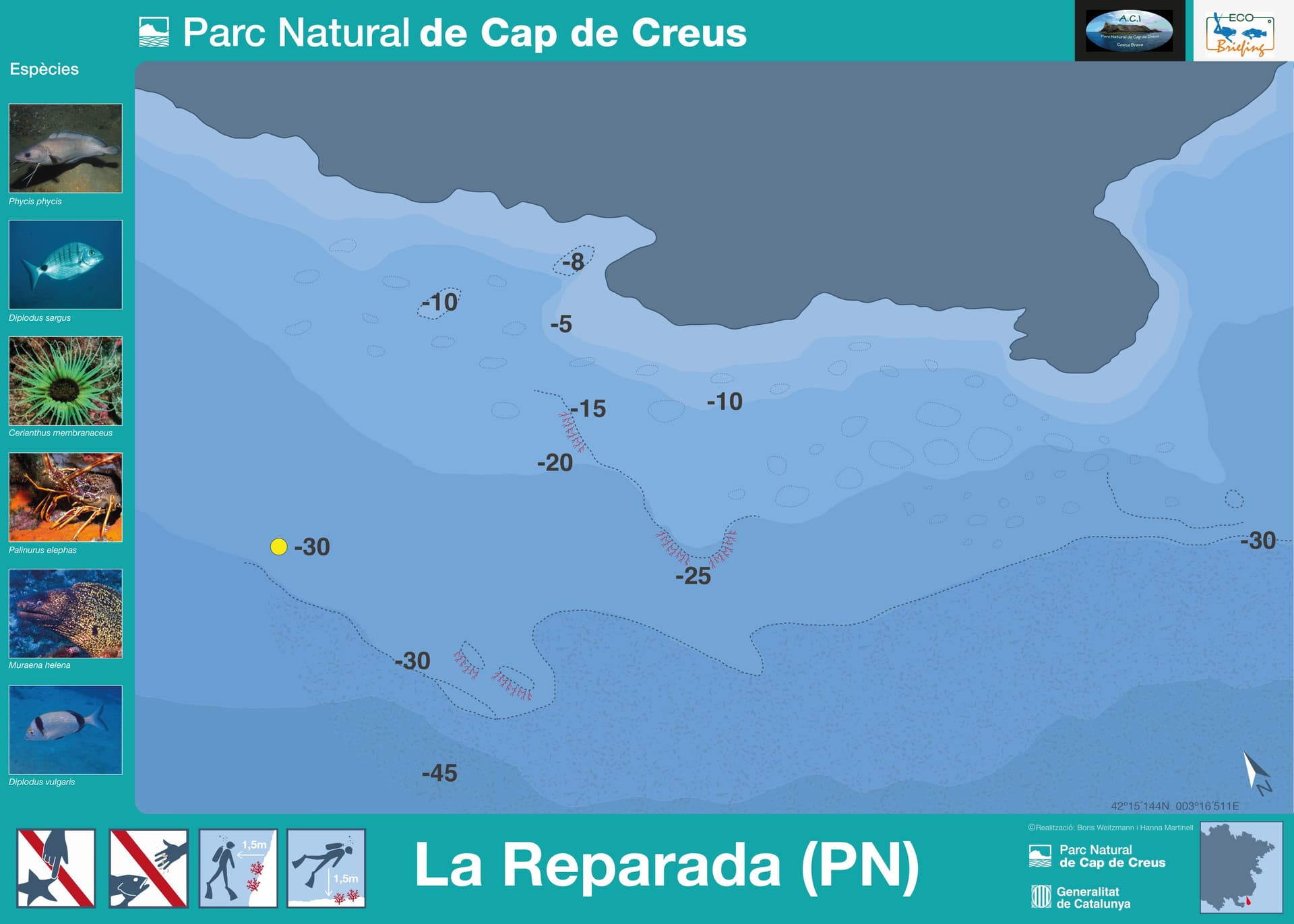
A steep rock face drops from close to the surface off Cadaqués, on the mid-coast stretch of Cap de Creus's Cadaqués sector. Two gorgonian-covered ledges break the descent, one around 15-20 metres and a second around 25-30, thick with the pre-coralligenous growth that gives the wall its character.1 Below that, the working depth is read two ways: the park's own mooring buoy sits at -30 metres, matching a run to 30-35 metres; a different figure for the same coordinates puts the drop-off at 27-40 metres, climbing back through a 20-metre zone of loose rock scree on the way up.
La Reparada carries no wreck, cave or other built landmark: the dive is the rock slope itself and the gorgonian-covered ledges that break its descent. The park chose six species specifically for this sheet: two seabream, a forkbeard, a spiny lobster, a cylinder anemone and the Mediterranean moray, a mix built around rock-and-crevice residents, not open-water schools.1 Sea fans and coralligenous growth cover the slope at both ledges, the kind of pre-coralligenous community the wider park keeps in only a few places.
The park's own chart marks a fixed mooring buoy here; the same site is also described as reached by anchoring the boat instead. Anchoring onto a coralligenous slope is normally the exact practice a mooring buoy exists to prevent, so ask your centre which method it uses before you book. Independent divers must give the park authority prior notice and keep within its cap, applied per boat, not per diver: six dives a day, thirty a week, a hundred and twenty a year.2 Touching, removing or altering flora, fauna or archaeological remains is banned throughout the park.2 This point carries the park's general zone tag rather than one of its three marine reserves, so the reserve-only night-diving authorisation most likely does not apply here, though that is unconfirmed for this exact site. Three centres run trips to La Reparada, one based in Cadaqués and two more out of Roses.
What makes this dive site stand out.
Sea fans and pre-coralligenous growth cluster on two ledges during the descent
The park's own itinerary sheet names six species for this exact point
No shore access point is mapped for this site
Centres based in both Cadaqués and Roses service this dive
42.2524°N, 3.2752°E
No season specific to this point is documented; the area's general clearer window, April-May and September-October, is the working guide.
Both published depth ranges fall inside the same bracket: the 30-metre ceiling of Advanced Open Water covers the shallow end, and a deep-diving certification covers the 35-40 metre end, whichever figure applies on the day.
Summary
Driven by an operating depth on a steep slope that published figures put between 30 and 40 metres.
Safety considerations
What can go wrong here, and what divers do about it. Conditions change - take the briefing from the operator on the day.
Book a guided dive at this site.
SSI-listed dive centre inside the Carpe Diem Cadaqués complex, running since 2008 with three daily boat departures across 15 named Cap de Creus sites.
Beachfront PADI/FEDAS/CMAS dive centre inside the Cala Montjoi resort near Roses, running its own boat to Cap de Creus sites and a seasonal freediving course.

SSI Instructor Training Center in Cadaqués running guided dives to 25+ Cap de Creus Natural Park sites and a blue shark snorkeling program.

Get in touch to add or claim your dive center listing on DiveCodex.
Dive centres in Catalonia must require insurance from every diver on their dives, and must be able to offer a policy to anyone who has none.
The park's own chart marks a fixed mooring buoy at the site's working depth. The same site is also described as reached by anchoring the boat directly onto the drop-off. Anchoring on a coralligenous slope like this one is normally what a mooring buoy is installed to prevent, so if that matters to you, ask your centre which method it uses before booking.
Log your dives - notes, photos, conditions and the marine life you saw - and share them as one public diver profile. What you share helps the next diver, too.
Log every detail
Depth, duration, conditions, gear, buddy, notes — all in one place. Import from Suunto and other dive computers.
Track marine life
Record species sightings on each dive. Build a personal catalogue of everything you've seen underwater.
Your public dive profile
Share your dive history, stats, and experiences with a profile page you control. Show the world where you've been.