

Scuba Total Cancun
Family-run dive centre in Cancun's Marina AquaFun running reefs, MUSA, the C-55 and C-58 wrecks, cenotes and Cozumel at four divers per guide.
PADI / SSI / SDI / TDI7 services3 languages
Also known as: Cancun Underwater Museum, Cancún Underwater Museum, MUSA Salon Manchones, MUSA Salón Manchones, Museo Subacuatico de Arte, Museo Subacuático de Arte, Underwater Museum of Art
Sculpture gallery on sand at 8-9 m in Isla Mujeres water, sold as Cancún's underwater museum and created to draw divers off damaged reef.
Last updated August 2026
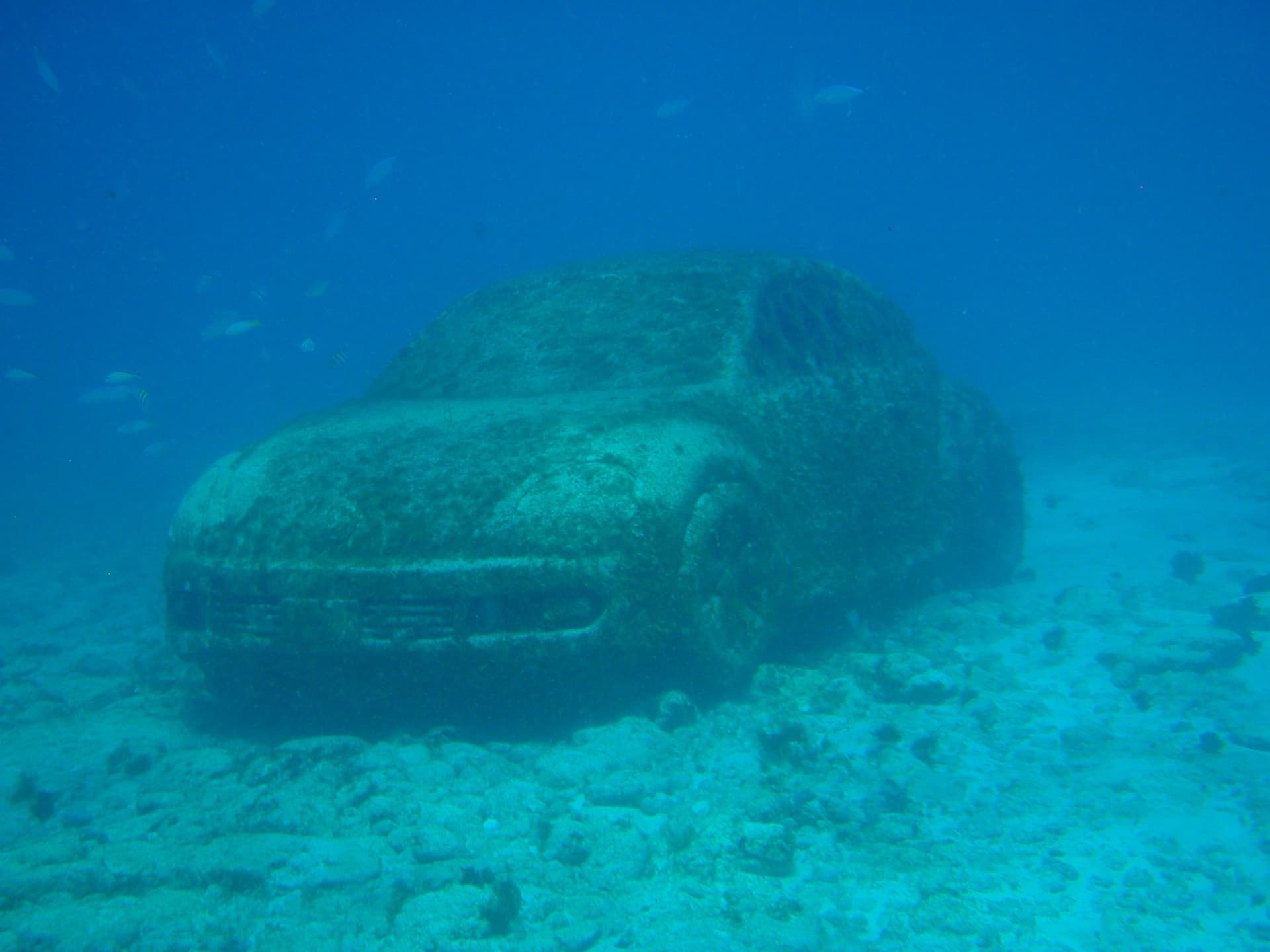
The figures are fixed to the sand across more than 420 square metres of what was barren seabed, at 8 to 9 m. The Silent Evolution, the flagship installation with more than 400 statues, is a mass of figures: families, a man at a desk, businessmen with their heads in the sand. There is no line to follow, so the dive is a slow circuit from group to group, and the sand bottom makes it easy to hold position for a closer look.
Up close the figures are furred with growth, and it is mostly algae. A 2014-15 study of the sculptures, a preprint that has not been peer reviewed, found them dominated by two algae and a sponge, with corals and hydroids under 1 percent of the macrofauna counted.1 Fish gather around the structures: French grunts are the park's most common fish, green turtles its most common reptile, and operators list rays and turtles for the museum and Manchones reef pairing, a two-tank morning with little boat time between the two.
Divers book "Cancún's underwater museum" and are taken to Isla Mujeres; day trips run from Isla Mujeres and from Cancún. The gallery open to scuba, Salón Manchones, lies in the island's water at 8 m. Salón Nizuc, the second gallery, sits on the Cancún side near Punta Nizuc at 4 m and is open to snorkellers only.
The sculptor Jason deCaires Taylor puts the museum at over 500 permanent life-size sculptures,2 and the park itself counts 529 sculptures in 125 artificial habitats placed up to 2015, at two sites.3 Other artists contributed too: the Mexican artists Karen Salinas Martínez and Rodrigo Quiñones Reyes are credited with works, and Elier Amado Gil with "Understanding" and "Blessings". Over 90 fishermen and women were cast as models for the sculptures.
Divers' accounts are mixed. Some call it worth doing once, and others describe the figures as full of seaweed. It suits a first dive after certification or a relaxed second dive beside Manchones reef.
The park's management programme dates the museum to 2008, as part of a policy of redirecting tourists away from the most visited reef units to alternative sites.3 The natural reef at Manchones Grande had lost 37 percent of its coral colonies to Hurricane Wilma in 2005.3
The work was commissioned by the national marine park and the Cancún Nautical Association, and Taylor installed sculptures from 2009.2
Growth on the figures breaks easily, and the park lists accidental coral breakage by inexperienced divers as a cause of damage to its reefs.3 Settle your trim and neutral buoyancy over the open sand before you approach the figures, and hover as you move between them. Fire coral occurs across the park, so every surface stays untouched.
Scuba groups need a guide, with a maximum of 6 divers per guide by day and 4 at night.3
What makes this dive site stand out.
The gallery open to divers, in Isla Mujeres water; the second gallery is snorkel-only
Begun in 2008 under the park's policy of moving tourists off busy reef units
The artist's whole-museum count; The Silent Evolution alone has more than 400
Over 90 fishermen and women were cast as models for the sculptures
A 2014-15 preprint found algae and a sponge dominate the figures
21.1992°N, 86.7266°W
Every sourced depth for the gallery is 10 m or less, so Open Water is enough
Summary
Shallow, and the skill that matters is buoyancy near fragile growth
Safety considerations
What can go wrong here, and what divers do about it. Conditions change - take the briefing from the operator on the day.
Book a guided dive at this site.
Family-run dive centre in Cancun's Marina AquaFun running reefs, MUSA, the C-55 and C-58 wrecks, cenotes and Cozumel at four divers per guide.
Get in touch to add or claim your dive center listing on DiveCodex.
Two exist: Salón Manchones for divers and Salón Nizuc for snorkellers. The park envisages twelve galleries across its waters, while an earlier 2009 impact assessment is reported to have covered ten sites, so published plans differ on the total. The dive described here is the Manchones gallery.
Yes. Salón Manchones is described by the artist as suitable for both divers and snorkellers, and a non-diver can swim over the same figures at the surface. Salón Nizuc is the gallery reserved for snorkellers only.
Log your dives - notes, photos, conditions and the marine life you saw - and share them as one public diver profile. What you share helps the next diver, too.
Log every detail
Depth, duration, conditions, gear, buddy, notes — all in one place. Import from Suunto and other dive computers.
Track marine life
Record species sightings on each dive. Build a personal catalogue of everything you've seen underwater.
Your public dive profile
Share your dive history, stats, and experiences with a profile page you control. Show the world where you've been.