

Dive College Lanzarote
Family-run PADI 5-Star IDC in Playa Blanca with beachside pool, house reef, 12 rotating dive sites, and a formal partnership with Safari Diving.
PADI6 languages
Also known as: Atlantic Museum, Lanzarote Underwater Museum, Museo Atlantico, Museo Atlántico Lanzarote, Underwater Museum Lanzarote
Europe's first underwater art museum off Playa Blanca, Lanzarote: 300+ Jason deCaires Taylor sculptures at 12-15m, guided dives only.
Last updated May 2026
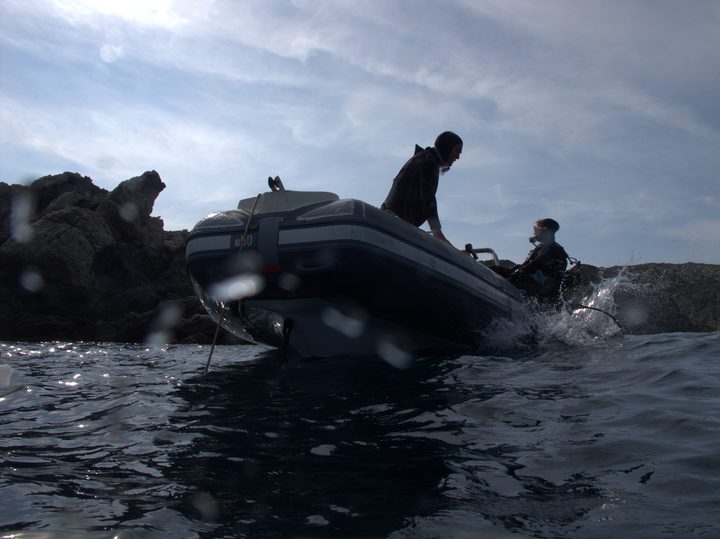
Boats leave Marina Rubicón and round the south-east headland for a ten-minute run into the Bahía de Las Coloradas. The artistic briefing happens on the way: the artist, the ten installations, the order of approach. You descend the first marker buoy onto sand at roughly 12 metres and the first figures appear almost immediately. The route runs roughly elliptical, ascending and descending only by a metre or two as the sand undulates, ending at a second buoy with a standard 5m safety stop in clear blue water.
Strongest memories tend to come early. The Rubicon, with its 35 figures advancing in formation towards a wall and gateway, is the first close encounter, and divers describe the figures walking with you, or past you, depending on how you swim through the file. The Raft of Lampedusa sits at the political centre of the dive, a tin boat of bodies in distress whose silt pattern is never quite the same as the photographs of it. The Human Gyre, around 200 figures arranged in a vortex, is the installation most likely to make people stop and hover for several minutes.
Marine life is woven through, not concentrated. Parrotfish, damselfish, an occasional octopus around the bases, schools of barracuda passing overhead. Algae now move "like hair" in the gentle bay current on most figures.
This is the only dive site in Europe, and the only one in the Atlantic Ocean, built around a permanent contemporary-art installation. Globally, MUSA in Cancún is its closest sibling. Within the Canaries and the Mediterranean basin it has no peer. For divers in Lanzarote it is the destination dive when the question is "what should I do here that I cannot do anywhere else?"
The site also splits the room. Community accounts collect both reactions in the same conversation. Divers who treat it as an art exhibit rate it among their most affecting dives ("I honestly felt lonely and quite sombre during this," one wrote about the Rubicon procession). Divers who treat it as a reef rate it as average for the island, because the surrounding bay is, by design, emptier than a volcanic-rock site like Cathedral or Mala. Both readings are right at the same time.
The breadth of access is the second differentiator. At 12-15m on flat sand, the museum opens to Discover Scuba participants, snorkellers, and freedivers as well as certified divers. That combination of "world-first attraction" and "open to first-timers" is rare on Lanzarote, where the most distinctive other sites usually demand AOW or boat access in less forgiving water.
Lanzarote's authorities approached Jason deCaires Taylor, already known for installations in Cancún and Grenada, with a proposal to turn the underused Bahía de Las Coloradas into a dual-purpose attraction: a sculpture park and a marine-life sanctuary in one. Construction ran from 2015 through early 2017. The first figures, including The Rubicon and Los Jolateros, were installed and opened to divers in March 2016. The full ten-installation programme was completed by spring 2017, with the formal inauguration on 10 January 2017 by then-island-president Pedro San Ginés.
The pH-neutral concrete was engineered to host marine colonisation, so the museum doubles as an artificial reef from day one. The Raft of Lampedusa drew the most political attention — a direct reference to the European migration crisis, sited on a Spanish island that itself sits on an Atlantic migration route from West Africa. None of the installations have been altered or removed since opening, and CACT Lanzarote runs the museum as a stable permanent collection.
You cannot visit on your own. Every dive runs through an authorised centre holding Ecoguide certification, and a local-authority patrol boat enforces the rule. Book ahead in peak season; some operators ask for seven days' notice. Most centres run museum dives Monday to Saturday, with one historically dedicating Thursday afternoons to it.
A museum supplement of EUR 8-12 sits on top of the standard guided-dive fee in 2026, with EUR 8 admission for snorkel and freedive programmes. The fee structure has changed over the years, so confirm at booking. Bring a camera. At 12-15m on flat sand, ambient light is good enough for natural-light wide-angle, and Spanish-speaking divers single this out as the photographic strength of the site. Do not touch the sculptures or any marine life. Maximum dive time is 60 minutes by site rule.
What makes this dive site stand out.
300+ life-sized Jason deCaires Taylor sculptures across ten thematic installations
Authorised centres run an artistic briefing on the boat, then a fixed buoy-to-buoy route
No independent access; a local-authority patrol boat enforces the rule
Flat sand at 12-15m with no current works for Discover Scuba and snorkel programmes
pH-neutral concrete is greening up year on year, with occasional angel shark sightings
28.8500°N, 13.8300°W
Warmest water and clearest visibility. The Canary Current keeps Atlantic-temperate water cooler than the latitude implies.
Museum supplement is on top of the standard guided-dive fee and varies by centre. Fee structure has shifted over the years; verify with the operator at booking.
Open Water minimum for certified divers. Discover Scuba programmes and snorkel/freedive admission also available through authorised centres. Minimum age 10.
Flat sand at 12-15m, sheltered bay, no current. Spanish-language community accounts call it a dive everyone can enjoy.
Book a guided dive at this site.
Family-run PADI 5-Star IDC in Playa Blanca with beachside pool, house reef, 12 rotating dive sites, and a formal partnership with Safari Diving.
PADI 5-Star CDC in Playa Blanca with 5.0 rating across thousands of reviews, daily shore and boat dives at 30+ sites, and full IDC training pathway.
SSI Diamond, PADI 5-Star, and BSAC centre 100 m from Playa Chica with free Nitrox 30%, free boat dives, and a custom trimaran hard boat.

SSI Diamond ITC in Playa Blanca with 4 boats across two sectors, daily Museo Atlantico excursions, tech diving to 100m+, and Lanzarote's only Mermaid School.

PADI 5-Star Dive Resort on Playa Chica in Puerto del Carmen, one of 9 MOD ComMac-approved centres worldwide, with 40+ years on the island.

PADI 5-Star IDC in Puerto del Carmen, the only Halcyon dealer in the Canary Islands, with 5.0/5 across 386 reviews and Playa Chica shore-diving access.
Get in touch to add or claim your dive center listing on DiveCodex.
Museum supplement of EUR 8-12 per certified diver depending on centre; EUR 8 for snorkel/freedive admission. Access restricted to authorised centres holding 'Ecoguide' certification. Independent shore or boat access is not permitted; a local-authority patrol boat monitors compliance. The Lanzarote UNESCO Biosphere Reserve designation imposes no diving permits or fees.
Forum and review consensus is 'yes once.' The art and the route are unforgettable on a first visit, but the layout is fixed, so repeat visits feel less novel unless a year or more has passed and the colonisation has visibly progressed. Many local divers do it once and rotate back to Playa Chica or Cathedral for their regular fun dives.
Yes. Authorised centres run snorkel and freedive programmes (around EUR 8 admission) that look down on the sculptures from the surface, and Discover Scuba programmes pair morning pool training with an afternoon museum dive. Minimum age is 10.
Ten installations of more than 300 life-sized figures: The Rubicon (35 figures walking towards a wall and gateway), The Raft of Lampedusa (refugee-crisis tableau), The Human Gyre (around 200 figures in a vortex), Los Jolateros (children in traditional Canarian tin boats), The Hybrid Garden, Deregulated, The Portal, and The Photographers among them.
No. Every visit must go through an authorised dive centre with Ecoguide certification, and a local-authority patrol boat enforces this. The centre handles authorisation; you pay the museum supplement through them.
Boats leave Marina Rubicón or Puerto de Playa Blanca for a 10-15 minute run. Dive time is typically 45-60 minutes (one local centre caps at 60 by site rule), following a fixed elliptical route between descent and ascent buoys. Operators give an artistic briefing on the boat before descent.
Not guaranteed. The Canary Islands are one of the angel shark's last global strongholds and resting individuals do show up on the sand around the figures, but multiple divers report two on one trip and zero on the next. If angel sharks are the goal, ask the centre about Playa Chica in winter as well.
April-October for warmer water (22-24°C) and 15-20m+ visibility. The site is diveable year-round; winter water drops to 18-19°C and most local guides switch to 7mm with hood and gloves or drysuits across multi-dive days.
Log your dives - notes, photos, conditions and the marine life you saw - and share them as one public diver profile. What you share helps the next diver, too.
Log every detail
Depth, duration, conditions, gear, buddy, notes — all in one place. Import from Suunto and other dive computers.
Track marine life
Record species sightings on each dive. Build a personal catalogue of everything you've seen underwater.
Your public dive profile
Share your dive history, stats, and experiences with a profile page you control. Show the world where you've been.