
DIVECODEX FOR CENTERS
Add your dive center
Get in touch to add or claim your dive center listing on DiveCodex.
Contact us
FreeReach divers
Egypt's most remote offshore reef: a liveaboard-only seamount with a lighthouse, famed for hammerhead schools, whitetip sharks and an anemone wall.
Last updated October 2026
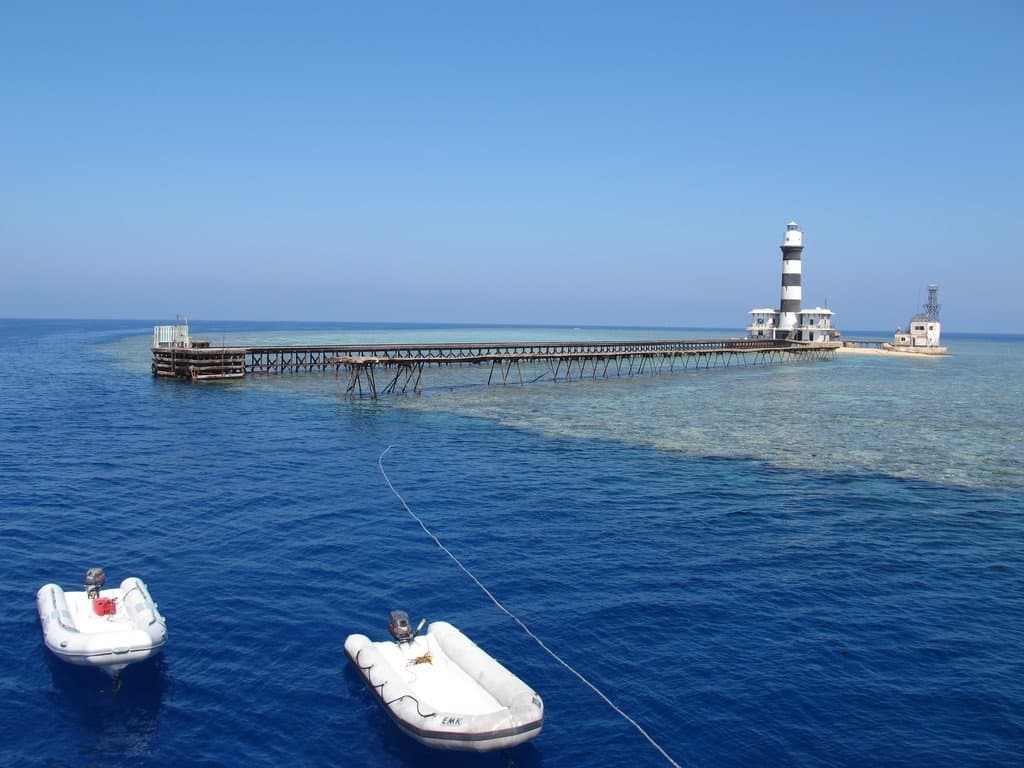
Daedalus Reef is the furthest-offshore stop on Egypt's southern liveaboard circuit, an isolated oval seamount ringed on every side by sheer walls and crowned with a manned lighthouse standing alone on the platform; the seabed below is variously measured at about 450 to 550 metres deep. There is no shore base and no day-boat option here: every dive runs from a liveaboard, typically on the classic Brothers-Daedalus-Elphinstone ("BDE") safari or a longer southern itinerary.
Three dives define a Daedalus visit, each known for something different. The north tip holds the region's top schooling-hammerhead action, where the current splits at the point and stacks scalloped hammerheads in the blue, best chased May to August. The southern plateau offers the more dependable close encounter: oceanic whitetip sharks circling the moored boats from October to February. Anemone City, on the western wall, is the reef's scenic counterpoint and its best shallow, photographic dive: magnificent anemones and resident clownfish from about five metres down to forty, the pick when the sharks are not showing. Divers who prize coral scenery sometimes find the reef itself a notch quieter than its neighbours on the same route; the pull here is almost entirely pelagic.
Daedalus has been a navigational hazard longer than it has been a dive site. The British built a cast-iron lighthouse on the platform in 1863 to mark the shipping lane through a newly busy Red Sea; the French firm Barbier, Benard et Turenne rebuilt it in stone in 1931, and it still stands, manned today by the Egyptian Coast Guard and Navy. The steamer Zealot ran onto the reef's northern side in 1876 and sank immediately; her bow and stern now lie at roughly 75 and 110 metres on the wall, technical-only but with cargo beams still visible shallower for divers passing the north tip. The whole reef sits inside Egypt's marine-protectorate framework dating to Law No. 102 of 1983, most recently reinforced in December 2025, when a Prime Minister's decree folded the entire Great Fringing Reef of the Red Sea, Daedalus included, into one fully designated marine protected area.
Reach Daedalus by liveaboard only, boarding at Port Ghalib, Marsa Alam or Hurghada for an overnight crossing; there is no way to dive it as a day trip. Operators commonly ask for Advanced Open Water, and logged-dive minimums quoted range from 30 to 50, with the higher figure the one more consistently enforced in practice, so check the real requirement with your specific operator before booking. Night diving is not permitted anywhere on the reef, so operators normally run three day dives for each overnight stop at Daedalus; marine-park rules also ban collecting, fishing, spearfishing and anchoring. A government marine-park fee is already folded into every liveaboard's price, not charged on top. October-November gives the calmest seas and best visibility; May-August and the autumn are the best windows for hammerheads, October-February for oceanic whitetips. Multiple liveaboard operators run Daedalus on their southern and BDE itineraries, but weather, not the operator, decides whether a reef this exposed actually gets dived on any given day.
A single oval reef platform about a kilometre long, ringed by walls that drop near-vertically before sliding into sand; the seabed below is variously put at about 450 to 550 metres, and the surface carries a manned lighthouse rather than any land.
The diving here splits into 3 zones:
Book online or contact a centre that dives this area.
Safari boats based elsewhere that run itineraries to these dive sites.
41m, 26-guest wooden liveaboard running Master Liveaboards' full Egyptian Red Sea catalogue from Hurghada and Port Ghalib, from northern wrecks and Tiran through the offshore Brothers, Daedalus and Elphinstone to the far-south Rocky, Zabargad and St John's reefs.
38 m wooden liveaboard with 13 ensuite cabins for 26 guests, on 7- and 10-night Red Sea trips from Hurghada and Port Ghalib.

Compact 18-guest, 9-cabin wooden liveaboard focused on Deep South and St John's routes from Port Ghalib, reaching remote Rocky Island and Zabargad.

26-guest sister of Superior with Junior and Executive suites, ranging across Emperor's Egypt catalogue from northern wrecks and offshore Brothers, Daedalus and Elphinstone to the Deep South.

13-cabin, 26-guest wooden liveaboard running Emperor's northern Red Sea wreck-and-reef weeks from Hurghada, plus offshore Brothers, Daedalus and Elphinstone.

Red Sea Explorers' largest liveaboard: 37.5m, 28 guests across 14 cabins, running the same GUE-leaning offshore and deep-south Egypt route catalogue.

36m, 22-guest steel liveaboard with a dedicated camera room and gas-blending deck, running the Brothers, Daedalus, Deep South and Fury Shoal weeks.

40m, 25-guest steel liveaboard, built 2023 for the Deep South: Daedalus, Rocky Island, Zabargad and St John's, plus Fury Shoal, from Port Ghalib.
May-August and the autumn months give the best odds on schooling hammerheads at the north tip; October-February is the oceanic whitetip window, with October-November combining calmer seas, 30 m-plus visibility and reliable whitetips. January-March brings cooler, rougher conditions and more weather cancellations.
What can go wrong here, and what divers do about it. Conditions change - take the briefing from the operator on the day.
National rules also apply: Rules and permits in Egypt
Operators disagree. Some advertise a minimum of 30 logged dives plus Advanced Open Water; others set the bar at 50 logged dives plus AOW, a figure that traces back at least two decades to a reported regional circular covering Daedalus and its sister marine parks. The 50-dive figure is the one more consistently enforced in practice, so a diver counting on 30 logged dives should confirm the real requirement with their specific operator before booking.
No. There has never been a shore base at Daedalus, and the reef sits far enough offshore that no day boat can reach it reliably. Every dive here is run from a liveaboard that carries you out overnight, usually as part of a longer Brothers-Daedalus-Elphinstone or southern Red Sea safari.
It depends which shark you want. May through August and the autumn months give the best odds on large schooling hammerheads at the north tip, while October through February is the more dependable window for oceanic whitetips at the southern moorings. October and November overlap the two seasons reasonably well and also bring calmer seas and clearer water, which is why they're cited as the overall sweet spot. None of this is a guarantee: regulars note that the current here follows no fixed seasonal pattern and that sightings of any kind are never certain.
Yes, one. The steamer Zealot struck the reef's northern side in 1876 and sank immediately; the hull now lies deep on the wall, with the bow at roughly 75 metres and the stern at around 110, plus two anchors nearby at about 88 metres. It's a technical-only dive, out of recreational range, though steel cargo beams from the wreck rest shallower on the north wall where recreational divers pass. The exact day of the sinking is disputed in the record, so only the year is reliably known.
It varies more with luck and weather than with season. The reef is large enough to filter out day-boat traffic that never reaches it, but its fame still draws liveaboards, and operators warn of up to twenty vessels at the busiest points of peak months. Set against that, trip reports also describe arriving to find only a handful of other boats in the same month. Daedalus tends to feel less pressured than some of its neighbours on the same route, without ever being guaranteed quiet.
A working aid to navigation that has stood on the reef platform since 1863, when the British built the original cast-iron tower to mark the shipping lane through a newly busy Red Sea. The French firm Barbier, Benard et Turenne replaced it in 1931 with the black-and-white banded stone tower that stands today, and it remains continuously manned by the Egyptian Coast Guard and Navy. Liveaboards often land guests on the pier between dives for a short walk to its base.
Abu Kizan is the reef's Arabic name, built from a word for pots or pottery: local legend holds that a ship carrying a cargo of pots sank on the reef's northern side, though no wreck remains have ever confirmed the story. The English name Daedalus is unconnected to the legend; it's thought to come from the British Admiralty's 1830s survey of the area, possibly honouring a Royal Navy ship rather than the Greek myth.
Not reliably. Divers who know the reef well describe the current as changing all the time rather than following a predictable yearly pattern: manageable most of the time, and too strong on some days, year-round. It runs strongest at the north tip and along the western wall, which is exactly what stacks the hammerheads and whitetips where they're found, but it means no single month can be relied on to guarantee calm water.
Also known as: Abu el-Kizan, Abu Kizan, Daedalus Shoal
Log your dives - notes, photos, conditions and the marine life you saw - and share them as one public diver profile. What you share helps the next diver, too.
Log every detail
Depth, duration, conditions, gear, buddy, notes — all in one place. Import from Suunto and other dive computers.
Track marine life
Record species sightings on each dive. Build a personal catalogue of everything you've seen underwater.
Your public dive profile
Share your dive history, stats, and experiences with a profile page you control. Show the world where you've been.