
Mistral
36m, 22-guest steel liveaboard with a dedicated camera room and gas-blending deck, running the Brothers, Daedalus, Deep South and Fury Shoal weeks.
Liveaboard22 guestsHurghada
Also known as: Ada, Aida II
The more diveable of Big Brother's two wrecks: a coral-blanketed 1950s Egyptian lighthouse tender lying down the reef wall, intact and fish-thick.
Last updated July 2026
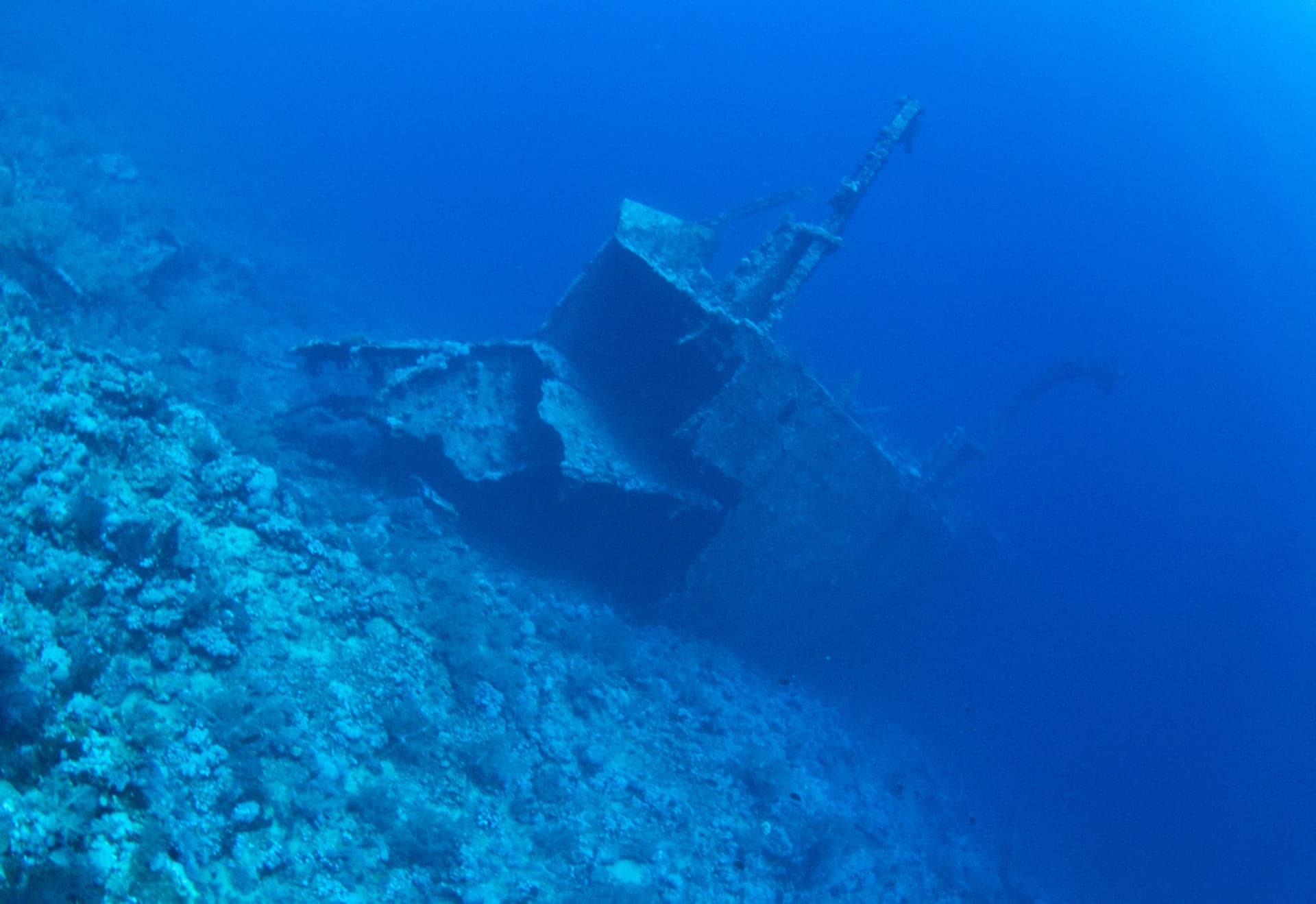
The Aida still looks like a ship. Where the Numidia is so broken and so deep that it reads as part of the reef, the Aida keeps a recognisable shape, with an intact superstructure and davits still lining the railings. You make a negative entry and descend through the current onto the upper hull, then work the structure before riding the drift back along the reef in the shallows. She lies on her port side at a steep angle down the wall, so the whole dive is a slow track along a tilted ship.
Coming down, you meet the coral-smothered upper hull first, then at around 33 metres the point where she broke apart, the damaged central section and an engine room you can swim through where the hull is split. The quarterdeck planking rotted away long ago, leaving the steel skeleton; heavy winches sit forward of the cargo hatches; the helm and, deepest of all, the propeller lie far down toward 65 metres, past recreational range. The real draw is the encrustation and the fish. Soft and hard coral cover the whole structure, best read under a torch, and the schools are dense enough that batfish, grouper and glassfish block the light in sections. Napoleon wrasse and morays work the recesses. Most divers keep to the 25 to 40 metre band; the stern and propeller are a technical choice, not a casual one.
The Aida is the Brothers wreck for divers who want a wreck dive, not a technical objective. It is the diveable one. The Numidia's interest lies mostly below 40 metres; the Aida's main body sits in the recreational-to-light-tech band, roughly 25 to 40 metres on the upper and mid wreck, so an advanced diver can swim the superstructure, look into the engine room and holds, and still surface with sensible margins. It is the more intact and more photogenic of the pair, a coral-blanketed hull with swirling, light-blocking fish life set against the blue.
It also carries a genuine, well-documented backstory that the pure reef sites lack: a French-built Egyptian lighthouse tender lost while relieving the very garrison whose lighthouse still stands above the dive. The history gives the dive a narrative, and the intact structure gives it the photographs. Together they make the Aida the wreck most divers actually enjoy at length out here, rather than tick off on a deep clock.
The Aida has an unusually well-documented past for a Red Sea wreck. She was built at Nantes, France, in 1911 as a combined cargo and lighthouse tender for Egypt's Ports and Lighthouses Administration1, and she spent decades supplying the remote navigational stations of the Egyptian Red Sea, in her later years pressed into service ferrying personnel and stores.
Her end came on a stormy day while she was relieving the station on Big Brother. Driven onto the reef in heavy seas as she tried to reach the jetty, she sank on 15 September 19572. Everyone aboard was saved, a tug taking off most of the crew and the rest reaching the island. One piece of dive-boat lore is worth correcting: the Aida is sometimes called an Italian ship, almost certainly because she was carrying military personnel when she was lost. She was, in fact, an Egyptian vessel, French-built, in the service of the lighthouses she spent her life tending.
Bring a torch, even in clear water. The Aida's whole appeal is the coral that has blanketed her, and it only shows its colour under a light. Treat this as a deep dive on a tilted hull, not a leisurely potter: the structure keeps dropping away below you, and it is easy to slide past your planned depth without noticing. Her stern and propeller sit in technical ground, best left alone unless you came equipped for them.
The broken-open engine room is a swim-through with light overhead, not a deep penetration, but treat any time inside the hull with respect for your training. Watch for downcurrents on the wall and the easy creep of depth on a hull that keeps tilting away below you. A surface marker is standard kit for the drift pickup, and nitrox makes sense given how often the dives run deep. The experience expectation here is genuine. These islands are reached only by liveaboard, and they assume advanced, current-comfortable divers, not a first deep wreck.
What makes this dive site stand out.
Superstructure, engine room, davits and helm all read as a ship, unlike the broken Numidia.
The main body sits around 25 to 40 m, swimmable by advanced divers within no-deco margins.
Batfish, grouper and glassfish pack the hull thick enough to dim the light in places.
Soft and hard coral cover the whole wreck, the colour best read under a torch.
A French-built Egyptian lighthouse tender lost relieving the garrison whose light still stands above.
October to November is the overall sweet spot; January and February can bring rough crossings. Long deep time on a shaded hull chills faster than the surface figure suggests.
Dived only as part of a liveaboard safari; marine-park fees are bundled into the trip price.
Advanced Open Water with a solid dive history covers the upper and mid wreck. The stern and propeller toward 65 m are technical only.
Summary
Depth, strong variable current with downcurrent risk, and a negative-entry drift onto a tilted hull far offshore.
Safety considerations
What can go wrong here, and what divers do about it. Conditions change - take the briefing from the operator on the day.
Multi-day safari boats with this site on their itinerary.
36m, 22-guest steel liveaboard with a dedicated camera room and gas-blending deck, running the Brothers, Daedalus, Deep South and Fury Shoal weeks.

138ft (42m), 26-guest Aggressor liveaboard out of Port Ghalib running two Saturday-to-Saturday southern itineraries: Brothers-Daedalus-Elphinstone, and St John's-Daedalus, across offshore plateaus and the Marsa Alam and St John's reefs.

44m, 28-guest wooden liveaboard and the Sea Serpent Fleet's technical flagship, running the fleet's shared Egyptian Red Sea route pool: offshore Brothers-Daedalus-Elphinstone, northern wrecks and the Strait of Tiran, and southern St John's and Fury Shoals.

Teak-finished 42m, 24-guest liveaboard running Seawolf's full Egypt catalog from Hurghada and Port Ghalib, from northern wrecks and the Strait of Tiran to the Brothers, Daedalus, Elphinstone and the Deep South.

40m, 26-guest wooden liveaboard (SS Glorious Miss Nouran) running the Sea Serpent Fleet's shared Egyptian Red Sea pool: Brothers-Daedalus-Elphinstone, northern wrecks and Tiran, St John's and Fury Shoals, with a panoramic suite and rebreather support.
34m, 20-guest steel liveaboard running Tornado's full Egypt spread, from northern wrecks through the Brothers and Daedalus to a Deep South St John's week.
Egyptian. She was built in France for Egypt's Ports and Lighthouses Administration and later served the Egyptian Navy. The Italian label comes up on dive boats and in old forum posts, almost certainly because she was carrying military personnel when she was lost, but the documented history is Egyptian.
She lies down a wall on her port side. Engine remnants sit on the reef top near 7 metres, the bow around 25, the hull break and engine room near 33 to 35, and the propeller deepest at about 65 metres. The recreational dive works the 25 to 40 metre band; the stern is technical.
It depends on what you want. The Aida is shallower, more intact and easier to enjoy at recreational depth, with dense fish life and a recognisable ship. The Numidia is deeper, more broken and more dramatic, spanning recreational to technical depth. Most divers do both on a Brothers stop and contrast the shallow with the deep.
Only lightly. Where the hull broke apart, the engine room is open as a swim-through with daylight overhead rather than a true penetration. Going deeper inside the structure is a technical decision that needs proper training, and the stern and propeller toward 65 metres are technical depth regardless.
A storm. She was driven onto Big Brother's reef in 1957 while trying to dock and relieve the lighthouse station. Everyone aboard survived, with a tug taking off most of the crew and the rest reaching the island. No lives were lost.
Log your dives - notes, photos, conditions and the marine life you saw - and share them as one public diver profile. What you share helps the next diver, too.
Log every detail
Depth, duration, conditions, gear, buddy, notes — all in one place. Import from Suunto and other dive computers.
Track marine life
Record species sightings on each dive. Build a personal catalogue of everything you've seen underwater.
Your public dive profile
Share your dive history, stats, and experiences with a profile page you control. Show the world where you've been.