
Adventure Divers
PADI and SSI center operating from Cabo de Palos port and La Manga Club resort, 25 years in the area, 298 TripAdvisor reviews at 4.9-5.0 stars.
PADI / SSI2 languages
Also known as: La Fosa Italiana, La Roca del Vapor, Piedra de Vapor
Outer pinnacle in the Cabo de Palos reserve where four ships wrecked on a reef rising from 70m to 3m. The wrecks are the draw and they sit deep.
Last updated May 2026
Bajo de Fuera sits beyond the Islas Hormigas lighthouse, the outermost and most exposed of the reserve's bajos. The boat ride out is the first cue this is a different dive: rougher water, longer transit, more attention paid to the surface. On the mooring the descent splits by route. A recreational profile holds the reef top and upper plateau between roughly 6m and 25m, closer in feel to Bajo de Dentro — bream and salps over rock, gorgonians on the flanks, the resident grouper passing if you're lucky, and the chance of barracuda in season. It's the honest answer for any diver below B2 and for anyone who'd rather not pay the wreck premium.
The wreck profile is a different dive. From the bajo top you drop along the northern flank toward the SS Sirio, where the first marker is usually one of the admiralty anchors at about 32m. The boilers and collectors emerge around 39m, with the broken stern further along at ~42m. Conditions bite here: poor visibility with particles in suspension, sharp summer thermocline, and current that locals describe as uncomfortable particularly on the deco stop. From the Sirio the south-east route across the bajo head leads to the inverted hull at 40-50m and, further down the slope, the Nord America. Distances between wrecks are deceptive at depth and narcosis is part of the picture; experienced locals warn that remembering wreck positions while narked is harder than it sounds.
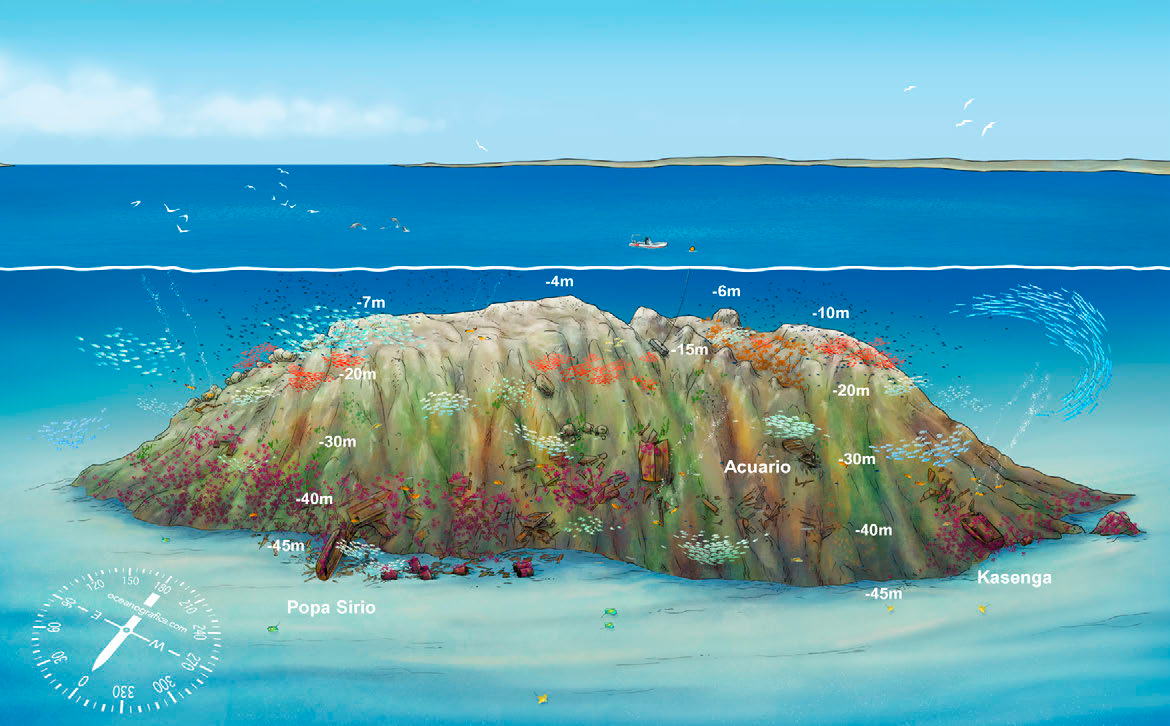
Illustration: © Oceanográfica (2021). Guía de Inmersiones de Cartagena - Cartagena Diving Guide. Boyra, A., C. Fernández-Gil, D. Balcarcel, A. Cánovas y M. A. G. Gallego.
Ships kept hitting this reef. A 70-metre seabed pushed up to within 3 metres of the surface, with no visual warning, took down at least four documented vessels in the late 19th and early 20th centuries — and what the reef collected, divers can now visit. The 1906 loss of the SS Sirio with up to ~500 casualties is one of the worst civil maritime disasters on Spanish coasts of the entire 20th century, and her boilers, collectors and stern sit on the northern slope today. The Minerva, locally called El Bocabajo, lies upside down on the eastern flank with an identity question: a bell found nearby in 2006 reads S.S. Hansell, and nobody has resolved the discrepancy. The 1930 Nord America rests further down the same slope, and Primo remnants — boilers, anchors, a cannon — sit scattered across the bajo. No other site in the Cabo de Palos reserve concentrates this much wrecked maritime history on a single pinnacle.
The reef's geometry made the disasters possible. A submerged mountain rising sharply from 55-70m to within a few metres of the surface, with no surface marker before the lighthouse infrastructure, was lethal for shipping into the early 20th century. The signature event came on 4 August 1906, when the Italian passenger steamer SS Sirio struck the bajo with around 800 people aboard; the death toll ran up to ~500 and the sinking is widely cited as the worst civil maritime disaster on Spanish coasts of that century. Locals refer to the inverted hull on the eastern slope as El Bocabajo and have historically called it the Minerva, but a stamped bell reading S.S. Hansell, found and reported in 2006, has left the wreck's identity in question. The Nord America followed in 1930, ending up on the lower eastern slope. Remains attributed to the Primo — boilers, anchors and a cannon — are scattered across the bajo. The marine reserve was declared in 1995, turning a wreck graveyard worked informally by local clubs into a permitted, capacity-controlled experience.
The wreck experience is not recreational diving. Cold water at depth, particles in suspension, extended deco obligations and narcosis between hulls are the norm for divers descending to the main structures. One local videographer logged 40+ dives over a year to compile usable footage, working past 60m on multiple attempts. Summer thermoclines drop bottom temperature toward 15-18C without warning, so dress for the bottom. For divers without deep or technical training the reef itself rewards exploration: groupers and barracuda along the upper flanks, the shallow crown for safety stops, and in September and October the boga baitball action with leerfish and dentex hunting around the bajo. Centre pricing in 2024 sat at roughly 60-65 EUR with reserve fees bundled. Daily capacity is capped at 25 and centres need lead time for the paperwork — book before you travel.
What makes this dive site stand out.
SS Sirio (1906), Minerva, Nord America (1930) and Primo scattered across the bajo's eastern and southern slopes.
Italian passenger steamer lost in 1906; up to ~500 casualties, the worst civil maritime disaster on Spanish coasts of the 20th century.
Submarine mountain rising sharply from a 55-70m base to within 3-6m of the surface, creating the lethal shipping geometry.
September and October bring boga baitballs with leerfish, little tunny and dentex hunting along the flanks.
Scattered along the northern crown of the reef; shallowest anchor at 32m, the first wreck signature most dives reach.
37.6618°N, 0.6398°W
Warm shoulder water, best visibility, and the boga-leerfish baitball action that locals consider the site's signature season.
Verify current rates with your dive centre. Bajo de Fuera sits at the top of the local pricing range as the reserve's flagship slot.
AOWD / FEDAS B2 / CMAS 2-star minimum is the reserve floor that centres apply at this site. The reef top at 3-6m is technically accessible to OW divers but centres do not run sub-B2 profiles here. The wreck structures at 35-50m+ require Deep Diver specialty or technical certification for meaningful exploration.
Summary
Advanced for the upper plateau and reef top; technical for the wrecks. Open-water exposure, sharp summer thermoclines, particles in suspension at depth, current on deco stops and narcosis between wrecks combine to make wreck profiles genuinely demanding.
Safety considerations
What can go wrong here, and what divers do about it. Conditions change - take the briefing from the operator on the day.
Book a guided dive at this site.
PADI and SSI center operating from Cabo de Palos port and La Manga Club resort, 25 years in the area, 298 TripAdvisor reviews at 4.9-5.0 stars.

Long-running multi-agency dive centre in Cabo de Palos running daily boats into the Islas Hormigas Marine Reserve and the local technical wrecks.

Cabo de Palos dive centre operating since 2004, boating divers into the Islas Hormigas reserve and onto the namesake Naranjito wreck.
SSI and PADI dive centre off the main strip in Cabo de Palos, with a 140 m² shorefront base and small-group RIB trips into the Islas Hormigas marine reserve.

PADI 5-Star Career Development Center on the Cabo de Palos harbour, run by Dutch course-director couple Martin and Brenda van Gestel since March 2023.

Nature-and-education dive center in Cabo de Palos, the first National Geographic Dive Center in Spain and the first Avelo center in Europe.

British-run PADI 5-Star centre on La Manga Strip with multi-agency teaching, small-group reserve diving, technical and cavern training at Cueva del Agua.
Get in touch to add or claim your dive center listing on DiveCodex.
Reserva Marina de Cabo de Palos e Islas Hormigas
Centres handle the paperwork. All reserve diving must be booked through an authorised centre. AOWD/B2 minimum and a 3m competency test (renewed every 2 years) per BOE-A-2017-5108. 25 divers per day at this site.
Four wrecks lie scattered across the bajo. The SS Sirio (1906) has boilers and collectors at 39m and broken stern sections at ~42m. The Minerva, locally called El Bocabajo, sits inverted on the eastern slope at 40-50m, though a bell found nearby stamped S.S. Hansell has cast doubt on the name since 2006. The Nord America (1930) lies deeper down the eastern slope at 35-45m. Boilers, anchors and a cannon attributed to the Primo are also visible. Admiralty anchors are scattered along the northern crown, the shallowest at 32m.
Locals with extensive site experience say no — the marine life is broadly equivalent to Bajo de Dentro and the Piles, and the larger, deeper reef can disperse it. The unique draw is the wrecks. If you cannot or do not want to dive past 30m, the cheaper inner bajos give you a similar fish list with less paperwork.
AOWD or FEDAS B2 / CMAS 2-star is the reserve floor that centres apply at this site. The wreck features at 35-50m sit beyond AOWD recreational limits, so meaningful wreck exploration calls for Deep Diver specialty or technical certification. A reserve competency test at 3m, renewed every 2 years, is also required for diving inside the reserve.
September and October are considered the most spectacular months: warm shoulder water, the year's best visibility window, and the boga baitball action with leerfish, little tunny and dentex hunting along the flanks. The reef is diveable year-round but conditions at wreck depths are demanding regardless of season. April is locally avoided.
Different sites with different draws. Bajo de Dentro has the traversable cavern, gorgonian meadows and shallower variety from 3-45m, and runs at OW/B1 minimum on calm days. Bajo de Fuera is the wreck site of the reserve, with four ships across a deeper, more exposed pinnacle, B2 minimum, daily capacity capped at 25, and centre lead-time for booking. Marine life is similar across both.
The SS Sirio was an Italian passenger steamer that struck Bajo de Fuera on 4 August 1906 with around 800 people aboard. Estimates of the death toll run up to ~500. It is widely regarded as the worst civil maritime disaster on Spanish coasts in the 20th century. The wreck broke into sections; the boilers and collectors now sit at ~39m and the stern at ~42m, with debris extending across the northern slope of the reef.
Daily capacity is capped at 25 divers, with centre-managed slots and lead time for paperwork. The cap is the reason centres market this site as an inmersion especial and price it at the top of the local range.
Log your dives - notes, photos, conditions and the marine life you saw - and share them as one public diver profile. What you share helps the next diver, too.
Log every detail
Depth, duration, conditions, gear, buddy, notes — all in one place. Import from Suunto and other dive computers.
Track marine life
Record species sightings on each dive. Build a personal catalogue of everything you've seen underwater.
Your public dive profile
Share your dive history, stats, and experiences with a profile page you control. Show the world where you've been.