
Centre d'Immersió Cap de Creus
SSI-affiliated dive centre in Llançà, the Cap de Creus Natural Park's northern access point, with air-only fills and a one-instructor-per-diver baptism dive.
SSI4 services3 languages
A boat-only Cap de Creus point in the Mar d'Amunt sector, with a shallow channel near shore and a deeper gorgonian wall to 40 m.
Last updated September 2026
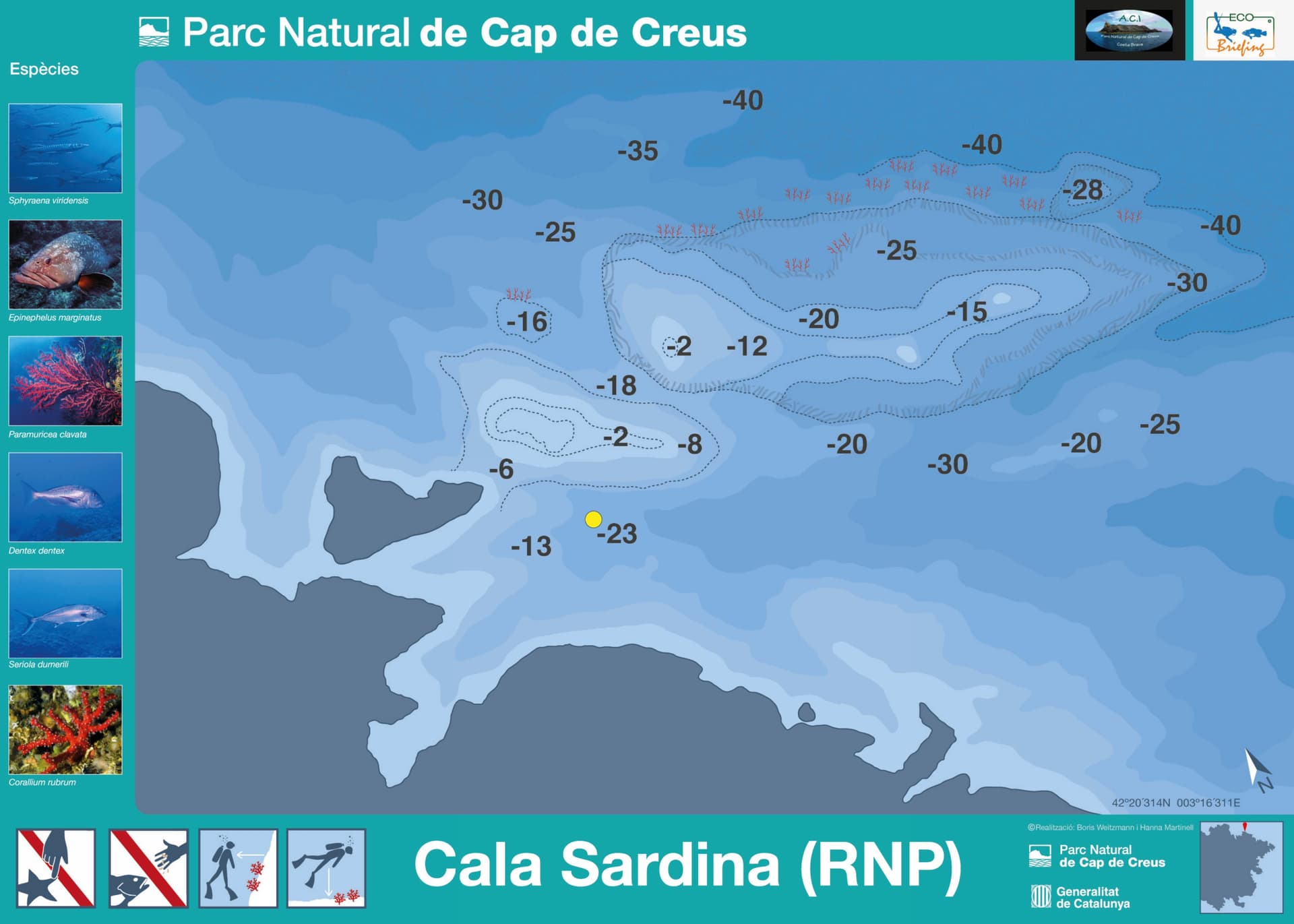
Cala Sardina sits on Cap de Creus's Mar d'Amunt shore, one of the natural park's own underwater itinerary points, reached by boat from Llançà or Port de la Selva. The park's own chart traces a channel-like bottom between 2 and 18 metres close to shore, then steps down past the -20 metre line to a wall reaching 40 metres, where a cluster of gorgonians grows between 20 and 28 metres around the chart's single marked mooring point, at 23 metres.1
Dusky grouper, red gorgonians and red coral headline six species the park's own itinerary sheet illustrates for this exact point:1 yellowmouth barracuda, common dentex and greater amberjack round out the panel, working the open water off the rock. Protection matches the billing: touching, fishing or removing anything is barred throughout the point, and red coral colonies like these may only legally be harvested under license elsewhere on this coast.
This point sits inside one of the park's marine Partial Natural Reserves, and its own sheet repeats the standard no-touching, no-fishing and no-spearfishing icons for the spot.1 Night diving here needs special authorisation, and entry-level scuba courses are not run in its no-fishing sectors.2 The eco-route registry rates the whole point "all levels" on its own page, a label that sits oddly against a wall option running past 30 metres: treat it as a catalog tag, not a substitute for knowing your own certification limit.
What makes this dive site stand out.
Entry 24 of 30 on the park's own itinerary index, in the Mar d'Amunt sector between Llançà and Port de la Selva
Night diving needs special authorisation inside this reserve
Grouper, gorgonians, red coral, barracuda, dentex and amberjack named here
The regional eco-route registry names Centre d'Immersió Cap de Creus as this route's guide
42.3386°N, 3.2719°E
Graded to the shallower channel reading's 30-metre ceiling. The deeper wall reading to 40 metres calls for a deep-diving qualification instead; ask your centre which profile the trip runs.
The shallower channel option sits above easy once the thermocline and possible current near its base are counted. The deeper wall option, running to 40 metres, is advanced.
Book a guided dive at this site.
SSI-affiliated dive centre in Llançà, the Cap de Creus Natural Park's northern access point, with air-only fills and a one-instructor-per-diver baptism dive.
Small PADI centre in Camping Sant Miquel, working Colera's Tramontana-sheltered coast into France's Cerbère-Banyuls reserve.

Get in touch to add or claim your dive center listing on DiveCodex.
Dive centres in Catalonia must require insurance from every diver on their dives, and must be able to offer a policy to anyone who has none.
No. A single online mention proposes 'Illa Sardina' as another name for this point, but it gives a different depth, 12 to 60 metres, and an entirely different profile: vertical pinnacles with the remains of old ship cannons, not this point's channel-and-wall shape. Treat it as a separate, unconfirmed site, not another name for Cala Sardina.
Log your dives - notes, photos, conditions and the marine life you saw - and share them as one public diver profile. What you share helps the next diver, too.
Log every detail
Depth, duration, conditions, gear, buddy, notes — all in one place. Import from Suunto and other dive computers.
Track marine life
Record species sightings on each dive. Build a personal catalogue of everything you've seen underwater.
Your public dive profile
Share your dive history, stats, and experiences with a profile page you control. Show the world where you've been.